

Ask most agency owners for their go-to-market strategy and you'll hear "referrals, mostly." It works, until it doesn't. A big client leaves, referrals slow down, and suddenly you're scrambling for pipeline with no system to fall back on.
If you sell to other businesses, LinkedIn is the most direct place to build that system. Your buyers are there, logged in, and telling you what they care about every day. But posting now and then and blasting connection requests isn't a go-to-market strategy. It's noise.
Here's the LinkedIn go-to-market framework we use for agencies and B2B founders. It's the same approach that took one new company from zero to $1M in ARR in seven months, with LinkedIn as its only channel.
Want the long version? Watch our webinar Building a Predictable B2B Sales Engine in 30 Days. It walks through the same three engines: content that pulls buyers in, signal capture and lead scoring, and SDRs who turn conversations into booked calls.
First: Is LinkedIn the Right Channel for You?
LinkedIn isn't for everyone. Before you invest in it, run this four-box test. LinkedIn works as a primary channel when all four are true:
You sell B2B.
Your buyers are white-collar and use LinkedIn. Founders, marketing directors, CTOs, heads of growth.
You sell through calls. A booked call is the front door to revenue.
Your market is big enough. At least a few thousand prospects active on LinkedIn.
If you run an e-commerce agency selling to small shop owners who never log in, put your effort elsewhere. If you sell B2B services with a sales call, keep reading.
The Four Parts of a LinkedIn GTM System
A LinkedIn go-to-market strategy that produces meetings every week has four parts working together. Most agencies try one (usually random posting) and conclude that "LinkedIn doesn't work."
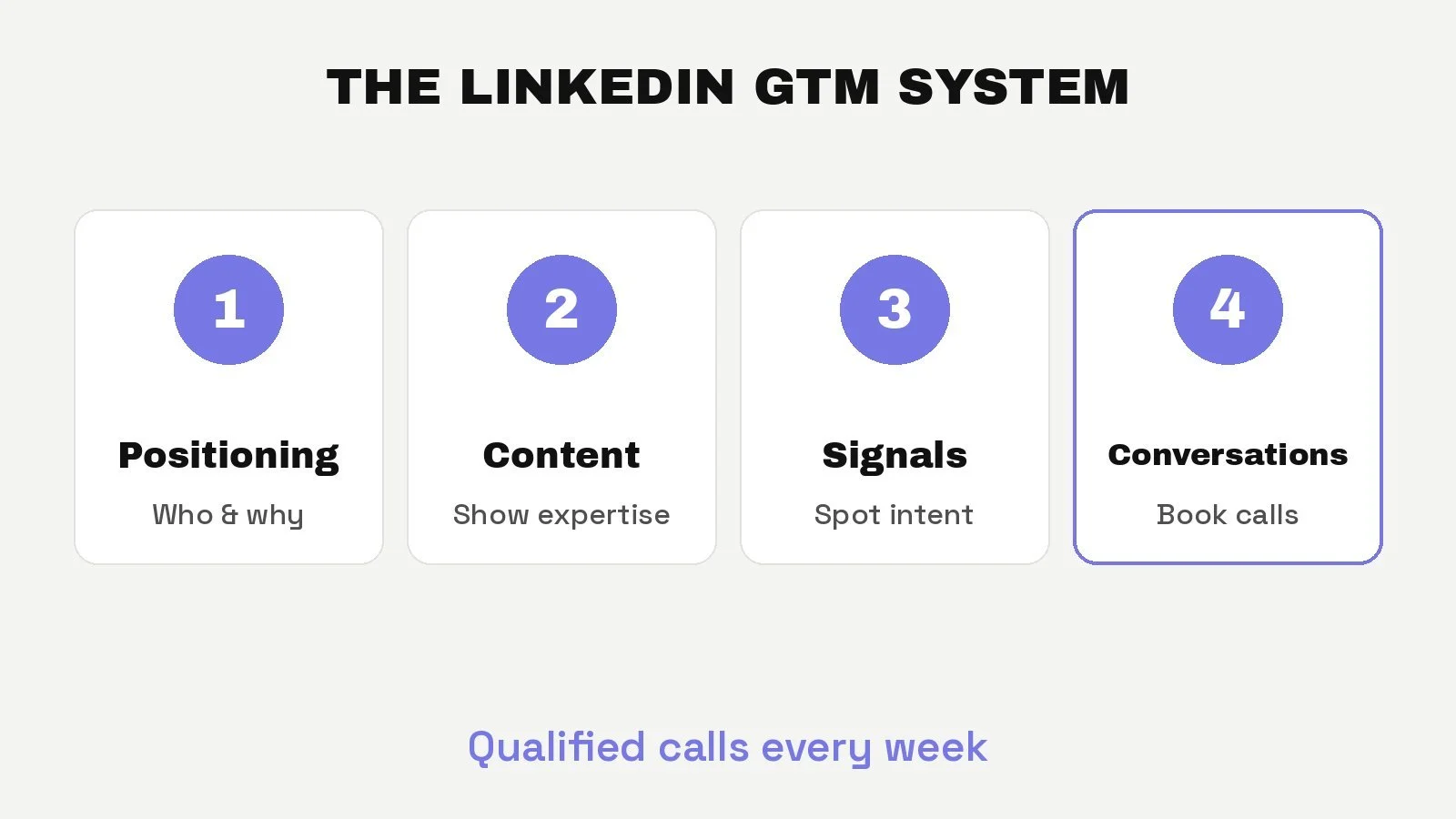
1. Positioning: Your Profile Is the Landing Page
Every connection request, comment and post sends people to your profile. If your headline says "Founder & CEO | Helping Brands Grow," you've lost them.
Your profile should answer three questions in five seconds:
Who do you help? A specific ICP, not "businesses."
What outcome do you deliver? In their words, not your jargon.
Why should they believe you? A number, a client type, a result.
Positioning is also where most agencies get stuck, and that's not a LinkedIn problem. It's an offer problem. If your offer is vague, no amount of content will fix it. In one engagement, it took seven weeks of testing to lock the positioning. Once it clicked, 22 messages produced 10 booked calls.
You can serve more than one ICP with the same offer. That's fine, as long as the offer stays the same and only the messaging changes for each audience.
2. Content: Build Trust Before the First Message
Content does the warming up so your outreach doesn't land cold. When a prospect gets your connection request, they check your profile and see a week of posts about their exact problem. The conversation starts halfway done.
What works:
Consistency over virality. Post at least several times a week. Daily text posts work well. One great post a month doesn't build trust.
Write for your ICP, not your peers. Teach the problems your buyers face, show results, and share opinions they'll recognize.
Mix the formats. Tactical how-tos, client stories (with permission), contrarian takes and behind-the-scenes posts.
Use a system, not inspiration. A content calendar and, ideally, a ghostwriter who interviews you, so it doesn't depend on your free time.
Content compounds. One client post reached 647 reactions and 195K impressions. That led to 181 new conversations, 9 meetings in 48 hours, and a $25K ARR contract signed 13 days after the first meeting. That doesn't happen every week. But it only happens to people who post every week.
3. Signals: Reach the Right People at the Right Time
This is where most LinkedIn outreach goes wrong. People send hundreds of requests to anyone with a matching job title, get ignored, and burn their account's reputation.
Signal-based outreach is different. You look for evidence that someone is a good fit and paying attention right now:
They engaged with your posts, or with posts on topics you cover.
They recently changed jobs or got promoted.
Their company is hiring for the role your service replaces or supports.
They raised funding, launched a product or expanded into a new market.
They follow you or viewed your profile.
Then score each lead against your ICP criteria (industry, company size, role, geography and so on) and only reach out to the ones who pass. Our system uses a 25-gate ICP filter. Your first version can be a simple spreadsheet with five or six criteria.
Respect LinkedIn's limits. LinkedIn caps invitations for every account and doesn't publish the number. If you hit the limit, or if too many of your invitations are ignored or marked as spam, you can be restricted from sending invites for about a week (LinkedIn Help). Fewer, better-targeted requests get higher acceptance and protect your account. Spread sending through the week, keep your pending list short, and use tools that follow LinkedIn's User Agreement.
Connect, don't just follow. A connection opens the door to a conversation. A follow doesn't.
4. Conversations: Someone Has to Book the Call
Content and signals create opportunities. Someone still has to turn them into meetings.
Open with relevance, not a pitch. Reference the signal: their post, their new role, a topic they engaged with.
Ask one simple qualifying question. When someone new connects or follows, a single easy question starts more conversations than a paragraph about your services.
Get to a call fast. Long DM threads die. Once there's interest, offer a specific short call.
Follow up. Most meetings come from the second or third touch, not the first.
AI and human SDRs. AI tools are useful for finding signals, enriching data and drafting messages. Booking a call with a senior buyer still depends on judgment and rapport, so many teams pair a human SDR focused on booking qualified calls with AI as a co-pilot for research and drafts. That's the approach the B2B Sales Engine webinar walks through.
Setting Targets: What "Working" Looks Like
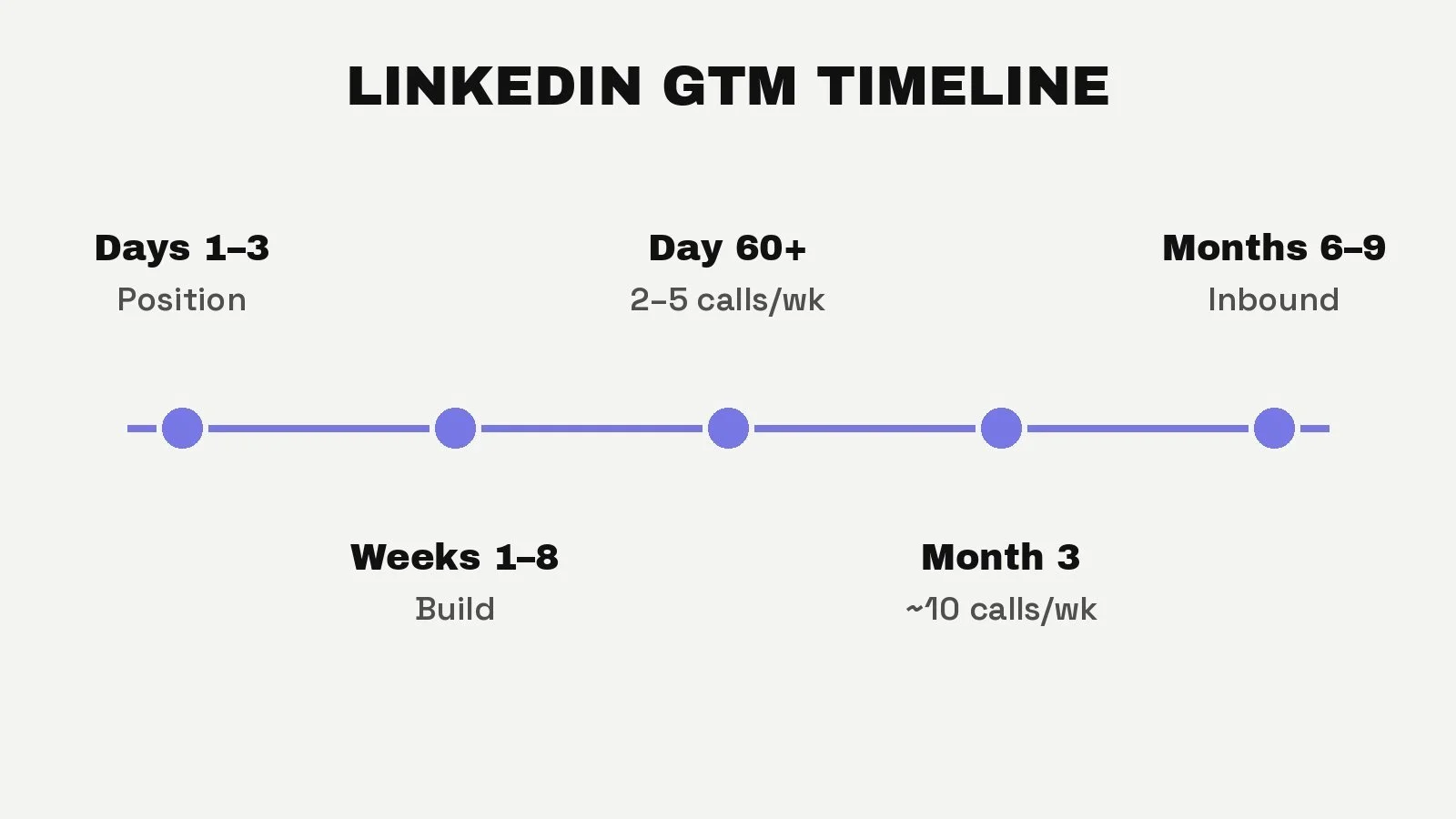
LinkedIn is not an overnight channel. Here are realistic milestones for a well-run system:
Days 1–3: Review offer-market fit; define the ICP
Weeks 1–8: Find the positioning that lands; refine messaging every few days based on replies
Day 60+: 2–5 qualified meetings booked a week
Month 3: Around 10 qualified meetings a week
Months 6–9: Content compounds and inbound leads start arriving
These are the targets we set at The GTM Business. Typical connection acceptance runs 50–70%, and we plan around 35% to be conservative.
Track a few weekly numbers: connection requests sent, acceptance rate, conversations started, meetings booked and meetings held. If acceptance is low, fix targeting or the profile. If conversations don't become meetings, fix the message or the offer.
Common LinkedIn GTM Mistakes
Posting without positioning. Great content for a vague offer still brings in nobody.
Pitching in the connection request. Earn the conversation first.
Chasing volume over fit. Mass requests to loosely matched job titles kill acceptance rates and risk restrictions.
Expecting results in two weeks. Plan for 60 days before judging.
The founder doing everything. If you're writing, prospecting, messaging and closing, the system stops the moment client work gets busy. Delegate the parts that don't need you.
Treating LinkedIn as your only channel forever. It's a strong core, but pair it with referrals, partnerships, events or public RFPs.
DIY or Done-for-You?
You can run all of this yourself. Plenty of founders do in the early days. The tradeoff is time: writing five posts a week, researching signals, sending personalized requests and handling DMs adds up to a part-time job.
If you'd rather install the whole system, The GTM Business runs it for you: profile positioning, five ghostwritten posts a week, a signal engine that scores leads and sends up to 800 targeted connection requests a month, and a US-based SDR with an AI co-pilot whose one job is booking qualified calls. Your time commitment is approving posts and one 30-minute call a week. Book an ICP mapping call to see whether LinkedIn fits your market.
Want a lighter option focused on your personal brand? See the LinkedIn Authority Builder Funnel. For the wider picture, read our guides on cold outreach, funnels and how to scale a marketing agency.
FAQ
What is a go-to-market strategy for an agency?
It's your plan for reaching and winning clients: who you sell to (your ICP), what you offer, which channels you use to reach them, and how leads become paying clients. For B2B agencies, LinkedIn is often the core channel.
Does LinkedIn lead generation work for agencies?
Yes, if you sell B2B through sales calls and your buyers are active on LinkedIn. It works best when positioning, content, signal-based targeting and consistent follow-up run together.
How many connection requests can I send on LinkedIn?
LinkedIn doesn't publish a fixed number. All accounts have invitation limits, and hitting them, or having many invites ignored, can lead to a restriction of about a week. Send fewer, better-targeted requests.
How long does it take to get meetings from LinkedIn?
With a well-run system, 2–5 qualified meetings a week by around day 60 is a realistic target, growing to around 10 a week by month three. Inbound from content usually builds between months six and nine.
How often should I post on LinkedIn?
Several times a week at minimum. Consistency matters more than any single post. Daily posting, with a ghostwriter if needed, works well for founders building a pipeline.
Should I use an AI SDR?
AI is useful for research, signals and drafting. Many teams keep a human in the conversation itself, because booking calls with senior buyers relies on rapport and judgment.