

Most agency owners I talk to treat RFPs like a lottery ticket. They see one, spend two weeks on a proposal, lose, and swear never to do it again.
That's the wrong lesson. Public-sector and institutional RFPs are one of the few lead sources where the buyer has already decided to spend money, published the budget range, and told you exactly how they'll pick a winner. Cities, provinces, universities, health networks and Crown corporations hire marketing agencies every week, and plenty of those contracts go to small shops.
The agencies that win don't bid on everything. They find the right RFPs early, cut the bad fits fast, and treat proposals as a repeatable system. Here's how to do that in Canada.
Why RFPs Are Worth It for Small Agencies
Referrals are great until they stop. Outbound works, but you're interrupting people who didn't ask to hear from you. RFPs flip that:
The budget is real. An organization doesn't publish a request for proposal unless the money is approved.
The criteria are public. You know how proposals are scored before you write a word.
Size matters less than you think. Evaluation is on the proposal, the price and your ability to deliver, not on how big your office is.
Wins compound. Once you've delivered one public contract, you have a reference and a case study for the next ten.
The catch is the effort. Every RFP is different, and a good response can take days or weeks. So the whole game is choosing the right ones.
Where Marketing RFPs Are Posted in Canada
There's no single place. Canadian procurement is spread across federal, provincial and municipal portals, plus paid aggregators.
Federal. The Government of Canada posts tender notices on CanadaBuys (it replaced Buyandsell.gc.ca). Under the Canadian Free Trade Agreement, federal departments must publicly post service contracts worth $139,000 or more from January 1, 2026 to December 31, 2027 (Treasury Board notice). Smaller contracts are often posted too, but they don't have to be.
Provincial and territorial. Each province runs its own system, for example Ontario Tenders Portal, BC Bid, Alberta Purchasing Connection and Quebec's SEAO. The trade-agreement thresholds apply here as well. Western provinces have their own lower thresholds under the New West Partnership.
Municipal, academic, school and hospital (the "MASH" sector). Cities, universities, school boards and health authorities buy a lot of marketing: campaigns, websites, branding and media. Many post through platforms like Bids&Tenders or MERX, or on their own procurement pages.
Crown corporations and agencies. These often run their own supplier portals.
The problem isn't that RFPs are hidden. It's that they're scattered across dozens of sites, several of them paywalled, and checking them all every week is a part-time job.
Option: Get Them Delivered Instead
This is exactly why we built The Deal Flow. Every Monday at 6 AM, you get 5 to 10 live Canadian marketing RFPs curated from more than 14 RFP sources. Each one includes:
the deadline (every RFP closes at least two weeks out, and most give you about 30 days)
a named decision-maker contact
the submission portal
a one-paragraph scope summary
Budgets start at $15K, with an average around $76K. Buyers include government agencies, universities, health networks and mid-market brands.
The Lite plan is $115 CAD/month. The full plan is $249 CAD/month and adds proposal writing for a 10% success fee, charged only on contracts you win with a proposal written for you. One recent example: The Deal Flow sent a $145,000 brand and media RFP from a provincial health authority in Canada, and a 4-person Toronto shop that received it submitted on day 9, was shortlisted on day 17 and won on day 22.
Whether you use a service or search the portals yourself, the next steps are the same.
Step 1: Decide Bid or No-Bid in 20 Minutes
The most expensive mistake in RFPs is spending a week on a proposal you were never eligible to win. I've seen owners read the scope of a big municipal contract, think "this is easy," and only discover on page 30 that they don't meet a mandatory requirement.
Read the mandatory requirements first, before the scope. Then run this checklist:
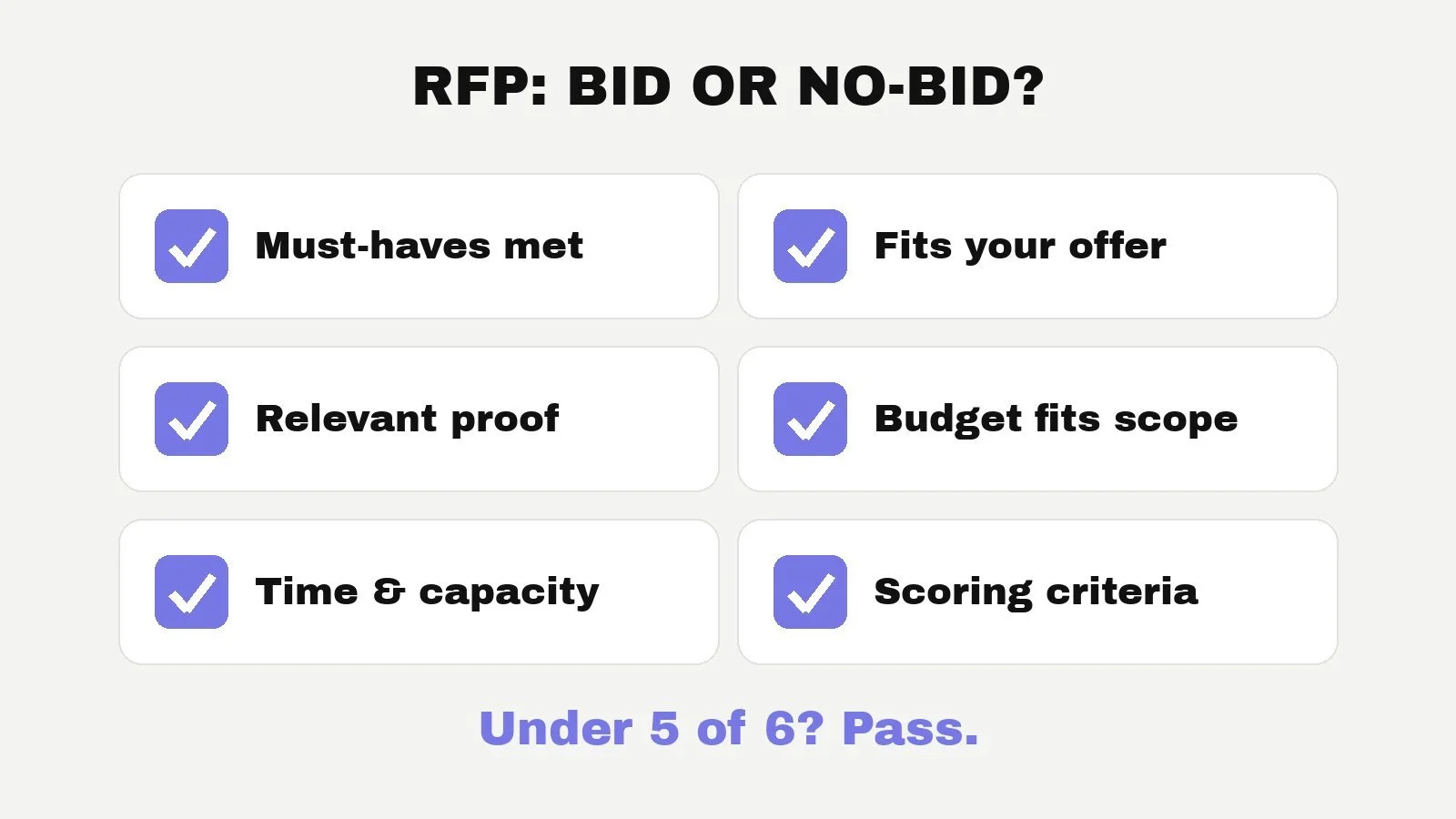
Mandatory requirements. Can you meet every pass/fail item? Common ones: corporate liability insurance, years in business, a minimum number of similar projects, security clearance, or a Canadian or local presence.
Fit with your offer. Is this what you actually sell, or would you be stretching? Very niche services often don't match broad public RFPs, and that's fine.
Relevant proof. Do you have two or three case studies that match the scope or sector?
Budget vs. scope. Is the budget realistic for the work? If no budget is listed, does the scope suggest a number worth your time?
Timeline. Do you have the capacity to write a strong proposal before the deadline, and to deliver if you win?
Evaluation criteria. How heavily is price weighted? If it's mostly price, small agencies with lean costs can win. If it's mostly experience, make sure yours is relevant.
If you can't tick at least five of the six, pass. Saying no to the wrong RFPs is how you have time to win the right ones.
Step 2: Map Every Date and Rule
RFPs have rules, and breaking one gets you disqualified no matter how good your proposal is. As soon as you decide to bid, put these in your calendar:
Intent to bid or registration date, if there is one. Some buyers only send addenda to registered bidders.
Question deadline. Your chance to clarify scope, budget or evaluation. Use it.
Addenda. Answers to all bidders' questions get published as amendments to the RFP. Check for them until the closing date, because they can change requirements.
Submission deadline and format. Portal, email or physical. Late submissions are almost always rejected automatically.
Mandatory forms. Signed declarations, pricing forms, insurance certificates and conflict-of-interest forms.
Assign one person to own the RFP calendar. If you're a small team, that's probably your PM, not you.
Step 3: Answer Exactly What They Asked
There's no universal RFP template, because each one is built differently. What works every time is mirroring the RFP's own structure.
Build a compliance matrix. List every requirement and where your proposal answers it. Evaluators score against a checklist. Make their job easy.
Use their headings and their language. If they ask for "Project Approach," don't call it "Our Methodology."
Lead with their outcome, not your history. Open each section with what they'll get, then how you'll do it.
Show relevant proof. Two or three tight case studies with real numbers beat ten vague logos. Public-sector buyers love results from similar organizations.
Name the team. Show who will actually work on the account, their roles and their experience.
Make pricing clear. Follow the pricing form exactly. For multi-year contracts, plan scope and budget for year one and the renewal years, so you're not stuck delivering year three at a loss.
Keep it as short as the RFP allows. A focused 15-page response that hits every criterion beats a 60-page brochure.
Step 4: Partner When You're Missing a Piece
If you meet 90% of an RFP but are missing one capability (video production, translation, a specific platform), you don't have to pass. Team up with a partner agency or contractor and name them in the proposal, if the RFP allows subcontracting.
Agree on roles, rates and any referral or commission terms in writing before you submit. Changing the deal after you've won always ends badly.
Step 5: Treat RFPs as a Volume Game (With Quality Control)
You won't win every bid. Nobody does. If you apply for one RFP every few months, you'll probably never win one. Agencies that build public-sector revenue bid consistently, learn from each submission, and get faster each time.
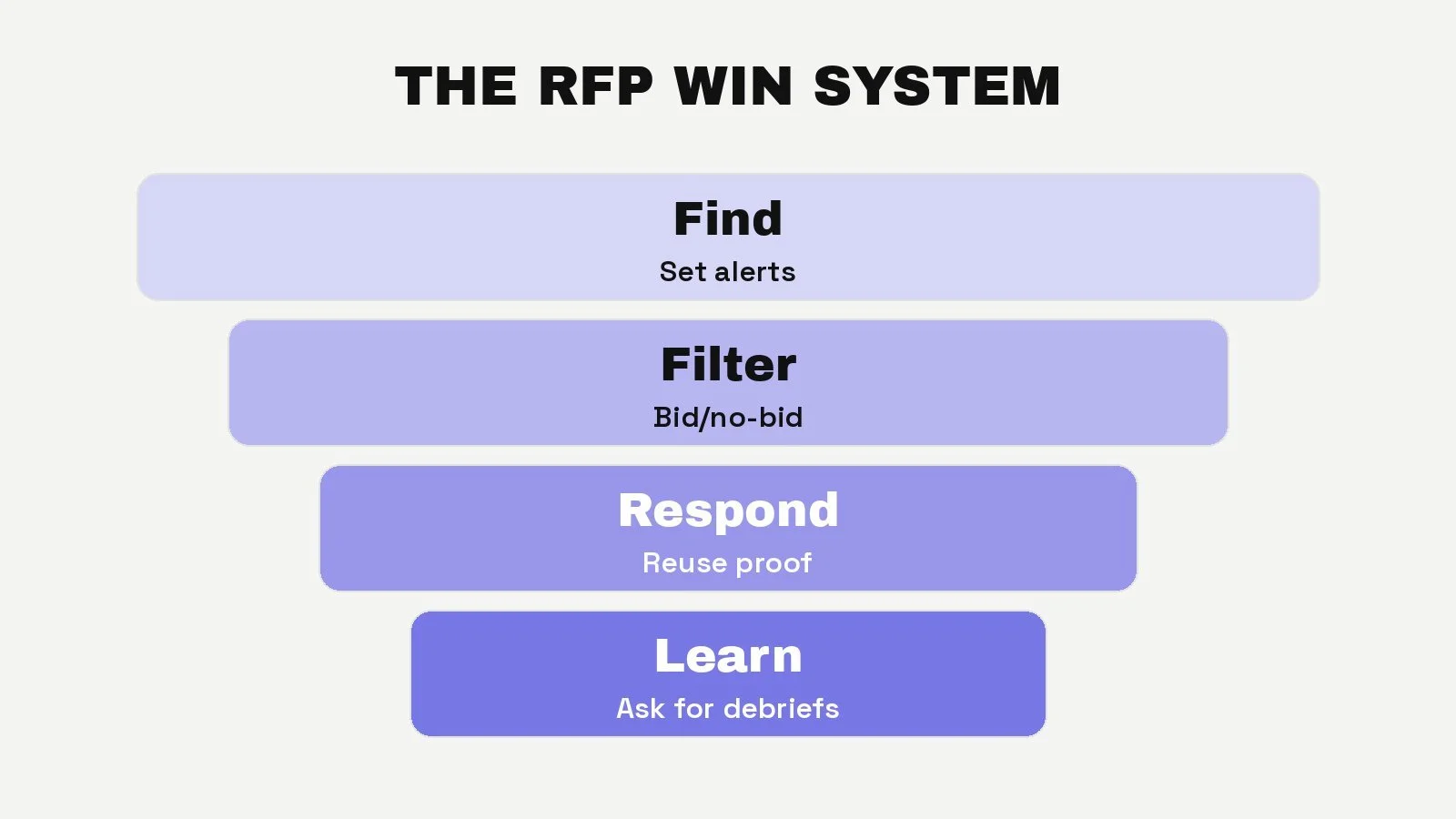
That's only sustainable if you build a system:
Keep a content library. Store your company overview, team bios, case studies, insurance certificates, methodology and security policies as reusable blocks.
Ask for a debrief every time you lose. Most public buyers will tell you how you scored. That's free coaching.
Track your numbers. RFPs reviewed, bid, shortlisted and won. Your win rate tells you whether your bid/no-bid filter is working.
Hand off the admin. Monitoring, formatting and compliance checks should sit with a coordinator or PM, so the founder only steps in for strategy and pricing.
Common Mistakes That Lose RFPs
Missing a mandatory form or signature.
Missing an addendum that changed the scope.
Copy-pasting a generic agency deck instead of answering the questions.
Pricing that doesn't follow the required format.
Submitting at 4:58 PM and hitting a portal error.
Bidding on everything and winning nothing because every proposal was rushed.
How RFPs Fit Into Your Growth Plan
RFPs shouldn't be your only lead source. Contracts can take months to award, and buyers are price-sensitive. But as one channel alongside referrals and outbound, they add something most agencies lack: big, predictable contracts with organizations that pay on time and renew.
If you're still figuring out your offer or how to get clients, start with our guides on offer design and how to scale a marketing agency. If you're starting from scratch, read how to start a marketing agency. For help building a full lead engine, book a clarity call.
And if you want live Canadian marketing RFPs in your inbox every Monday, join The Deal Flow.
FAQ
Where can I find marketing RFPs in Canada?
Federal tenders are on CanadaBuys. Provinces run their own portals (Ontario Tenders Portal, BC Bid, Alberta Purchasing Connection, SEAO in Quebec). Municipalities, universities and hospitals often use Bids&Tenders, MERX or their own sites. The Deal Flow curates marketing RFPs from more than 14 sources into one weekly email.
Can a small agency win a government RFP?
Yes. Proposals are scored on published criteria, not company size. For example, a 4-person Toronto shop won a $145,000 provincial health authority RFP that The Deal Flow had sent, 22 days after receiving it. Small agencies win by bidding on good-fit RFPs and answering every requirement precisely.
Do I need insurance to bid on RFPs?
Often, yes. Many public RFPs require commercial general liability insurance and sometimes professional liability (errors and omissions) insurance, with a certificate at submission or contract award. Check the mandatory requirements before you start writing.
How long does it take to respond to an RFP?
Anywhere from a few days to a few weeks, depending on complexity. Most RFPs in The Deal Flow give around 30 days and never less than 14. A reusable content library cuts response time sharply.
What's the CFTA threshold for services in 2026?
For federal departments and agencies, CA$139,000 from January 1, 2026 to December 31, 2027. At or above that, the procurement is generally subject to the Canadian Free Trade Agreement and must be publicly posted.
Can US agencies bid on Canadian RFPs?
Sometimes. Some procurements are covered by international agreements such as the WTO Government Procurement Agreement above certain thresholds, while many smaller contracts favour Canadian suppliers. The Deal Flow is designed for agencies that can contract with Canadian organizations.