

Let's be honest, starting a marketing agency has never been easier. You can register a business, build a website and call yourself an agency in a weekend.
Building one that pays you more than your old job? That's the hard part. Most new agencies never get past a handful of small clients and a founder doing everything.
I started on Fiverr. Solo. No team, no network, no playbook. From there I built Startup Slang into a 75-person team across North America and Europe, and later scaled BrandButter to eight figures in annual revenue before exiting. I've made almost every mistake you can make starting an agency, so you don't have to.
This guide is for skilled marketers in Canada and the US — media buyers, SEO specialists, developers, designers, marketing managers — who are thinking about going out on their own. Here's how to start a marketing agency the right way, and get to your first $30K a month.
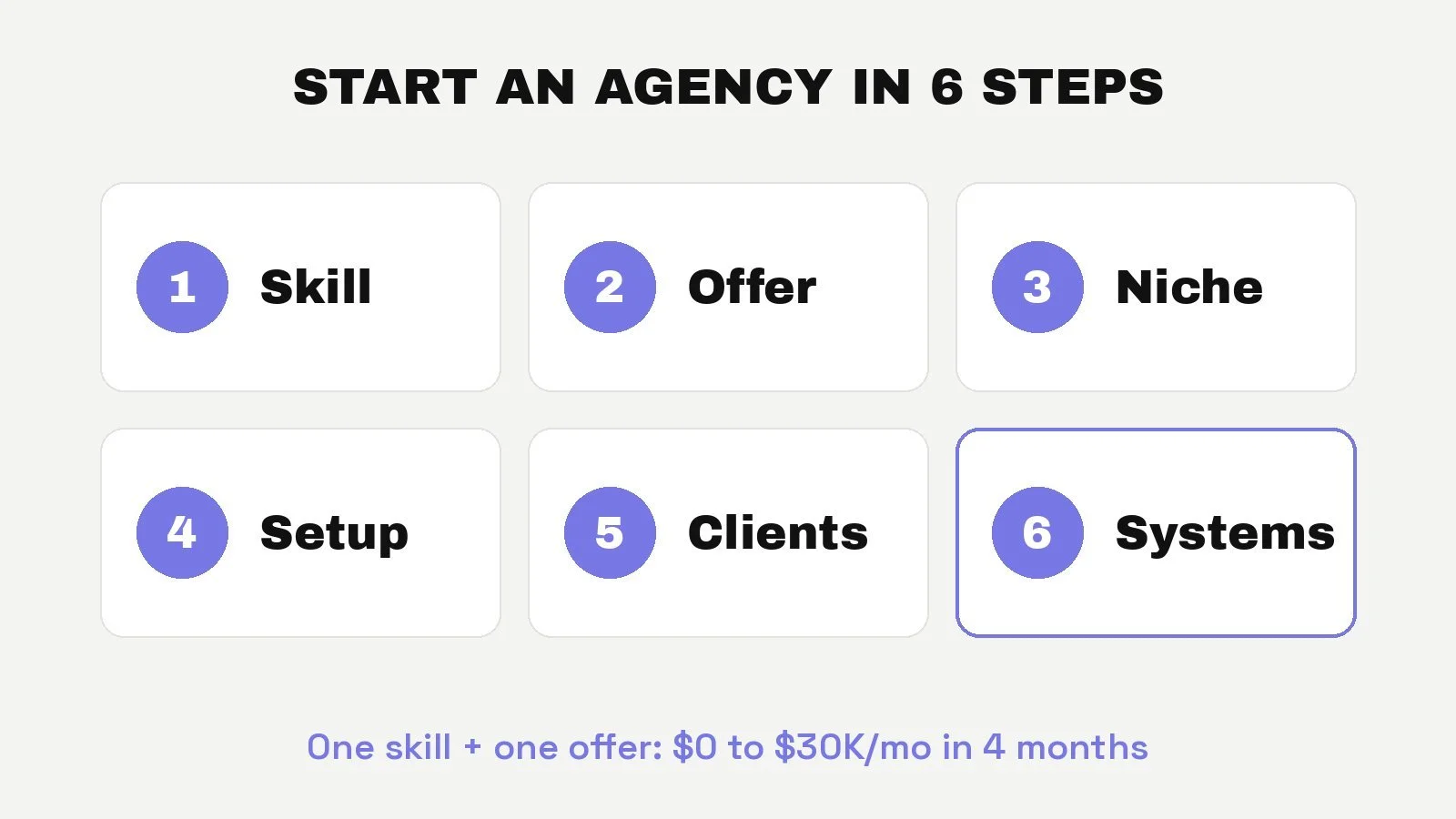
Start With the Skill You Already Get Paid For
Most people starting an agency make the same mistake: they try to offer everything.
Don't. Your first offer should be built on the skill someone is already paying you for.
Take Brydon McMillen. He spent seven years as a media buyer managing over $40 million in ad spend, for someone else's business. He didn't need to learn a new skill. He needed to package the one he had.
That became Plateau PPC, a Google Ads agency. In 4 months, Brydon went from $0 to $30,000 a month.
Ask yourself three questions:
What do I do better than most people in my field?
Who has already paid for it? (Your employer counts.)
What result does it create? Leads, sales, booked calls, revenue.
If you can answer those clearly, you have the start of an agency.
Package It Into an Offer, Not a Menu
A skill isn't an offer. "I do Google Ads" puts you in a race to the bottom with every freelancer on the internet.
An offer is a clear promise to a specific buyer, tied to a result they care about. Compare:
"We run Google Ads for businesses."
"We help home service companies in Ontario turn ad spend into booked jobs."
The second one tells the buyer who it's for, what they get and why it matters. That's the difference between getting compared on price and getting hired.
A good first offer is:
Narrow. One service, one type of client.
Outcome-based. Sold on the result, not the hours.
Repeatable. You can deliver it the same way for every client.
I go deeper on this in The Agency Offer Rebuild and Your Offer Is the Problem, Not Your Lead Gen.
Pick a Niche You Can Win In
New agency owners resist niching because it feels like turning away money. In practice, it's the fastest way to get your first clients.
When you serve one type of client, your marketing gets sharper, your case studies stack on top of each other, and your sales calls get easier because you've already seen their problems.
You don't have to pick a niche forever. Pick the one where you already have proof, contacts or experience, and dominate it first. You can expand later, which is exactly what agencies like Spring Media did once they had traction.
More on this in Niche Specialization: How Narrow Focus Drives Real Agency Growth.
Set Up the Business (Keep It Simple)
This is the part people overthink. You don't need a perfect brand, a 20-page website or a fancy office to start.
What you do need:
A legal structure. In Canada, that usually means a sole proprietorship or incorporating federally or provincially. In the US, an LLC is the common starting point. Talk to an accountant about which one makes sense for your income and province or state.
Sales tax registration. In Canada, you must register for GST/HST once your taxable revenue passes $30,000 over four consecutive calendar quarters. At $30K a month, you'll be there fast.
A simple contract. Scope, payment terms, and what happens if either side ends it.
A one-page website. Your offer, who it's for, proof (even from your previous job, where you're allowed to share it), and a way to book a call.
A way to get paid. Invoicing and a business bank account.
That's it. Everything else can wait until you have clients.
Land Your First Clients
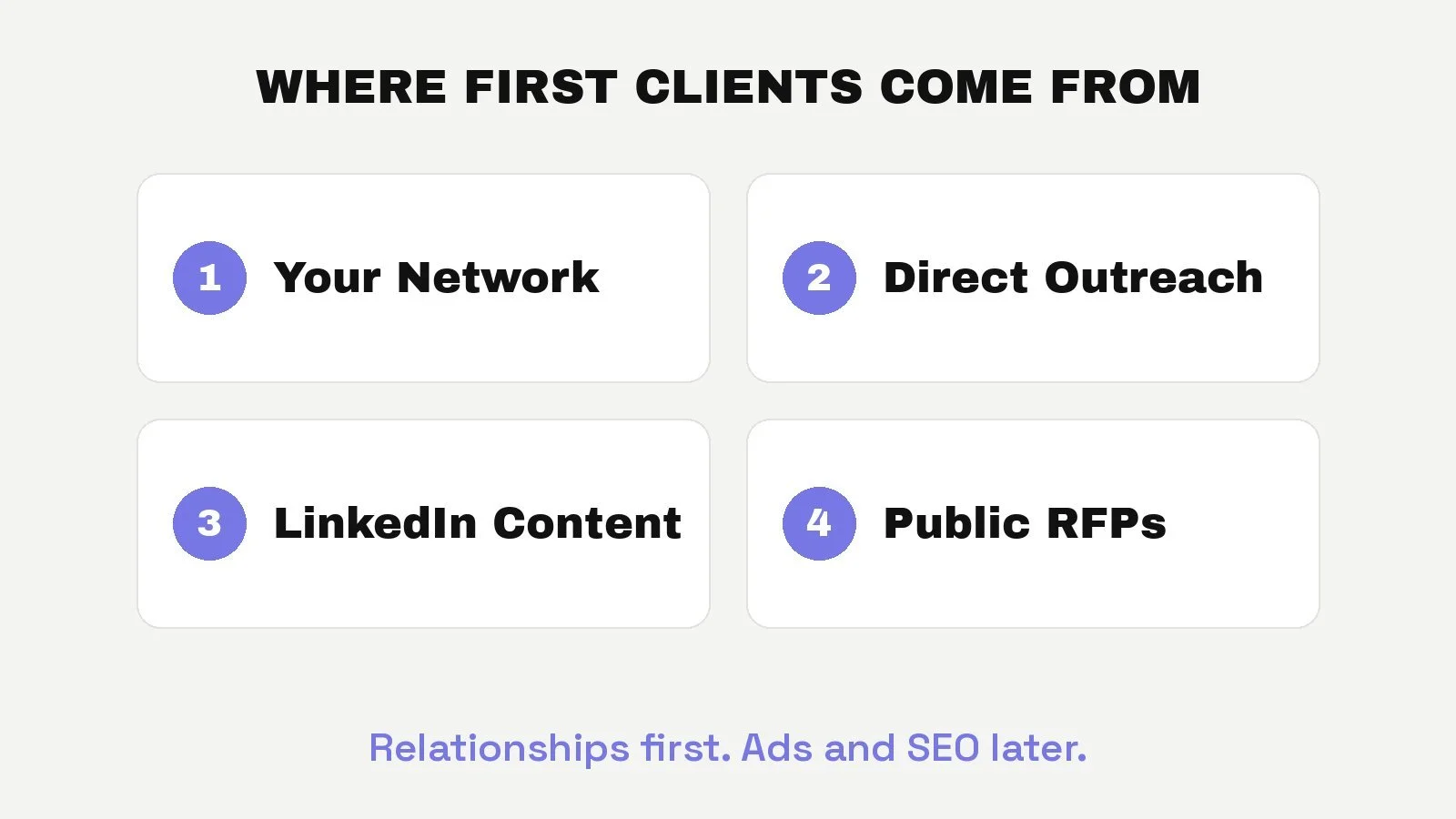
Your first clients almost never come from ads or SEO. They come from people who already know, like and trust you, and from direct outreach.
Here's where to start:
Your existing network
Former employers, colleagues, clients you've worked with and vendors you've dealt with. Tell them exactly what you do and who it's for. Your first client is often closer than you think.
Direct outreach
Cold outreach on LinkedIn and email, aimed at the specific niche you chose. Personalized, short, focused on their problem. Not a pitch deck in the first message.
Content on LinkedIn
If you sell to B2B buyers, LinkedIn is where they are. Posting consistently about the problems you solve builds trust before the first call. If you want this done for you, The GTM Business builds and runs a full LinkedIn pipeline for B2B founders: profile, ghostwritten content, lead scoring and an SDR who books calls.
RFPs (especially in Canada)
Most new agencies ignore RFPs. That's a mistake. Government agencies, universities, health networks and nonprofits publish requests for proposals with approved budgets and set timelines. The Deal Flow sends Canadian agencies 5 to 10 live marketing RFPs every Monday, with scope summaries and the decision-maker's contact. One subscriber, a 4-person shop in Toronto, won a $145,000 brand and media RFP from a provincial health authority.
Say No to the Wrong Clients
This sounds backwards when you're starting out. Every dollar feels important.
But the wrong client will eat your time, burn out your team and keep you from landing the right ones.
When we worked with Ravon, a performance marketing agency, a big part of the work was deciding what not to take: avoiding niches where delivery risk was too high and saying no to misaligned clients, even when the cash was tempting. Ravon went from $0 to $35K a month in 5 months without collapsing under delivery pressure.
Set your criteria early:
Can they afford your price without negotiating you down?
Is the result you promise realistic for their business?
Will they be a case study you're proud of?
If the answer is no, walk away.
Treat your own agency like a client
The most common trap for new owners is that client work fills the week and nobody markets the agency. A few months later, the pipeline is empty. Fix this by giving your own growth the same treatment a paying client gets:
Time-block it. Put prospecting, content and follow-ups on your calendar before client work claims the hours. Then review where your time actually went each week.
Set a weekly sales minimum. One example target is one closed deal per week. If you're behind, go create conversations through past contacts, referrals, your CRM and events.
Track your outreach. Log the messages or proposals you send each day, the new replies you get and the calls you book. Note when you change your message, so you can see what worked.
Price for Value From Day One
Most new agencies underprice because they're afraid of losing the deal. Then they're stuck with clients who pay too little and expect too much.
Price based on the result you create, not the hours you spend. If your work generates real revenue for a client, there's room to capture some of it.
Millennial Marketing is a good example. They moved away from flat retainers to a performance model built on a percentage of sales. The first time the CEO pitched it, he closed a $150,000 deal, the biggest in the company's history.
You don't have to start with performance deals. But you should start with pricing that makes the business worth running.
Build Systems Before You Hire
The moment you have three or four clients, things start to break. Onboarding lives in your head. Reporting is ad hoc. You're answering every email.
Before you hire, write things down:
A standard onboarding checklist
A delivery process for your core offer
A simple reporting template clients see every month
That way, your first hire inherits a system instead of chaos. I wrote about this in Building a Scalable Agency Without Becoming the Bottleneck.
What the First Year Can Look Like
Every agency is different, but here's what a focused start can look like, based on agencies we've worked with:
Plateau PPC: $0 to $30K a month in 4 months, built on the founder's media buying experience.
Ravon: $0 to $35K a month in 5 months, by being selective about which clients to take.
Ricochet: $5K to $30K a month in 3 months, then sold to a larger agency after 6 months.
None of these were overnight wins. They came from a clear offer, a narrow focus and consistent outreach. Once you're past $30K a month, the game changes again. That's what How to Scale a Marketing Agency to $100K/Month is for.
Frequently Asked Questions
How much does it cost to start a marketing agency?
Very little, if you keep it simple. You need a legal structure, a simple website, a contract and a way to invoice. Most of your early investment is time spent on outreach and delivery, not money.
Do I need to quit my job to start a marketing agency?
Not on day one. Many founders land their first client or two before leaving. But at some point you need the time to sell and deliver properly. Brydon McMillen went from employee to $30K a month within 4 months of going all in.
Do I need to register for GST/HST when I start an agency in Canada?
You must register once your taxable revenue goes over $30,000 in four consecutive calendar quarters. You can register voluntarily before that. Confirm the details for your situation with an accountant.
What services should a new marketing agency offer?
One. The service you're already best at and have proof for. Add services later, once you have a repeatable process and happy clients asking for more.
How do I get my first agency clients?
Start with your network, then direct outreach on LinkedIn and email aimed at one niche. In Canada, public-sector RFPs are an underused source of contracts with approved budgets.
Is there a program to help me start an agency?
Yes. The Agency Launchpad is built for professionals who want to turn their skills into an agency. It's the system Brydon used to go from employee to $30K a month in 4 months, and it starts with a free 30-minute call to check whether your skills fit. If you're already running an agency, see our services and case studies.
Ready to Start Your Agency?
If you have a skill people pay for and you're ready to build something of your own, let's talk. We'll look at your background, your first 90 days, and give you a straight answer on whether it's a fit.
Or start with The Agency Launchpad.