

Let's be honest, getting to $10K or even $30K a month isn't the hard part anymore. Plenty of marketing agency owners get there on hustle, referrals and a couple of good clients.
Getting to $100K a month is a different game. It's not more of the same. It's a different business.
I've been through it myself. I started as a solo freelancer on Fiverr, built Startup Slang into a 75-person team across North America and Europe, and later ran BrandButter, a creative marketing agency. And I've watched dozens of agency owners hit the same walls I did.
This is the playbook. No hacks, no "10 tips to grow your agency." Just the things that actually move an agency from five figures a month to six.
Why Most Marketing Agencies Stall Before $100K/Month
Most agencies plateau somewhere between $20K and $30K a month. I wrote a whole post on why agencies plateau at $30K/month, but here's the short version.
You're probably dealing with some version of this:
- You're still the engine behind every sale
- You're the safety net for delivery
- Your onboarding lives in your brain, not your backend
- Clients come from referrals, DMs or pure luck, with no repeatable funnel
That's not a revenue problem. That's a system problem. You're not running a business, you're stuck in an expensive job you built for yourself.
Here's the question I ask every agency owner I work with: Can this business double in revenue without doubling your time?
If the answer is no, that's your ceiling. And no funnel hack is going to fix it.
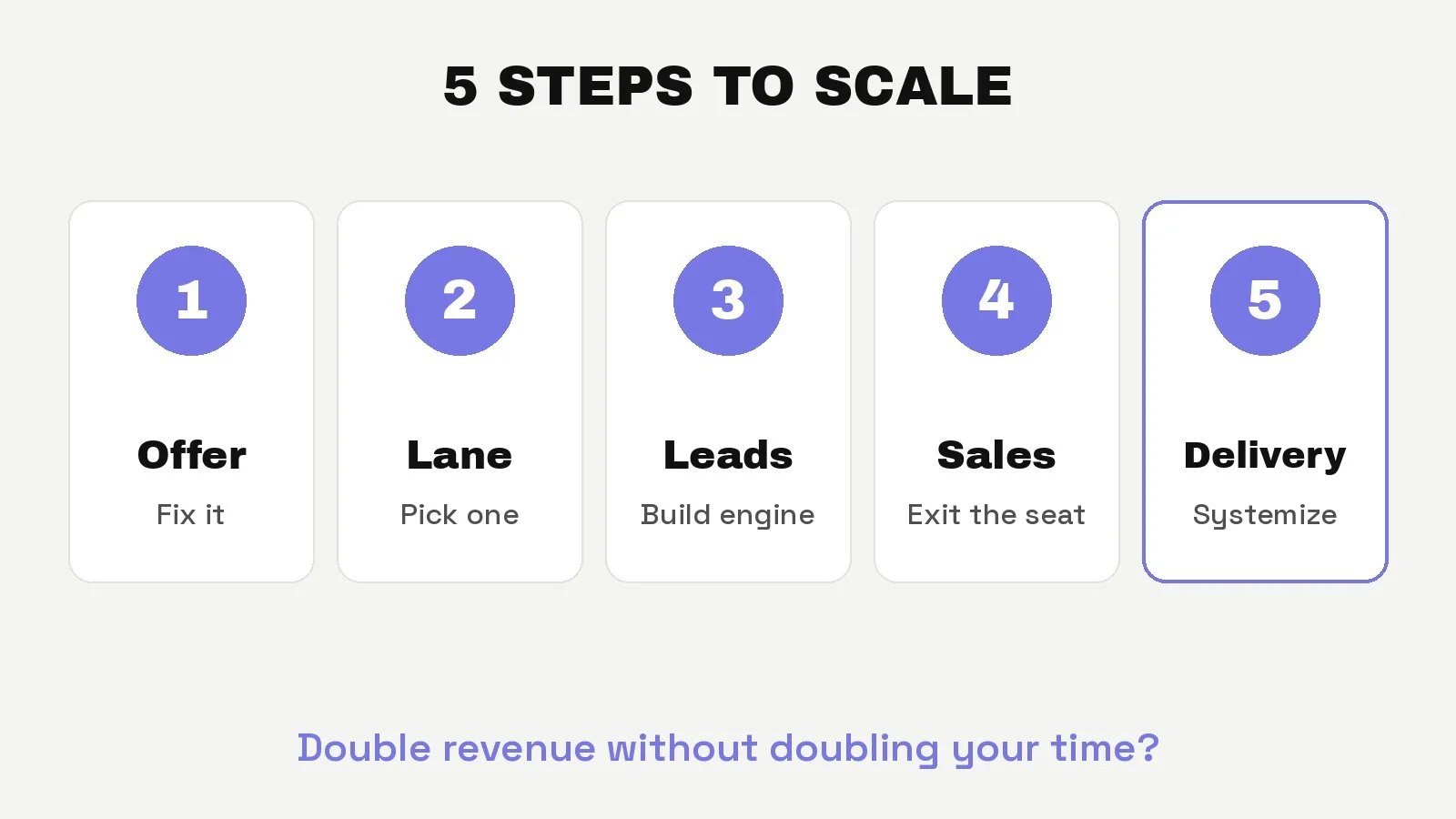
Scaling a marketing agency to $100K a month comes down to five things. Let's go through them.
Step 1: Fix Your Offer Before You Fix Your Lead Gen
Most agency owners think they need more leads. So they buy courses, test new scripts, hire an SDR. Nothing changes.
Because the problem usually isn't the leads. It's the offer.
Most agencies build their offer like a restaurant menu: "We do SEO, PPC, social, email, websites…" That makes you a vendor. Vendors get compared on price. Partners get paid for outcomes.
A scalable offer has three traits:
- It's clear. A prospect understands what they get in one sentence.
- It's tied to a result the client cares about. Revenue, booked meetings, pipeline, not deliverables.
- It's repeatable. Your team can deliver it the same way every time.
Look at what happened with Millennial Marketing. They were helping coaches build personal brands and generate leads, but selling retainers that didn't reflect the value they created. Their clients were making real money; the agency wasn't capturing any of it. We rebuilt the model around performance funnels with a percentage of sales. The first time the CEO pitched it, he closed a $150,000 deal, the biggest in the company's history.
Or Apex Leads, a Montreal-based outbound agency. They were offering custom solutions for every client. We rebuilt the offer into a high-retainer, outcome-based model positioned around booked meetings, not just "leads." That was the foundation for everything else they did.
If you want to go deeper, read The Agency Offer Rebuild: How to Charge More and Close Faster.
Step 2: Pick a Lane (Niche and Positioning)
You can't be a premium agency for everyone.
When an agency tries to serve every industry, its marketing gets vague, its case studies don't line up, and its sales calls turn into price negotiations. Narrowing your focus feels risky, but it's usually the fastest way to grow.
Höski, a Canadian branding studio, is a good example. They were stuck at around $15K a month, serving too many industries with no clear niche. We repositioned them around the verticals where they already had momentum: construction, real estate and consumer packaged goods. Then we restructured their offer into clear packages built around client pain points: launches, rebrands and growth-stage refreshes.
In 4 months, Höski went from $15K to $50K a month.
Positioning also decides how big your deals can get. Spring Media started as an email marketing agency for eCommerce brands, doing around $10K a month. The work was strong, but deal sizes were capped by a narrow service offering and clients saw them as a tactical vendor. Over 24 months, they evolved into a full-stack eCommerce growth partner: acquisition, conversion rate optimization, retention and integrated growth planning. They scaled to $150K a month.
Notice the difference. Höski narrowed who they serve. Spring Media expanded what they own for one type of client. Both made the agency more valuable to a specific buyer.
Step 3: Build a Lead Engine That Doesn't Depend on Referrals
Referrals are great until they aren't.
Almost every agency I work with started on word of mouth. It works until $20K or $30K a month, and then it dries up, usually right when you've hired.
To get to $100K a month, you need a lead engine you control. That usually means some mix of:
- LinkedIn outbound with personalized targeting
- Cold email with vertical-specific messaging
- Automated follow-up sequences
- Landing pages and lead magnets that build trust with bigger buyers
- CRM tracking, so you know what's working and what isn't
Don't copy someone doing $500K a month. Build a simple, consistent lead engine for your stage.
PN Digital is the clearest example. They were an established SEO and PPC agency with great delivery, but they'd grown on reputation and referrals and hit a ceiling. We launched multiple outbound channels: LinkedIn, cold email, automated follow-ups, and lead magnets repositioned toward enterprise-level trust. Over 8 months, they went from $30K a month to over $200K a month and closed their first $40K-a-month enterprise contract.
OU2there, a creative studio in Canada, was 100% dependent on referrals and repeat business, with no outbound, no funnel and no predictable pipeline. Within 3 months of building a real business development process, they closed their first big outbound deal: a $70,000 contract.
For the outbound side specifically, read Cold Outreach That Doesn't Suck.
Step 4: Stop Being the Sales Department
You can't scale if you are the sales department.
At $30K a month, the founder closing every deal works. At $100K, it's the bottleneck. You need a sales process that's written down, repeatable, and run by someone other than you.
That means:
- Defined stages, from first conversation to signed contract
- Qualification criteria, so you stop spending time on bad-fit deals
- Pitch materials built for the buyer you actually want
- Pricing you can defend without discounting
- A team trained to run it
Orizon, a digital product and innovation studio, was already doing $2M a year, but deals were referral-based, unpredictable and heavily reliant on the founder's network. We built a 6-stage enterprise sales process, repositioned them as a strategic innovation partner, and built pitch materials for C-level buyers. In 12 months, they grew from $2M to $5.3M in annual revenue. Their average deal size more than doubled, and the founder no longer had to be in every room for deals to close.
Deal selection matters too. When we worked with Ravon, a lot of the work was pressure-testing live opportunities and deciding what not to take: avoiding niches where delivery risk was too high and saying no to misaligned clients, even when cash felt tempting. Ravon went from $0 to $35K a month in 5 months without collapsing under delivery pressure.
Step 5: Get Delivery Out of Your Head

This one hurts.
If your service is custom, heavy, and only works because you're holding it together, you'll hit a wall no matter how many leads you bring in. More clients just means more fires.
Getting out of delivery means:
- Productize the service. Same scope, same process, same outputs for every client in a package.
- Standardize onboarding. A documented process, not a founder-led kickoff call.
- Build structured reporting. Clients stay when they can see results.
- Hire for the system, not for heroics. Project managers and leads who run the process.
Apex Leads is the best proof I have. When they came to us, client churn was around 70% per quarter, delivery was custom for every client, and the founder was spending 60+ hours a week buried in it. Over 8 months, with clearer onboarding, structured reporting and more proactive relationship management, client retention jumped from 30% to over 70%. The founder got down to less than 10 hours a week in delivery. Revenue went from $15K a month to over $90K a month, including two enterprise accounts at $10,000 a month or more.
When delivery is the constraint, sometimes the answer is simply capacity done right. AgilizeIQ was winning enterprise contracts but couldn't deliver at that scale. In 90 days, we scaled their project management capacity by 4X, and new PMs were embedded and delivering within 2–3 weeks of onboarding.
More on this in Building a Scalable Agency Without Becoming the Bottleneck and Why Agencies Fail at Retention.
What the Path to $100K/Month Actually Looks Like
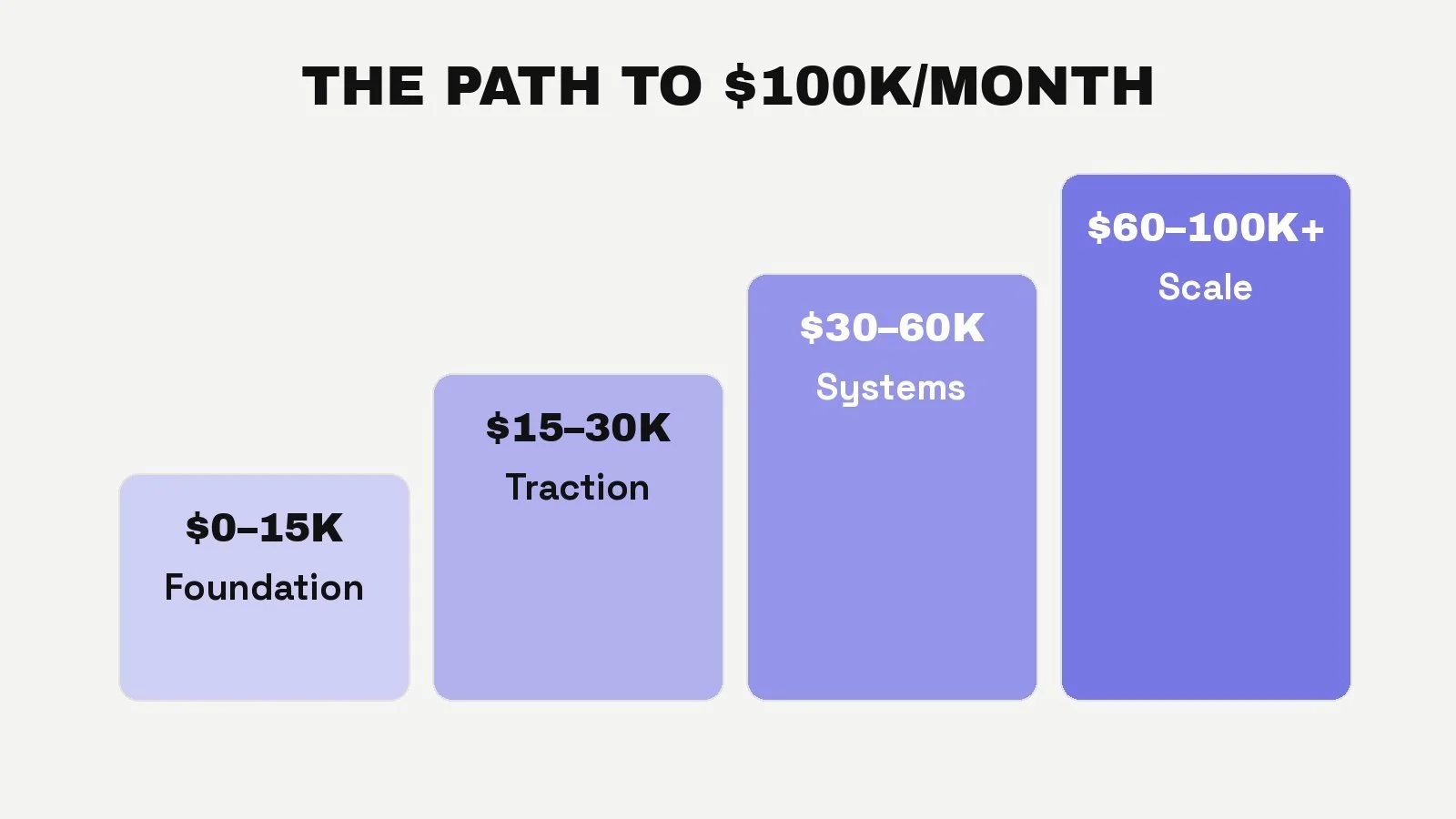
Every agency's path is different, but here's the order that works for most:
| Stage | Monthly revenue | Main focus |
|---|---|---|
| Foundation | $0–$15K | Clear offer, first clients, say no to bad deals |
| Traction | $15K–$30K | Niche down, build a repeatable lead source |
| Systems | $30K–$60K | Documented sales process, productized delivery, first key hires |
| Scale | $60K–$100K+ | Founder out of sales and delivery, bigger deals, retention |
Notice that lead generation isn't step one. If you pour leads into a broken offer and a founder-dependent delivery model, you just break faster.
Frequently Asked Questions
How long does it take to scale a marketing agency to $100K a month?
It depends on where you start and how fast you fix the system. Among our clients, PN Digital went from $30K to over $200K a month in 8 months, Apex Leads went from $15K to over $90K a month in 8 months, and Spring Media went from $10K to $150K a month over 24 months.
What's the biggest mistake agencies make when trying to scale?
Trying to fix growth with more leads before fixing the offer. If your offer is vague, custom and priced like a vendor, more leads just means more price negotiations and more delivery chaos.
Should I niche down to scale my agency?
Usually, yes. Höski grew from $15K to $50K a month in 4 months after repositioning around three verticals where they already had momentum. A clear niche makes your marketing, case studies and sales calls far more effective.
Do I need to hire a sales team to reach $100K a month?
You need a sales process that doesn't depend on you. That might be a salesperson, a partner or a trained team, but the process has to come first. Orizon's growth came after building a 6-stage sales process the team could run.
How do I scale my agency without working more hours?
Productize your delivery, standardize onboarding and build structured reporting. The founder of Apex Leads went from 60+ hours a week in delivery to less than 10 while revenue grew.
Is it worth hiring an agency consultant or coach?
If you've been stuck at the same revenue for months, an outside view from someone who has scaled and sold agencies usually finds the bottleneck faster than trial and error. See our case studies and services.
Ready to Break Through?
If you're stuck between $15K and $50K a month and want a clear path to $100K, let's talk. We'll look at your offer, pipeline and delivery and find what's actually holding you back.