

Most agency owners set their prices once, early on, by looking at what competitors charge and going a little lower. Then they spend years trying to grow on that number.
It doesn't work. Underpricing doesn't just cost you margin. It forces you to take on more clients to hit your revenue goals, which means more hires, more management and less time to fix the business. Pricing is one of the biggest growth levers you have, and most agencies never touch it.
This guide is for owners of marketing, digital and dev agencies in Canada and the US. It covers the four pricing models that work (retainers, tiered ad-spend fees, performance deals and scoped flat fees), how to set a minimum retainer, how long your contracts should be, and how to present your price without flinching.
Not sure your pricing is right? Book a free strategy call and we'll look at your offer, your numbers and what you should be charging.

Why Most Agencies Are Underpriced
In my video on building a $100K/month agency with four people (embedded further down), I call this the first reason most agencies never reach $100K a month: they're underpriced. Not slightly. Significantly. They run $5K, $6K or $7K retainers for work that's worth two or three times that.
Here's why that matters. The revenue math from the same video:
10 clients at $10,000 a month is $100K, with a lean team of four. At that size, payroll and direct costs should sit somewhere between $40K and $50K a month, leaving $50K to $60K in gross profit.
20 clients at $5,000 a month is the same revenue, but twice the deliverables, twice the relationships and twice the chances for something to go wrong. Those clients also tend to be more price-sensitive, and they question every invoice.
Same revenue, completely different business.
Pricing problems usually show up in three ways:
You close deals only when you discount. If dropping your price is the only way to win, the value isn't landing. That's an offer problem, not a sales problem.
Your clients make real money, and you capture none of it. You deliver strong results for a fixed fee, and your fee never changes as their results grow.
Every proposal is a remix. Nothing is standard, so you can't price consistently or hand the proposal to anyone else.
The fix starts with the offer. A service is a commodity, and commodities get compared on price. An outcome for a specific type of client doesn't. I've helped agency founders go from $2K "project rates" to $10K+ retainers with the exact same skill set, just packaged differently. If you haven't worked on your offer yet, read The Agency Offer Rebuild: How to Charge More and Close Faster first, then come back to pricing.
The 4 Agency Pricing Models (and When to Use Each)
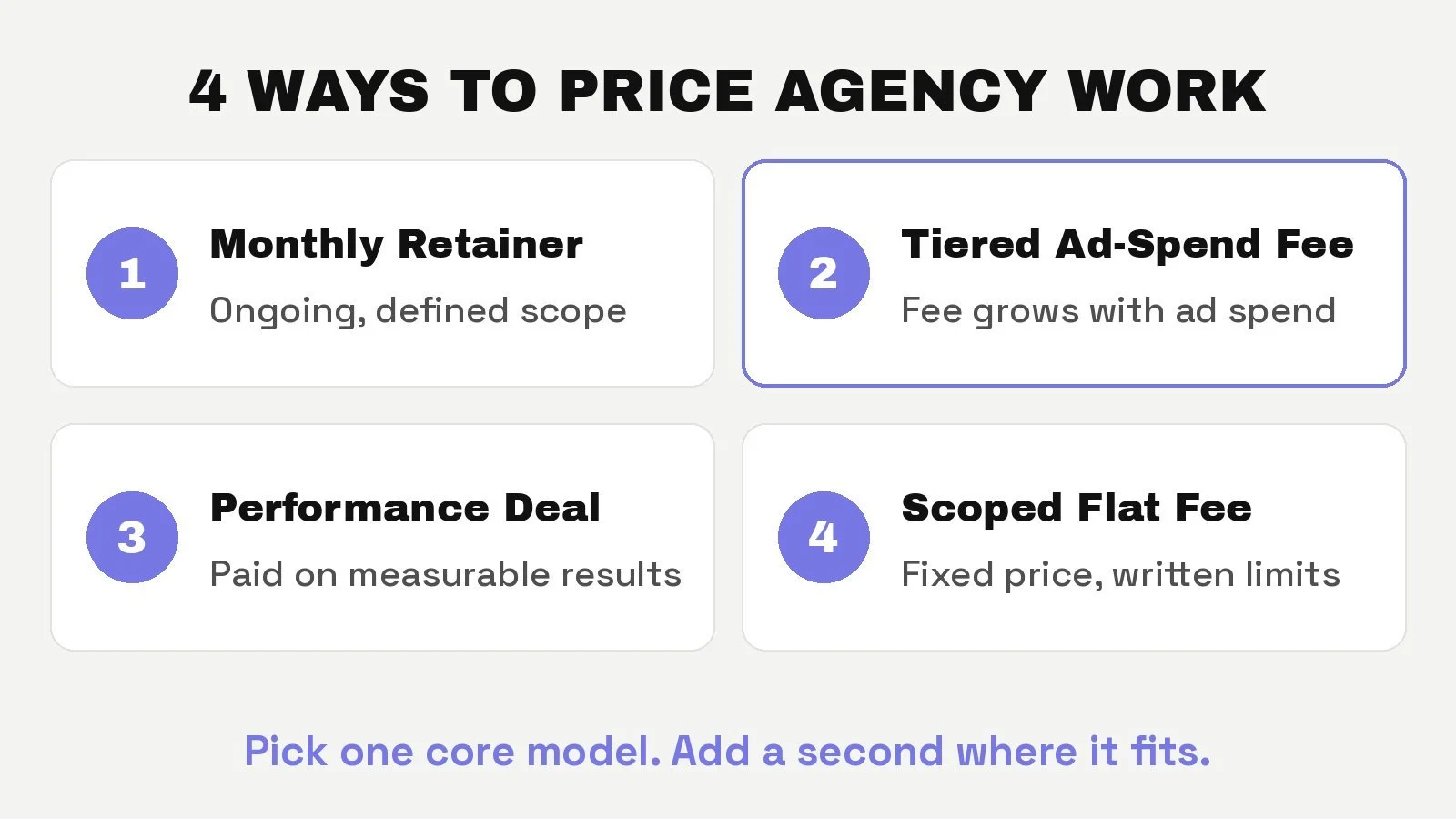
There's no single "right" way to price agency services. There are four models that work, and most healthy agencies use one as their core and add a second where it fits.
1. Monthly retainers
A retainer is a fixed monthly fee for an ongoing, defined scope of work. It's the backbone of most agencies because it makes revenue predictable, which makes hiring and planning possible.
The catch: a retainer only works if the scope is defined. "Social media management" is not a scope. A good retainer lists:
The outcome you're working toward (booked calls, qualified leads, pipeline, revenue).
The exact deliverables (for example, the number of campaigns, assets, posts or reports per month).
The cadence (weekly check-ins, a monthly report, a quarterly planning session).
What's not included, and how extra work is quoted.
Price retainers on the value of the outcome, not your hours. When Apex Leads rebuilt its offer into a high-retainer, outcome-based model positioned around booked meetings rather than "leads," it raised its minimum retainer from $1.5K to $4K a month with zero pushback, and grew from $15K to over $90K a month in 8 months.
Best for: ongoing services like SEO, content, social, email, outbound and dev maintenance.
2. Tiered ad-spend fees (ad management pricing)
Ad management is where flat retainers break down. Budgets vary a lot from client to client, and a client spending far more on ads usually needs more testing, more creative and more reporting. One flat number either overcharges small accounts or undercharges big ones.
The fix is tiered pricing by monthly ad spend. Instead of one fee, you set bands:
Monthly ad spendManagement feeUp to your first thresholdYour minimum monthly fee (your floor)Between your first and second thresholdA higher fixed fee for the bandAbove your second thresholdA higher fee again, or a fixed fee plus a percentage of spend above the threshold
This is a structure, not a price list. Set the thresholds and fees from your own costs, delivery time and results.
A few rules make tiered pricing work:
Always keep a floor. The lowest tier is your minimum fee, no matter how small the budget. Small accounts take real work too.
Separate management from creative. Prospects constantly ask "what's included?" Answer it in the proposal: the management fee, the creative fee, and the exact deliverables (how many static ads, how many videos, how often you refresh them). A simple written list beats a vague deck.
Let the fee grow with the account. When the client scales spend because the ads are working, your fee moves up a tier automatically. No awkward renegotiation.
Keep ad spend separate from your fee. Have ad spend billed directly to the client's own ad accounts, and invoice only your fees. It keeps the books clean and makes it clear the client owns their accounts and data.
Best for: paid search, paid social and any service where the workload grows with the budget.
3. Performance deals and revenue share
In a performance deal, part or all of your fee is tied to the results you produce: a percentage of sales, a fee per qualified appointment, or a share of the revenue increase.
This is the model that changed everything for Millennial Marketing. They helped coaches build personal brands and generate leads, and their clients were making real money, but the agency was stuck selling retainers that didn't capture any of the upside. We rebuilt the offer around performance funnels with a percentage of sales. The pitch was simple: we build the funnel, you keep most of the money, and we take a small piece of every sale we help generate. The first time they pitched the new model, they closed a $150,000 deal, the biggest in the company's history.
Performance pricing works when:
You can measure the result cleanly. Sales, appointments or revenue that both sides can see in the same system.
You control enough of the outcome. If the client's sales team, pricing or fulfillment can sink the results, you're taking their risk, not yours.
You have proof. A strong case study makes performance terms easier to sell, and makes it easier to sell without them.
You don't have to go all in. A hybrid (a base fee plus a performance component) protects your cash flow while still sharing the upside. In my video on AI agency models, one example is a $5,000-a-month fee for an outbound system plus a fee per qualified appointment. The Deal Flow uses a similar structure: its full plan is $249 CAD a month, plus a 10% success fee only on contracts won with a proposal they wrote.
Put every performance term in writing: what counts as a result, how it's tracked, when it's paid and what happens if the client changes something that affects the numbers.
Best for: funnels, lead generation, outbound and e-commerce growth, where results map directly to revenue.
4. Scoped flat fees (projects)
Websites, brand identities, launches and audits are often better as fixed-price projects than retainers. A flat fee is easy for the client to approve, and it rewards you for working efficiently instead of punishing you for it.
The rule: flat fees need limits. Even a flat-rate website should state the included pages, revision rounds, hours and timeline in writing. Without limits, a flat fee becomes unlimited work for a fixed price.
Ricochet, a design-led creative studio, moved its offers from hourly to fixed-scope projects starting at $5K+ and went from $5K to $30K a month in predictable, high-margin project revenue in 3 months. Ravon made a similar shift away from underpriced hourly thinking, toward clearer scopes and outcome-driven pricing, and hit $35K a month in 5 months.
For complex or enterprise work, don't quote a full package up front. Sell a paid discovery or strategy phase first and credit it toward the full engagement. Skip discovery for simple tasks.
Best for: websites, branding, launches, audits and discovery phases.
Want a second opinion on which model fits your agency? Book a call. We'll look at your services, your clients and your margins and tell you where we'd start.
Set a Minimum Retainer (and Stick to It)
A minimum retainer is the smallest monthly engagement you'll take on. It's one of the simplest pricing decisions you can make, and it changes the quality of your client base fast.
Set the floor from your delivery cost. Work out what it costs to serve the smallest client well (team time, tools, management, reporting) and set a floor that leaves you a healthy margin.
Don't go below it. Not for a "foot in the door," not for a friend of a friend. Every exception becomes the new normal.
Tie price to the outcome when they say they can't afford it. Bring the conversation back to what the problem is costing them and what solving it is worth. If it's still not a fit, it's not a fit.
Say no to clients who can't afford the service. An underfunded client gets a watered-down service, gets weak results and leaves unhappy. That hurts you more than the lost revenue.
Raise the floor as your proof grows. Apex Leads went from a $1.5K to a $4K minimum with zero pushback once the offer was rebuilt around booked meetings.
In my video on why agencies get stuck at $10–20K a month, the roadmap starts here: stop selling $3K-a-month services and rebuild your offer to attract $10K, $15K and $25K retainers by targeting bigger clients and selling outcomes, not hours.
Contract Length: Start Shorter, Renew on Results
Many agency owners push for 12-month contracts because they want security. Prospects push back because they don't trust you yet. The deal stalls.
There's a better way:
Ask what term the client is comfortable with. For example, four months instead of twelve. You remove the biggest objection in the room.
Make the first term long enough to show results. Pick a term that fits your service. Some channels need time to ramp up.
Set the renewal review up front. Agree on the metrics you'll review before the term ends, and put the date on the calendar.
Renew on results. When you can show the outcome, the renewal (and often a bigger scope) is an easy yes.
Use reporting and quarterly reviews to earn the renewal. Clients who can't see the win don't renew. Apex Leads introduced quarterly planning and client reviews and lifted retention from 30% to over 70%.
Shorter first terms close faster. Results, not contract clauses, are what keep clients.
The Pricing Math Behind a $100K/Month Agency (Video)
Pricing, positioning, team structure and operating system all connect. In this video I walk through the full model: why 10 clients at $10K beats 20 at $5K, the four-person team, and why you need to step back from delivery to make it work.
The short version: to command $10K retainers, you need two things, positioning and social proof. Generalists compete on price, and there's always someone cheaper. Specialists who solve a specific, expensive problem for a specific type of business compete on outcome.
How to Present Your Price With Confidence
The best pricing model in the world won't help if you apologize for it on the call.
Collect small agreements first. Summarize their problem, then ask, "Does that resonate?" Get a few yeses before you present anything.
State the price and stop talking. "Based on what you've told me, the investment is [your price] a month. Does that work for you?" No justification, no discount offered before they ask.
Treat "I need to think about it" as a trust issue. Clarify what they need to think about, and isolate the real concern: price, timing or something else.
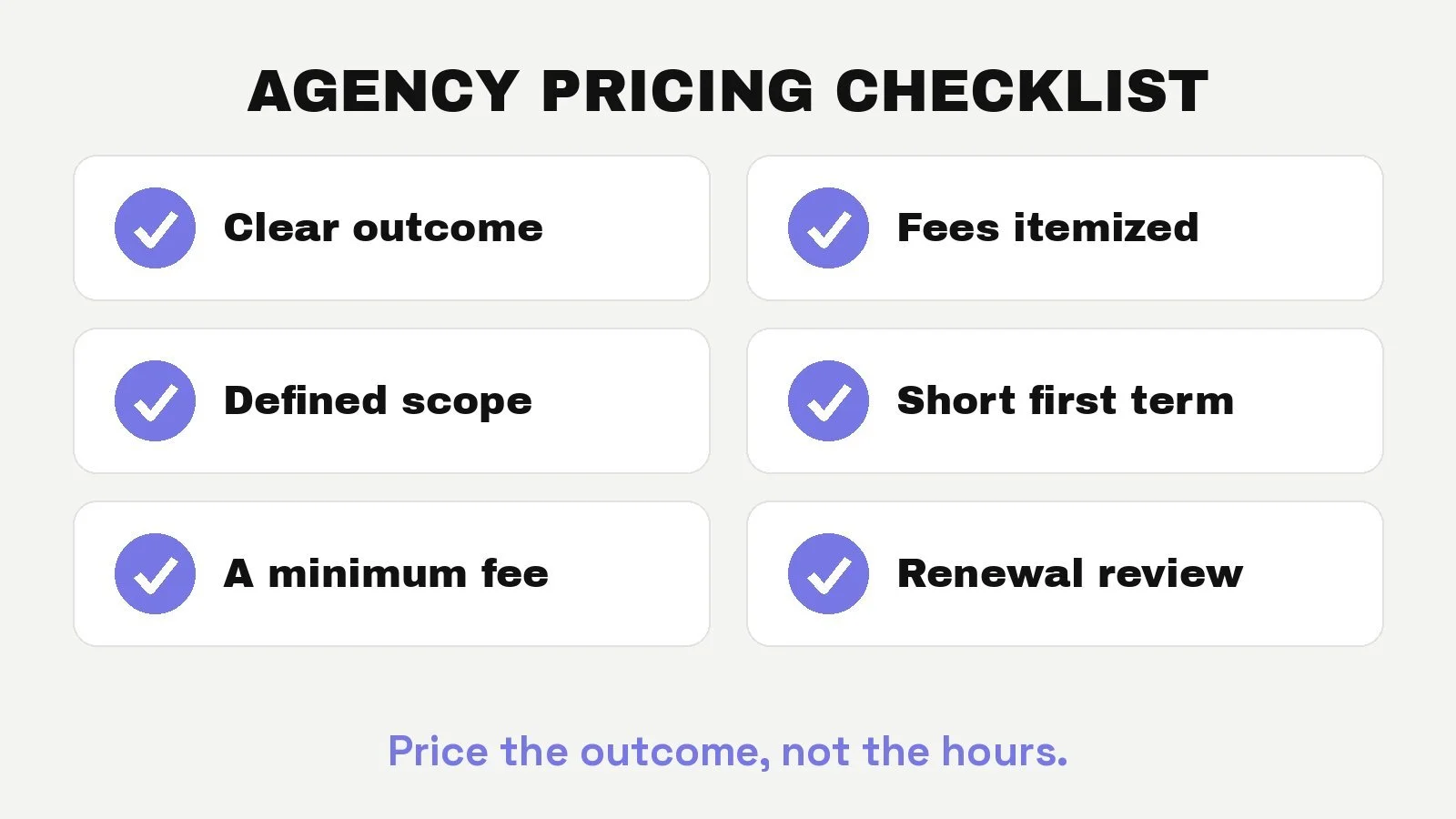
Make the proposal answer "what's included." Fees, deliverables, cadence and term, in plain language. Clear scope stops deals from stalling after a yes.
For the full 7-day sales fix, see How to Get Clients for Your Marketing Agency (Beyond Referrals).
Common Agency Pricing Mistakes
Pricing by copying competitors. Their costs, clients and results aren't yours.
Charging by the hour for outcome work. You get punished for getting faster.
One flat fee for every ad budget. Small accounts lose you money, big ones leave money on the table.
"Unlimited" flat fees. Every fixed price needs a written scope and limits.
Performance deals without clean tracking. If you can't agree on the number, you can't agree on the invoice.
Forcing 12-month contracts on new clients. Earn the long term with results.
Discounting to win. Price resistance is usually a value or trust problem, not a price problem.
Pricing Is an Offer Problem First
If you've fixed your pricing structure and you still hear "too expensive," the issue is almost always upstream. A vague offer gets compared on price. A specific outcome for a specific client gets bought. Read Your Offer Is the Problem, Not Your Lead Gen for the four elements of an offer that converts.
Once pricing and offer are fixed, the next step is scaling delivery without becoming the bottleneck. That's what How to Scale a Marketing Agency to $100K/Month covers.
Get Help With Your Agency Pricing
You can work through all of this yourself. If you'd rather pressure-test it with someone who's priced and repriced agencies many times:
Agency Clarity Call: a 60-minute 1-on-1 session with me (from US$500) for sharp, actionable advice on your offer, your funnel or how to grow without burning out. Bring your pricing questions. A recording is included.
Working with us directly: if you want help rebuilding your offer, pricing, sales process and delivery together, see how we work as an agency growth consultant.
FAQ
How should a marketing agency price its services?
Pick one core model that fits your service: a monthly retainer for ongoing work, tiered ad-spend fees for ad management, a performance deal when results are measurable, or a scoped flat fee for projects. Price on the value of the outcome, not your hours, and set a minimum fee you won't go below.
How do agencies price ad management?
Many agencies use tiered fees based on monthly ad spend instead of one flat number. The lowest tier is your minimum fee, and the fee moves up as spend grows. List the management fee and the creative fee separately, with the exact deliverables, so clients know what's included.
What should my minimum retainer be?
Set it from your delivery cost: what it takes to serve your smallest client well, plus a healthy margin. Then don't go below it. Raise it as your proof grows. Apex Leads raised its minimum retainer from $1.5K to $4K a month with zero pushback after rebuilding its offer.
Should agencies offer performance-based pricing?
Yes, when you can measure the result cleanly and you control enough of the outcome. Many agencies use a hybrid: a base fee plus a performance component. Millennial Marketing closed a $150,000 deal, the biggest in its history, the first time it pitched a performance funnel model with a percentage of sales.
Should I ask clients for 12-month contracts?
Not at the start. Ask what term the client is comfortable with, for example four months, agree on the metrics you'll review, and renew on results. Shorter first terms remove a big objection, and clients who see results renew.
Ready to Charge What Your Work Is Worth?
Better pricing means fewer, better clients, healthier margins and the time to actually grow the agency. If you want help choosing the right model, setting your minimum and presenting your price with confidence, let's talk.
Book a free strategy call and we'll map out a pricing structure that fits your agency.