

If you're a media buyer, you probably already run more ad spend than most agency owners. You know the platforms, you know what a good campaign looks like, and you've watched your employer bill clients for work you did.
So the thought shows up: why am I doing this for someone else?
It's a fair question. But the skill that makes you a great media buyer isn't the skill that builds an agency. You know how to get results for clients. You've never had to get clients for yourself. That's where most people who quit their job to start an agency get stuck.
This playbook is for media buyers, freelancers and in-house marketers in Canada and the US who want to make the jump the right way: the identity shift, six steps to build the business while you're still employed, and how to know when it's time to resign.
Thinking about making the jump? Book a free strategy call and we'll look at your skills, your plan and whether now is the right time to leave.

Your Skills Are Ready. Your Identity Might Not Be.
When Brydon McMillen started working with us, Plateau PPC didn't exist as a real business yet. He was a media buyer at another agency with strong technical skills, working a full-time job while trying to build something on the side. His list of challenges will sound familiar:
Starting from $0 a month in agency revenue.
No client acquisition system.
Limited experience selling as a founder.
No positioning in a specific niche.
An employee mindset, not an entrepreneur mindset.
The biggest obstacle wasn't technical execution. It was learning to think and operate like a business owner.
I call this "freelancer thinking trapped in an agency's body." It looks like this:
You think in hours, not leverage. You price your time instead of the outcome.
You say yes to everything because you're scared of losing a deal.
You do all the delivery yourself because no one else will do it as well.
Everything lives in your head. There are no systems anyone else could follow.
The owner mindset is the opposite. You sell outcomes, you build systems, you protect your time for sales and strategy, and you hand off work that someone else can do.
A simple test I use with founders: list every task you did last week and sort it into $10-an-hour tasks, $100-an-hour tasks and $1,000-an-hour tasks. If your week is full of the first kind, you're still working like an employee, even if you've already quit.
Freelancer or Agency: Decide What You're Building
Plenty of media buyers leave their job and become well-paid freelancers. That's a legitimate choice, but it's a different business. Be clear about which one you're building before you resign.
A freelancer sells their time. Income is capped by your hours, and when you stop working, revenue stops.
An agency sells an outcome, delivered by a system. You still do the work at first, but you build the offer, the lead flow and the processes so others can deliver it with you.
If you want to go from freelancer to agency, decide on day one. It changes how you price, how you pitch and which clients you take.
The Playbook: 6 Steps From Employee to Agency Owner
You don't need to quit first. The safest path is to build the foundations while you still have a paycheque, then leave when the business has real traction.
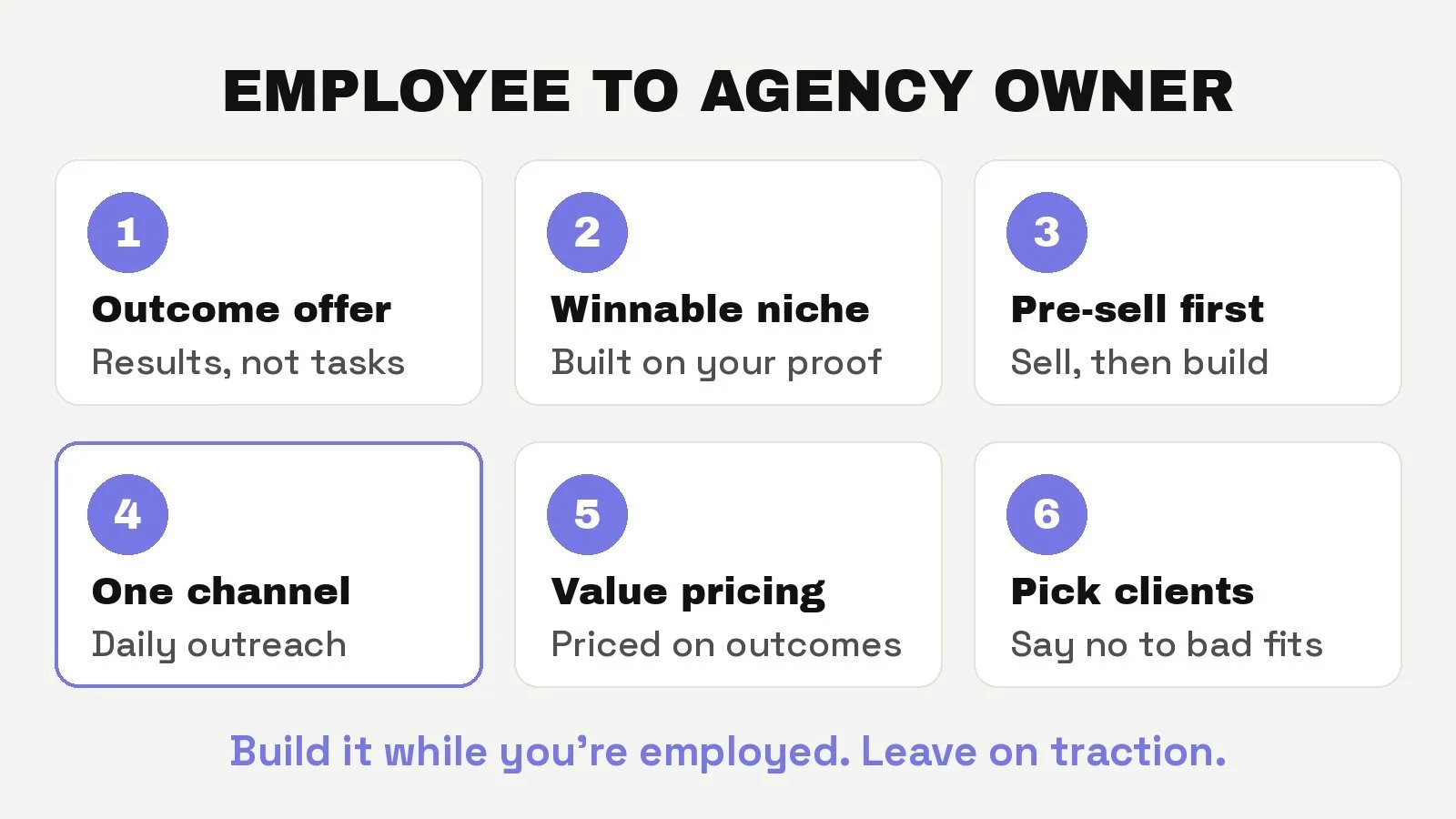
Step 1: Turn your skill into an outcome-based offer
"I run Google Ads" is a service. Services get compared on price. "I help a specific type of company acquire customers through paid search" is the start of an offer.
A good offer answers four questions:
Who is it for? A specific type of client.
What painful problem does it solve? Something urgent enough that they'll pay to fix it.
What measurable outcome do they get? Leads, booked calls, customers, revenue.
How do you reduce their risk? Clear scope, reporting and proof.
One of the first shifts we made with Brydon was learning to sell outcomes instead of tasks. The offer, not the technical skill, is what clients buy.
Step 2: Pick a niche you can actually win in
Prospects don't trust a generalist. Rather than competing as a generalist PPC agency, Plateau PPC positioned itself around fintech companies, AI companies and high-growth tech businesses. That specialization let Brydon stand out in a crowded market and command significantly higher retainers than a typical PPC freelancer.
But a niche has to fit what you can deliver. Early on, Ravon avoided over-complex niches like crypto and fintech, because the delivery risk was too high for where the business was at the time. Same category, opposite decision, and both were right.
The rule: niche where you already have experience and proof. If you've spent years running campaigns for one type of business, start there. If you haven't, start a little broader, get paid, and narrow down once you see who pays the most and gets the best results.
Step 3: Pre-sell before you build
Most would-be agency owners spend months on logos and websites before talking to a single prospect. Don't.
Sell first, then build. Get a real client to say yes to a clear offer, then deliver it well and turn it into a case study. Your first case study does more for your agency than any website ever will.
Keep the setup simple: a business registration, a simple contract, a way to invoice and a one-page site are enough to start. For the full setup checklist, see How to Start a Marketing Agency in Canada.
Step 4: Build one acquisition channel while you're still employed
This is where media buyers usually struggle. You've spent years generating leads for clients, but you've never had to generate them for yourself.
With Plateau PPC, we built an outbound lead generation engine for Brydon's target market. It included:
Prospect identification.
LinkedIn content and outreach.
Cold email campaigns.
Follow-up frameworks.
Qualification and a sales conversation structure.
Instead of waiting for referrals, he had a repeatable process for creating opportunities every week.
You don't have to build all of that at once. Pick one channel, such as LinkedIn DMs, cold email or your existing network, and do it every day. Time-block it before or after work, like a client appointment you can't move. Track three numbers each day: messages sent, new responses and calls booked. For channel-by-channel tactics, read How to Get Clients for Your Marketing Agency (Beyond Referrals).
Do it the clean way. Before you sign your first client, read your employment agreement for non-solicitation, non-compete, moonlighting and IP clauses, and talk to an employment lawyer if anything is unclear. Don't pitch your employer's clients, don't use their tools, data or accounts, and don't do agency work on company time. Starting clean protects your reputation, and in this industry your reputation is your pipeline.
Step 5: Price for value from day one
Employees think in salary. Freelancers think in hourly rates. Agency owners price the outcome.
At Ravon, we moved Imaan Taghavi away from underpriced hourly thinking. We introduced clearer scopes and outcome-driven pricing, and raised his consulting and strategy fees. As pricing improved, so did close rates and client quality.
Set a minimum fee you won't go below, put the exact deliverables in writing and start with a shorter first term that renews on results. The full breakdown of retainers, tiered ad-spend fees and performance deals is in How to Price Agency Services.
Step 6: Say no to the wrong clients
When you've just left a salary, every deal feels like one you can't afford to lose. That's exactly when bad clients do the most damage.
With Ravon, we reviewed live opportunities together, pressure-tested deals before they closed and decided what not to take. That meant saying no to misaligned clients, even when the cash felt tempting, and structuring offers Ravon could deliver confidently and profitably. It protected the business from early churn, refunds and reputation damage.
Want a second opinion on your offer before you resign? Book a free strategy call. We'll pressure-test your offer, your niche and your first 90 days.
When Should You Actually Quit Your Job?
There's no perfect moment, but there is a smarter one: when the business has traction, not just potential.
For Brydon, that moment came one month in. The early traction from his new systems let him leave his full-time position and focus entirely on Plateau PPC. That gave him the time and focus he needed to grow much faster.
Before you hand in your notice, check yourself against this list:
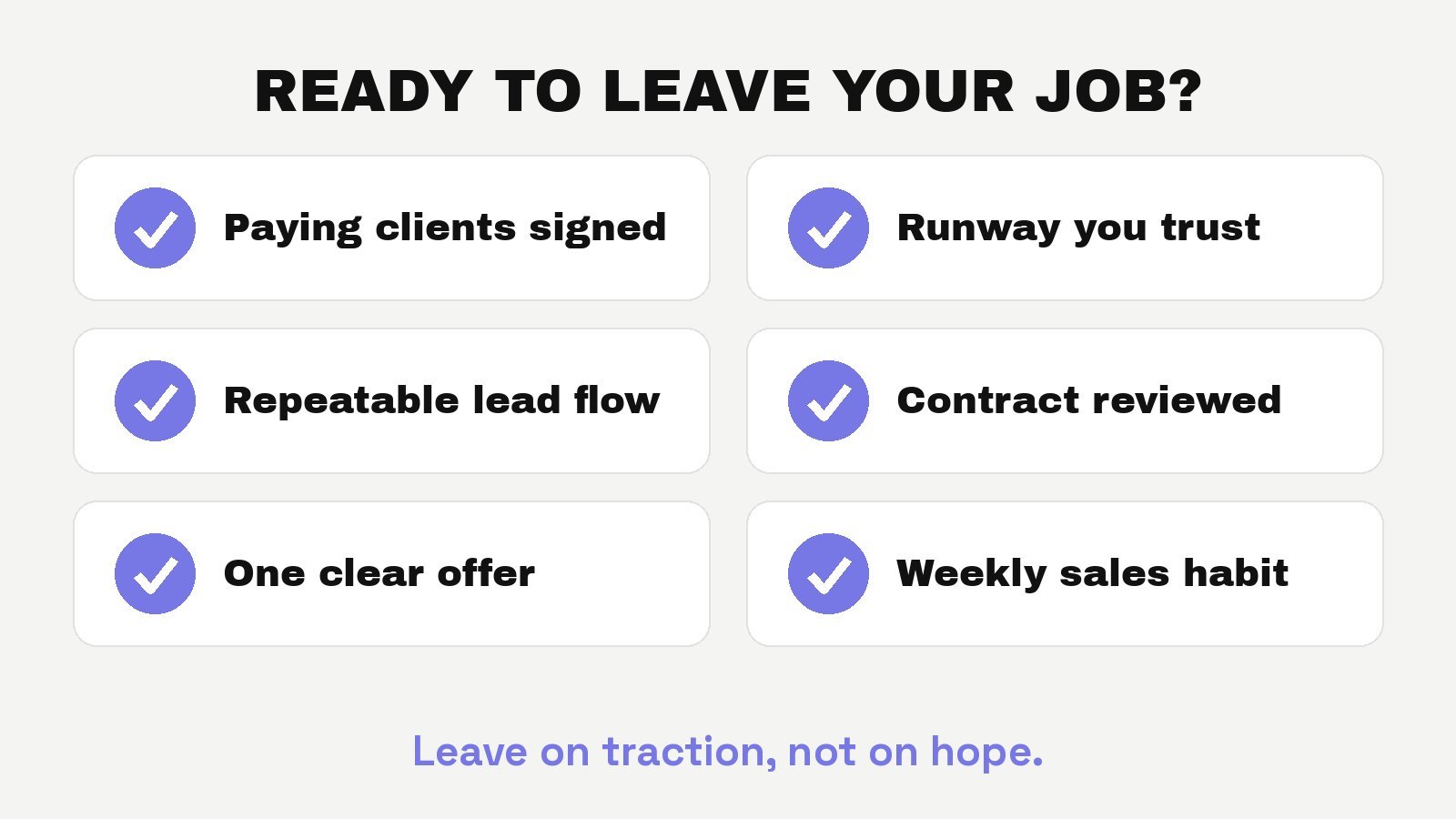
Paying clients signed. Not "interested." Signed and paying.
A repeatable lead flow. You know where the next conversations will come from.
One clear offer. You can explain who you help and what they get in a sentence.
A runway you trust. Enough savings that you won't take bad clients out of panic.
Your contract reviewed. You know your obligations to your employer and you're leaving on good terms.
A weekly sales habit. A minimum number of outreach messages and sales calls every week, no matter how busy delivery gets.
If most of these are true, it may be time. If few are, keep building on the side.
Run It Like a Business From Day One
Leaving your job gives you time. What you do with it decides whether you build an agency or just a busier freelance practice.
Treat your own agency like a client. Your marketing and sales get a schedule, an owner and deliverables, just like a paying account.
Keep selling when delivery gets busy. Founders who stop outreach when they're busy get a dry pipeline a few months later.
Separate strategy from execution. As Ravon started closing deals, it brought in low-cost but reliable operators for execution and built simple systems for ads, landing pages and follow-up. That protected margins and kept Imaan from becoming the bottleneck.
Hire before it feels comfortable. Plateau PPC hired two full-time team members as it grew, so delivery didn't depend on one person.
Watch: From Media Buyer to Agency Owner (Video)
In this short video, Brydon tells the story in his own words: leaving his media buying job, building Plateau PPC around fintech companies, and what changed in his mindset along the way.
What This Looked Like for Two Founders
Every agency is different, and results vary. Here's what a focused start looked like for two founders we worked with:
Plateau PPC: from $0 a month to over $30,000 a month in recurring revenue in 4 months. Brydon quit his full-time agency job after the first month, built a specialized position in fintech and AI, and hired two full-time team members.
Ravon: from $0 to over $35K a month in 5 months, hitting the exact goal set at the start. The focus was deal selection, outcome-based pricing and protecting delivery margins.
Neither was an overnight win. Both came from a clear offer, a focused niche and consistent outreach.
Get Help Making the Jump
You can do all of this on your own. If you'd rather have a proven system and someone in your corner:
The Agency Launchpad: built for skilled employees, like media buyers, who want to turn their skills into an agency. It's the system Brydon used to go from employee to $30K a month in 4 months. It starts with a free 30-minute call: an honest assessment of whether your skills translate to agency revenue, a picture of your first 90 days and a straight answer on fit. No pitch.
Already running an agency? If you've made the jump and want help with your offer, sales and delivery, see how we work as an agency growth consultant.
FAQ
Should I quit my job before starting an agency?
Usually not. Build your offer and one lead channel while you're still employed, and land your first paying clients on the side. Leave once you have traction: signed clients, a repeatable lead flow and a runway you trust. Plateau PPC's founder left his full-time job one month into building the agency, once early traction was there.
How do I go from freelancer to agency?
Stop selling your time and start selling an outcome. Package your skill into a specific offer for a specific type of client, price it on the result, build a repeatable lead channel, and document your delivery so others can do the work with you. Then hire before it feels comfortable.
Can a media buyer start their own agency?
Yes. Media buyers already have the skill clients pay for. What's usually missing is an offer, a niche and a way to get clients. Brydon McMillen went from media buyer to running Plateau PPC, a Google Ads agency for fintech and AI companies, and grew it from $0 to over $30,000 a month in 4 months.
Can I start an agency while working full time?
Yes, if you do it cleanly. Read your employment agreement for non-solicitation, non-compete and moonlighting clauses, and get legal advice if anything is unclear. Never pitch your employer's clients or use their time, tools or data. Time-block your outreach outside work hours and keep it consistent.
How long does it take to replace a salary with an agency?
It depends on your skills, offer and effort, and results vary. With a clear offer and consistent outreach, Plateau PPC went from $0 to over $30,000 a month in 4 months, and Ravon went from $0 to over $35K a month in 5 months.
Ready to Make the Jump?
If you've got a skill people pay for and you're ready to build something of your own, let's talk. We'll look at your background and your first 90 days, and give you a straight answer on whether now is the time to leave.
Book a free strategy call or start with a free call through The Agency Launchpad.