

You spent three hours on the monthly report. Charts, traffic, conversion rates, a full breakdown of the work. You sent it on Friday and heard nothing. Two weeks later the client asks, "So what exactly have you been doing for us?"
They didn't read it. Not because they don't care, and not because your work was bad. Agency reporting usually fails for one reason: it shows data instead of communicating value. This post walks through the fix I teach agency owners. It's a short, repeatable report your clients will actually read, and you can reuse the same thinking to close new clients.
Why Clients Don't Read Your Agency Reports
Your clients are running a business. They're dealing with staff, cash flow, sales and operations. By the time your 20-page report lands, it's competing with dozens of other things, so they skim it or skip it.
That's where it gets dangerous. When a client doesn't understand your value, they start questioning it. They look at the invoice each month and ask, "Is this worth it?" They don't tell you. They just quietly build a case to cancel.
Most agency owners treat this as a reporting problem. It's a communication problem. Data is not communication.
What Poor Reporting Really Costs Your Agency
Here's the example from my video. At $20K a month, losing one client a quarter is roughly $3K to $5K walking out the door every 90 days, or $12K to $20K a year from churn alone.
And churned clients leave with a story: "We tried that agency and it didn't work." That's the referral you never get, the case study that never happens and the testimonial that never gets written. Poor reporting hurts retention, referrals and revenue at the same time. If retention is your weak spot, read Why Agencies Fail at Retention (and How to Fix It) next.
The Reframe: Reporting Is Translating Value
Your client doesn't care about impressions, click-through rate or quality score. They care about two things. Is my business growing? Am I getting a return on what I spend?
Your job isn't to show them what happened. It's to connect what happened to what it means for their business. That means moving from data to meaning, and from numbers to a story.
The 3 Levels of Agency Reporting
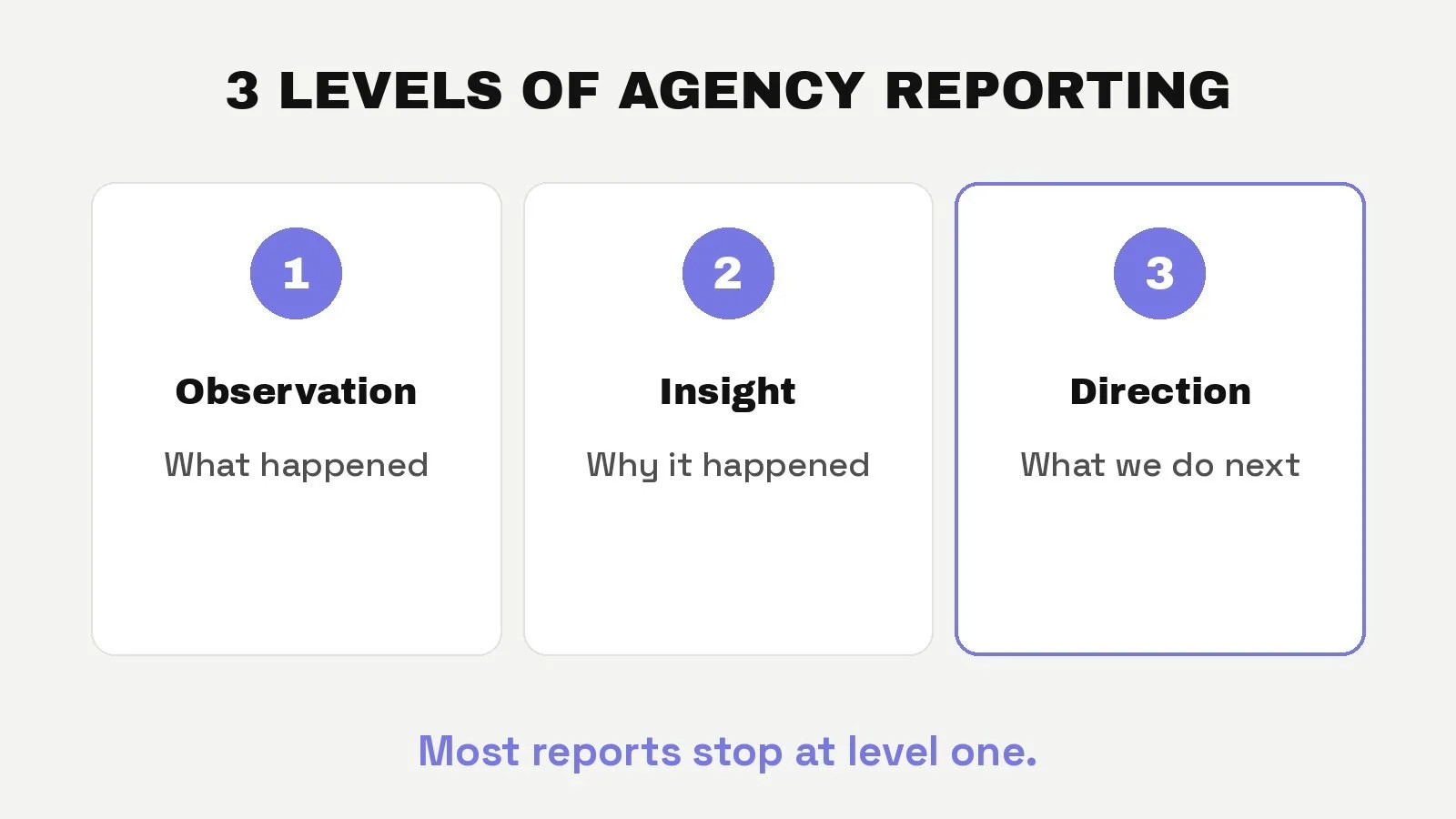
Observation: what happened. "Traffic went up 12% this month." It's a fact, but it means little to someone who doesn't live in your world.
Insight: why it happened. "Traffic went up 12% because we moved budget to the three best-converting keywords and cut the ones eating spend." Now the client can see your thinking.
Direction: what happens next. "Here's what we'll do over the next 30 days to push that further, and here's what to expect."
Most agencies stay at level one. Some reach level two. The agencies that consistently reach level three rarely lose clients, because their clients feel they have a strategic partner, not a vendor.
The 5-Minute Report: A Simple Client Report Template
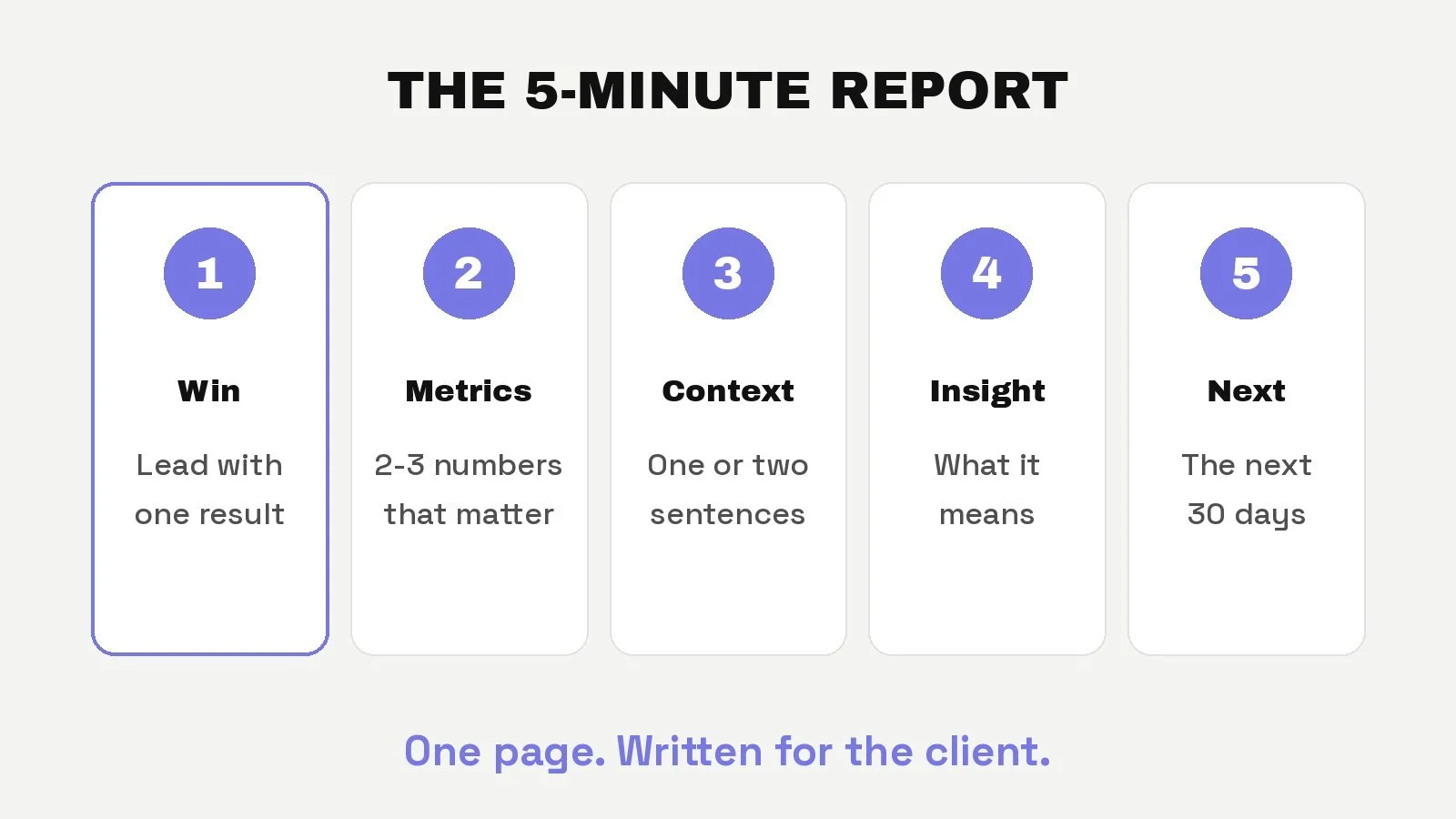
The name doesn't mean it takes five minutes to write. It means it should feel like a five-minute read. Use the same five sections every time:
The win. Open with one clear, specific result, for example "47 leads this month at a cost per lead 22% lower than last month." Let the client feel the win before anything else.
Key metrics. Only the two or three numbers that matter to their business, such as revenue, leads or conversions. Whatever their north star is. No noise.
Context. One or two sentences on what's behind the numbers: "Lead volume increased because we launched a new landing page and shifted budget to the top ad set."
Insight. What it means: "The new page converts at 4.1% vs 2.3% on the old one, so the messaging is landing. We'll double down on this angle."
Next steps. What you'll do and what to expect: "Over the next 30 days we're testing two new creatives and tightening follow-up. The goal is 60 leads with cost per lead under $40."
The figures above are illustrations from the video. Use your client's real numbers.
Keep it to one or two pages and send it weekly or every two weeks. It's written for the client, not for you, so it gets read.
Use the Same Thinking to Close New Clients: The Revenue Gap Method
Most proposals list services, show a portfolio and explain the process. Then the prospect goes quiet or "goes with someone cheaper," because the agency never made the cost of doing nothing real.
The revenue gap method fixes that. Before you pitch, run a real audit of the prospect's website, SEO, ads or funnel. Find the gap between where they are and where they could be, and put a number on it.
Here's the SEO example from the video. A prospect ranks on page two for a keyword with about 8,000 searches a month. The competitor on page one gets roughly 30% of that traffic, about 2,400 visits. At a 2% conversion rate and a $500 average order value, that's $24,000 a month the prospect isn't getting. Now you're not selling SEO. You're showing them $24,000 a month and how to capture it.
AI tools now make a meaningful audit possible in an hour or two, so you can show value before the contract is signed. The tool is only as good as the thinking behind it, though. You still have to know what to look for and how to frame it. For the full offer side of this, see Your Offer Is the Problem, Not Your Lead Gen and The Agency Offer Rebuild.
Freelancer vs Operator: The Mindset Behind Better Reporting
A freelancer reports data. An operator translates value. A freelancer reacts to what clients ask for, while an operator leads them toward what they need. A freelancer competes on price, while an operator charges a premium because the client can feel the difference.
Plenty of agencies at $20K or $30K a month still run like freelancers, even with a team. The 5-minute report, the three levels and the revenue gap method are all ways of putting the operator mindset into practice. When this clicks, your client relationships get stronger. You can see it in Apex Leads, whose client retention went from 30% to over 70% as the agency rebuilt its offer and systems.
Watch the Full Video
Where Reporting Fits in Scaling Your Agency
Reporting is part of delivery, and delivery has to run without you as you grow. In a lean team, the project manager owns reporting and client communication. See How to Build a $100K/Month Agency With a 4-Person Team and How to Scale a Marketing Agency to $100K/Month.
If prospects understand your value but you still need more of them, How to Get Clients for Your Marketing Agency covers the pipeline. B2B agencies that want booked calls from LinkedIn can look at The GTM Business.
Frequently Asked Questions
What should a marketing agency client report include?
Five sections: one clear win, the two or three metrics that matter to the client's business, a sentence or two of context, an insight explaining what the results mean, and next steps for the coming 30 days. Keep it to one or two pages.
How often should an agency send client reports?
Weekly or every two weeks works well for a short, insight-led report. A shorter report sent more often keeps your value visible and catches problems before the client starts questioning the invoice.
Why do clients ignore agency reports?
Most reports are written for the agency, not the client. They're full of channel metrics like impressions and click-through rate that don't answer the client's real questions: is my business growing, and am I getting a return?
How does better reporting reduce client churn?
Clients rarely leave because the work is bad. They leave because they can't see the value. Reports that move from observation to insight to direction show the client the thinking and the plan, which builds trust and makes your fee feel like an investment.
Can reporting help an agency win new clients?
Yes. The same principle powers the revenue gap method: audit a prospect, find the gap between where they are and where they could be, and put a dollar figure on it. That turns a price conversation into a "how fast can we start" conversation.
Want a second pair of eyes on your client reporting, retention and sales process? Book a free strategy call or learn how I work with agencies as an agency consultant.