

Here's the biggest lie in the agency world: to build a $100K-a-month agency, you need a big team.
You don't. I've built agencies with 75 people on payroll and three offices. More people did not mean more money. Most of the time it meant more problems, more cost and less control. The agencies I've seen collapse fastest had the biggest teams and the thinnest profit.
This post breaks down the lean agency team structure: the revenue math, the four roles, the operating system that holds it together, and why most founders still struggle to make it work.
Why Most Agencies Never Reach $100K/Month
The usual story goes like this. You start solo, clients come in and you get busy, so you hire. Then you hire again. Soon there's payroll and complexity, and despite record revenue you take home less than when you worked alone.
Most agency owners scale headcount before they scale systems. Two problems sit underneath that:
They're underpriced. Not slightly. They charge $5K, $6K or $7K retainers for work worth two or three times that. Underpricing means more clients, more work and more hires, and that crushes margins.
The founder is still doing delivery. If you're writing the copy, building campaigns and explaining strategy on every call, you can't work on positioning, systems or better clients. You're too busy doing the work to build the thing that does the work.
If this sounds familiar, Building a Scalable Agency Without Becoming the Bottleneck and Breaking the $30K Plateau go deeper on both problems.
Why Small Agency Teams Now Win
Execution has become commoditized. A large share of content production, ad management, reporting, research and first drafts can now be done faster and cheaper with AI and specialist freelancers.
So the value of an agency is no longer execution. It's judgment: strategy, positioning, and knowing what a client's business needs and in what order. A 20-person agency is paying for execution. A four-person agency is selling judgment, and judgment commands a premium. Small teams also communicate faster, decide faster, keep quality tight and have healthy margins.
The Math Behind a $100K/Month Lean Agency
10 clients at $10,000 a month = $100K. That's the model.
Compare it with 20 clients at $5K. That's 20 sets of deliverables, 20 relationships and 20 chances for something to go wrong. And clients paying $5K tend to be price-sensitive and question every invoice.
With a lean four-person team at $100K a month, payroll and direct costs should sit somewhere around $40K to $50K, which leaves $50K to $60K in gross profit every month. That doesn't work with 20 clients at $5K, because they need more people and more management.
How do you get to $10K retainers? With positioning and social proof. Generalists compete on price. Specialists who solve a specific, expensive problem for a specific type of business compete on outcome. The full pricing playbook is in How to Price Agency Services.
The 4-Person Agency Team: Roles and Responsibilities
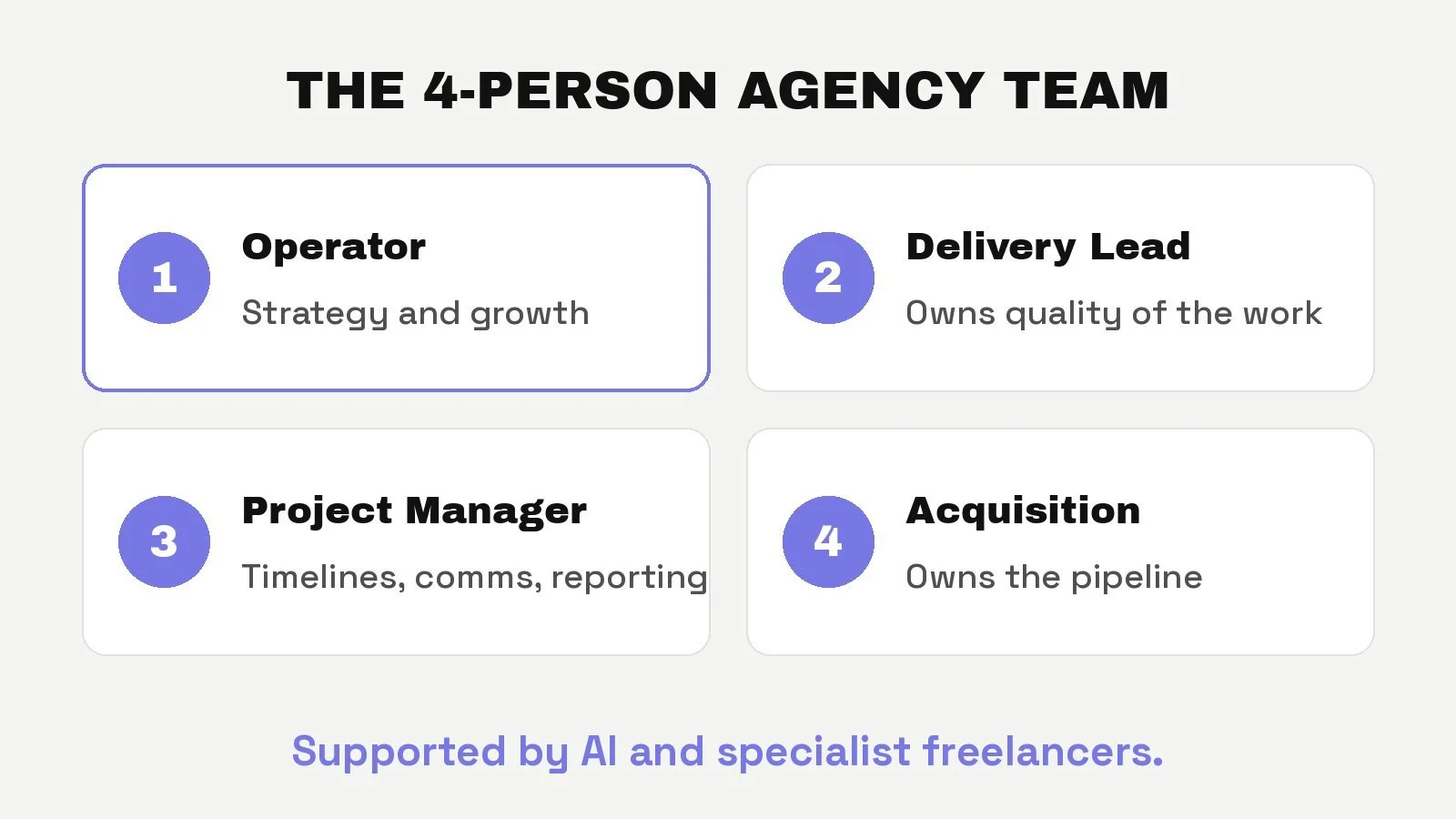
1. The Operator (the founder)
You do not do delivery. Your job is strategy, relationships and growth: setting direction for each client, having high-level conversations, and refining positioning and the offer. You're the brain of the operation, not the hands. "My clients want to work with me" is a trap. If every client needs you personally, you've built a job, not a business.
2. The Delivery Lead
This is the most important hire. They own the quality of the work, understand your standards, and manage the freelancers and AI tools behind production. It's not a junior role. What they don't do is manage client relationships, reporting or scope-creep conversations.
3. The Project Manager
They're the operational backbone. They own timelines, client communication and reporting, and they make clients feel looked after without you in every conversation. A seamless client experience drives retention, and retention drives profit. For the reporting part of the job, see Agency Client Reporting: Reports Clients Actually Read.
4. Acquisition
This could be a salesperson, someone who owns outreach and content, or a fractional hire at first. Someone has to own the pipeline. If it falls on you on top of strategy and relationships, acquisition is what gets dropped.
Around these four people sits a network of AI tools and specialist freelancers. The team directs and quality-controls a wider production system. With the right tools and support, four people can deliver at a level that used to take 15.
The Operating System That Makes It Work
You can have the right team and pricing and still fail without an operating system. Ten clients at $10K is manageable with a clear system and chaos without one.
Every client has a defined scope. A documented set of deliverables, timelines and owners that your team and the client both understand. No vague retainers.
Every week has the same rhythm. It doesn't change based on which fire is burning.
All client communication goes through the project manager. That one isn't negotiable. Once anyone can get pulled into client conversations at any time, you lose the structure and the leverage.
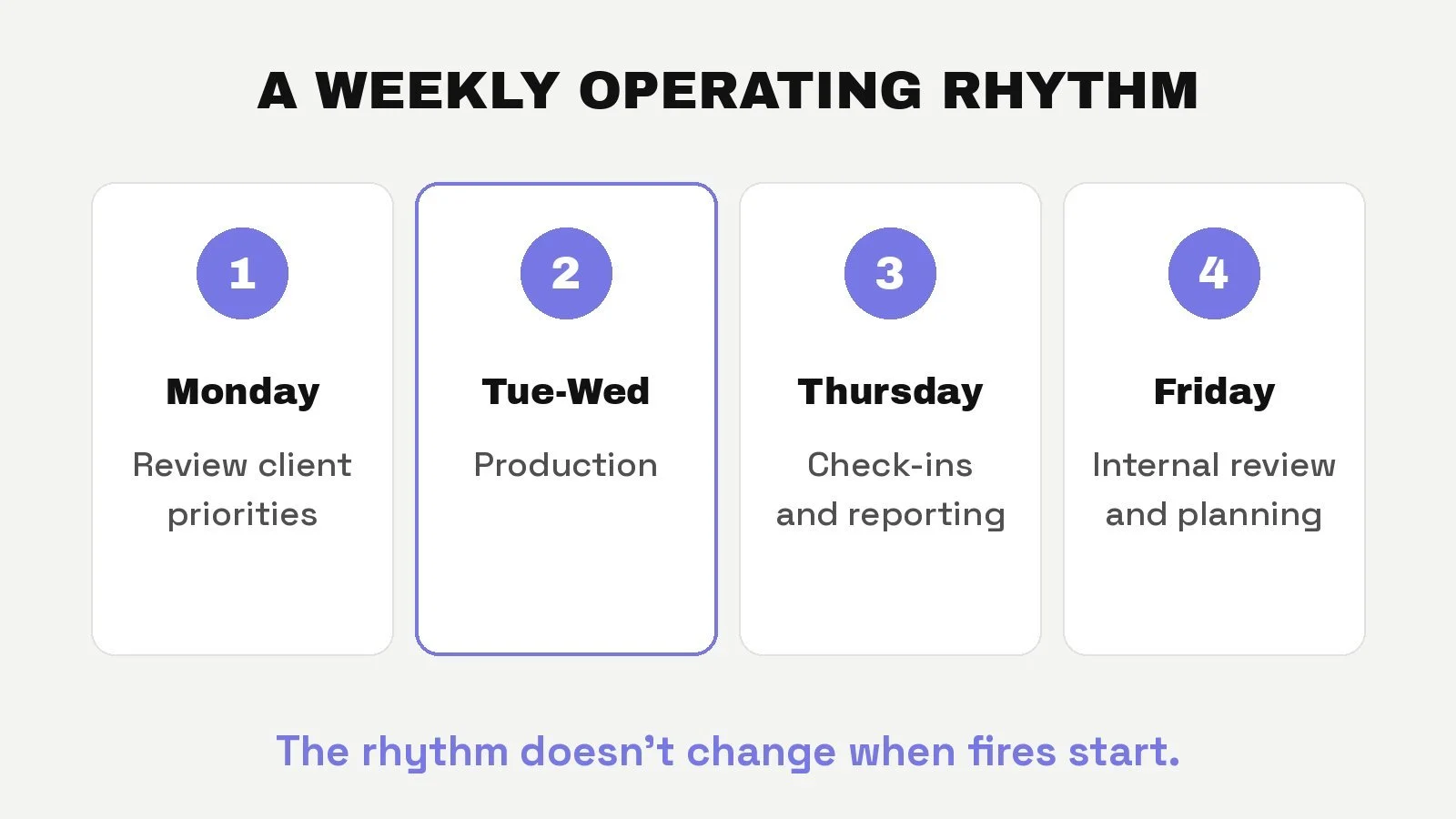
Monday: Delivery lead reviews client priorities
Tuesday–Wednesday: Production
Thursday: Project manager runs client check-ins and reporting
Friday: Internal review and planning for next week
Why Most Founders Still Fail at the Lean Model
They can't let go. They say they're stepping back, but they jump into every client question and review every deliverable. You have to let the work be slightly less perfect in the short term so the team can build the capability to reach your level.
The offer is unclear. If you can't say what you do and who you do it for in one sentence, clients can't refer you, your team can't deliver consistently and your outreach won't land. Start with The Agency Offer Rebuild.
They blame tactics instead of systems. New outreach tools, new services, new hires. You can't fix a system problem with a tactic. You only make the problem more expensive.
What This Looks Like in Real Agencies
Apex Leads grew from $15K to over $90K a month in 8 months. The founder went from 60+ hours a week in delivery to less than 10, and client retention rose from 30% to over 70%.
PN Digital scaled from $30K a month to over $200K a month in 8 months and closed its first $40K-a-month enterprise contract.
Spring Media grew from $10K to $150K a month over 24 months by evolving from an email agency into a full-stack eCommerce growth partner.
Still building toward your first clients? The Agency Launchpad shows the system that took a media buyer from employee to $30K a month in 4 months (Plateau PPC). For the acquisition seat, B2B agencies can use The GTM Business for LinkedIn pipeline, and Canadian agencies can add public-sector RFPs through The Deal Flow.
Watch the Full Video
How many employees does a $100K/month agency need?
With strong pricing and systems, about four core people: the founder as operator, a delivery lead, a project manager and someone who owns acquisition. They're supported by AI tools and specialist freelancers. The model assumes around 10 clients at $10K a month.
What is the best team structure for a small marketing agency?
Separate the roles. The founder owns strategy and growth, a delivery lead owns quality, a project manager owns timelines, client communication and reporting, and one person owns the pipeline. Every client communication goes through the project manager.
What profit margin should a lean agency target?
In the four-person model, at $100K a month in revenue, payroll and direct costs should sit around $40K to $50K, which leaves $50K to $60K in monthly gross profit. Your own numbers depend on pricing and delivery costs.
Who should an agency founder hire first?
Usually a strong delivery lead who can hold your quality standard without you, because that frees you to work on positioning, sales and systems. It should be an experienced hire, not a junior one.
Why do agencies with big teams often make less money?
They scale headcount before systems, and they're usually underpriced. Lower retainers mean more clients, more work and more hires, and every hire adds cost and management overhead without necessarily adding leverage.
Want help designing the team, pricing and operating system for your agency? Book a free strategy call or see how I work as an agency consultant.