

Ask most agency owners where their clients come from and you'll hear the same answer: "Referrals, mostly."
Referrals are great. They close fast, they trust you on day one, and they cost nothing. But they also come in waves. One month you're turning work away, the next a big client leaves and the pipeline is empty. You can't plan hires, you can't forecast revenue, and you can't grow on purpose.
This guide is for owners of digital, marketing and dev agencies in Canada and the US who want clients to show up on a schedule, not by luck. It covers the offer, the channels, the sales process and the weekly routine that keeps it all running.
Want a second set of eyes on your pipeline? Book a free strategy call and we'll map out which channels fit your agency.

Why Referrals Alone Stall Your Agency
Referrals aren't the problem. Depending on them is.
The pattern shows up on almost every consulting call we run. Delivery gets busy, so sales and marketing stop. Nobody notices, because the work is still coming from last quarter's referrals. A few months later, the pipeline dries up, and the agency is back to scrambling. Feast, then famine.
Two of our clients show what changes when you fix this:
PN Digital was an established SEO and PPC agency with great delivery that had grown on reputation and referrals and hit a ceiling. We launched multiple outbound channels: LinkedIn, cold email, automated follow-ups, and lead magnets repositioned toward enterprise-level trust. Over 8 months, they went from $30K a month to over $200K a month and closed their first $40K-a-month enterprise contract.
OU2there, a creative studio in Canada, was 100% dependent on referrals and repeat business, with no outbound, no funnel and no predictable pipeline. Within 3 months of building a real business development process, they closed their first big outbound deal: a $70,000 contract.
Neither stopped getting referrals. They just stopped relying on them.
Fix the Offer Before You Add Channels
Here's the uncomfortable truth: most agencies that say they have a lead problem actually have an offer problem.
If your website says "full-service digital agency," every new channel you open just puts that vague message in front of more people. More outreach won't fix it. A clearer offer will.
A strong agency offer has four parts:
A specific avatar. One type of client, not "businesses."
A painful, urgent problem. Something they want fixed this quarter.
A measurable outcome. Leads, booked jobs, pipeline, revenue.
Optional risk removal. A guarantee or performance terms. You need this less once you have strong case studies.
A service is a commodity; an offer is an outcome. "We do SEO" gets compared on price. "We help B2B SaaS companies turn organic search into demo requests" gets a meeting.
You can serve more than one type of client, as long as the offer stays the same and only the messaging changes for each audience. I go deeper on this in Your Offer Is the Problem, Not Your Lead Gen. If you're still at the very beginning, start with how to start a marketing agency.
The 6 Channels That Bring Agency Clients (Beyond Referrals)
Think of client acquisition as two branches:
Systems: outbound, content, funnels and RFPs. These run on a schedule and can be delegated.
Human business development: partnerships and events. These run on relationships.
The healthiest agencies run both. You don't need all six channels at once, though. Pick two, run them properly for 90 days, then add a third.
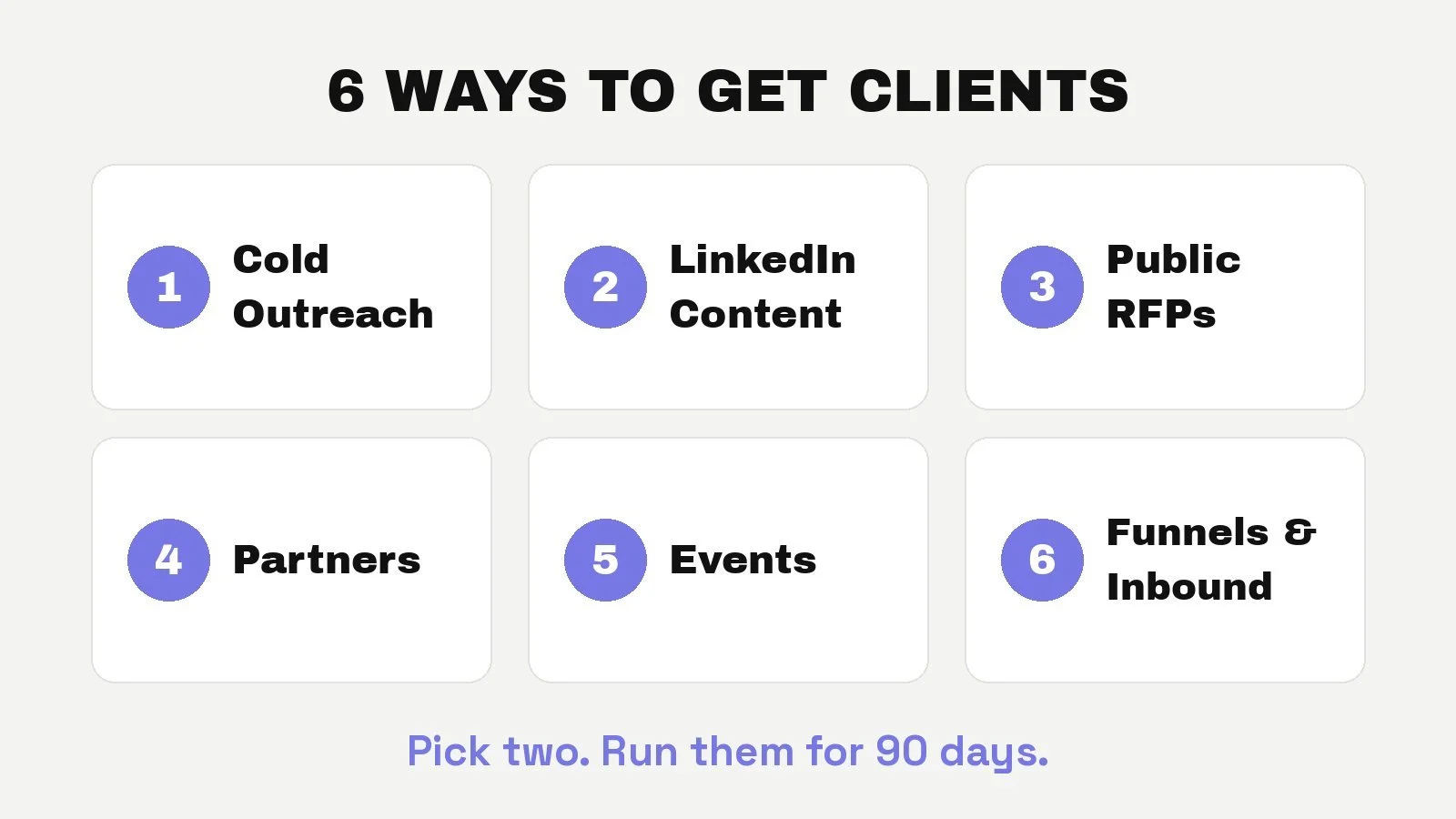
1. Cold outreach (email and LinkedIn)
Outbound is the fastest channel you fully control. Done right, it's personal, short and focused on one problem the prospect has.
Build your own target list. Pick accounts that match your avatar and research them. Don't buy or scrape lists. They're poorly targeted and wreck your sender reputation.
Follow the rules. In Canada, CASL generally requires consent for commercial email (implied consent can apply, for example when a business address is published publicly and your message is relevant to the person's role). In the US, CAN-SPAM requires accurate sender information, a working opt-out and a physical mailing address. Check the details with your lawyer.
Lead with relevance. Reference something real about their business, then ask one simple question. Not a pitch deck in the first message.
Treat it as volume with quality control. A few dozen messages a month won't fill a pipeline. A few hundred a month starts to. Keep each one tailored, and add a short video walkthrough or real results to stand out.
The full playbook is in our guide to cold outreach for agencies.
2. LinkedIn content and conversations
If you sell to B2B buyers, LinkedIn is where they show up under their real names, with job titles and business intent.
Post consistently. Several times a week at minimum. Daily text posts work well.
Connect, don't just follow. A connection opens the door to a conversation. A follow doesn't.
Follow up with people who engage. A like or comment from the right person is a signal. Open with that, not a pitch.
Respect LinkedIn's limits. Send a steady number of personalized connection requests within normal limits, not mass invites to loose job-title matches.
Content compounds. On The GTM Business, one client post reached 647 reactions and 195K impressions, which led to 181 new conversations, 9 meetings in 48 hours, and a $25K ARR contract signed 13 days after the first meeting. That doesn't happen every week. But it only happens to people who post every week.
For the full system (positioning, content, signals and conversations), read Agency Go-to-Market Strategy: How B2B Agencies Build Pipeline on LinkedIn.
3. Public RFPs (a big opening in Canada)
Most agencies ignore requests for proposals. That's a mistake. With an RFP, the buyer has already decided to spend money, set a timeline and told you how they'll pick a winner.
Read the mandatory requirements first. Insurance, past experience or local presence can disqualify you before you write a word.
Bid selectively. It's a volume game, but each bid takes real effort, so prioritize the ones that fit your offer and proof.
Track every date. Intent to bid, question deadline, addenda and submission.
If you're in Canada, The Deal Flow sends 5 to 10 live marketing RFPs every Monday, each with a deadline, a named decision-maker contact and a one-paragraph scope summary. Its site lists a $15K minimum and $76K average budget, and shares how a 4-person Toronto shop won a $145,000 brand and media RFP from a provincial health authority. Our step-by-step guide is How to Find and Win Marketing RFPs in Canada.
4. Partnerships
Partners are referrals you can actually plan for. Look for businesses that serve your ideal clients but don't compete with you: a dev shop that needs a paid media partner, a branding studio that doesn't do SEO, a platform's partner network.
Assemble bigger offers. Specialist partners let you act as a growth partner rather than a single-service vendor.
Make it someone's job. One founder we worked with made a partnership manager their first hire.
Go through the front door for enterprise. Large organizations have procurement processes and supplier reps. Approach them about partnership, and research the people you target.
5. Events and conferences
Conferences "never produce anything" when you show up without a plan. With one, they're some of the warmest conversations you'll get, because both sides are there to make deals.
Before: research sponsors, speakers and attendees. Message the most valuable people in advance to book time.
During: set a KPI, like valuable connections per hour. Give each team member targets too.
After: log each contact with their problem and a possible solution, then follow up the next morning with a specific next step.
6. Funnels and inbound
Inbound (SEO, lead magnets, webinars, a clear website) is the slowest channel to build and the best one to own. It also makes every other channel work better: a prospect who gets your cold email will check your site and content before replying.
Start simple: one page per core offer, a lead magnet that solves a small version of the client's problem, and a booking link on every page. Then add automated follow-ups for everyone who downloads or registers. Read how to build agency funnels for the full setup.
Not sure which two channels to start with? Book a call. We'll look at your offer, your market and your team, and tell you where we'd start.
Turn More Conversations Into Clients: Fix Your Sales
More leads won't help if they don't close. Most agency owners who think they have a lead problem actually have a sales problem. I walk through this in the video below. The warning signs: you're closing less than 30% of your sales calls, you discount when prospects push back, or you feel like you're convincing instead of leading.
Watch: Why Agency Owners Fail at Sales (And How to Fix It in 7 Days)
The three root causes are usually the same: you're uncomfortable selling, you don't have a framework (so every call is different and you can't see what's broken), and you're trying to convince instead of lead. Here's the 7-day fix from the video:
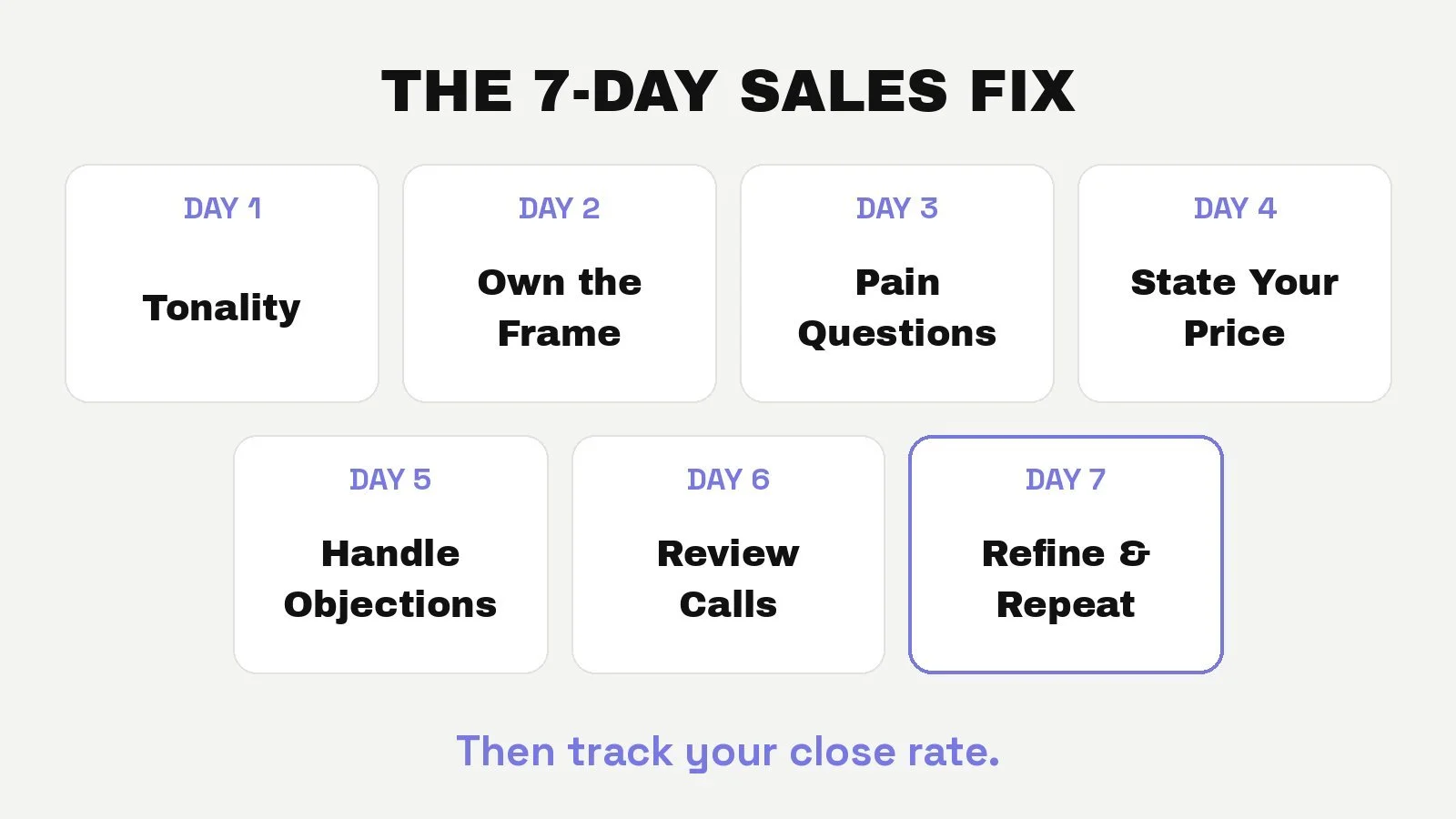
Day 1: Tonality and certainty
Record three sales calls and count every "um," "maybe" and "I think." Slow down, and swap "I think we could probably help" for "We can solve that."
Day 2: Own the frame
Set the agenda in the first 30 seconds: they tell you about their business, you tell them about yours, and you see if there's a fit. Use the same framework on every call.
Day 3: Ask questions that uncover real pain
Skip "What are your goals?" Ask:
What happens if you don't solve this in the next 6 months?
What have you tried before, and why didn't it work?
If we could solve this, what would that be worth to you?
Day 4: Deliver your price with confidence
"Based on what you've told me, the investment is $5,000 a month. Does that work for you?" Then stop talking. No justification, no apology.
Day 5: Handle objections
"I need to think about it" usually means "I don't trust you yet." Acknowledge it, clarify what they need to think about, isolate the real issue (price, timing, something else), then ask for the decision.
Day 6: Review your calls
The step most people skip. Listen to at least three calls: where did you lose control, sound unsure or get caught off guard?
Day 7: Refine and repeat
Run it all on your next five calls and track your close rate. Sales improves with reps.
Two more habits from our consulting calls help deals close faster. First, collect small agreements: summarize their problem and ask, "Does that resonate?" before you present anything. Second, make your proposal answer "what's included" in plain terms, with fees and exact deliverables listed, so prospects who say yes don't stall on scope.
Build a Weekly Client-Getting Routine
Channels don't fail because they don't work. They fail because the owner stops running them the moment client work gets busy. The fix is to treat your own agency like a client.
Time-block your growth work. Put prospecting, content and follow-ups on the calendar before client work claims the hours. Review each week where your time actually went.
Set a weekly sales minimum. One example target is one closed deal a week. If you're behind, go create conversations through past contacts, referrals, your CRM and events.
Track a few numbers every day: messages or proposals sent, new replies (not existing threads) and calls booked. Note the date whenever you change your message, so you can see what worked.
Delegate the repeatable parts. Hand list-building, proposal sending and outreach to a team member, and keep yourself on strategy and closing.
Here's a simple way to read your numbers:
Replies to outreach is low: fix targeting and the first line of your message.
Calls booked from replies is low: fix your offer and your call to action.
Close rate on calls is low: fix your sales process (see the 7-day fix).
Clients staying past 90 days is low: fix delivery and reporting.
Once you have a routine that consistently brings in clients, the next challenge is delivering for them without becoming the bottleneck. That's what How to Scale a Marketing Agency to $100K/Month covers.
Common Mistakes When Getting Agency Clients
Opening channels before fixing the offer. A vague offer just reaches more people who say no.
Trying every channel at once. Two channels run well beat six run badly.
Judging too early. Plan for 60 to 90 days before deciding a channel doesn't work.
Buying or scraping lists. It's poorly targeted, it damages your domain and accounts, and it can break anti-spam laws.
Stopping outreach when you get busy. That's how the feast-or-famine cycle starts.
Discounting to win. Price resistance is usually a value or trust problem, not a price problem.
DIY or Get Help?
You can run all of this yourself, and plenty of founders do at first. The tradeoff is time. If you'd rather have parts of it done for you:
The GTM Business installs and runs a full LinkedIn pipeline for B2B founders: profile positioning, five ghostwritten posts a week, a signal engine that scores leads, and a US-based SDR whose one job is booking qualified calls.
The Deal Flow delivers live Canadian marketing RFPs every Monday, from $115 CAD a month, with an option to have the proposal written for you.
Working with us directly. If you want help building the whole engine (offer, channels, sales process and the team to run it), see how we work as an agency growth consultant.
FAQ
How do I get clients for my marketing agency without referrals?
Pick two channels you control, usually cold outreach and LinkedIn content, and run them consistently for 90 days. Add public RFPs, partnerships, events and inbound funnels over time. Fix your offer first so every channel has a clear message.
What is the fastest way to get clients for a new marketing agency?
Start with your existing network, then personalized outreach to one specific niche. Your first clients usually come from people who already know you and from direct conversations, not from ads or SEO.
How many outreach messages should an agency send?
A few dozen a month won't fill a pipeline. A few hundred a month starts to. Keep every message tailored to the prospect, and track the new replies and calls booked so you can improve the message.
Is cold email legal for agencies in Canada and the US?
Yes, if you follow the rules. In Canada, CASL generally requires express or implied consent, plus clear identification and an unsubscribe option. In the US, CAN-SPAM requires accurate sender details, an opt-out and a mailing address. Check your process with a lawyer.
Why am I getting sales calls but not closing clients?
Usually it's the sales process, not the leads. Common causes are no call framework, weak discovery questions, apologizing for your price and unhandled objections. If you close under 30% of calls, work on sales before adding more leads.
Ready to Get Clients on a Schedule?
Referrals got you here. A client engine gets you to the next stage. If you want help choosing the right channels, fixing your offer and building a sales process that closes, let's talk.
Book a free strategy call and we'll map out your next 90 days of client acquisition.