

ChatGPT Ads let businesses show clearly labelled ads next to ChatGPT conversations on the Free and Go plans. For agencies, the opportunity is twofold: advertise your own offer to people describing the exact problem you solve, and sell a measured ChatGPT Ads pilot to clients. The platform is still in beta, so the agencies that win will be the ones with a sharp offer, sound unit economics and honest reporting, not the ones that promise early benchmarks.
Every new ad platform follows the same pattern. Early on, attention is cheap and competition is thin. Then the platform fills up, costs rise, and only the businesses with strong offers keep making money. Google rewarded advertisers who understood search intent. Facebook rewarded advertisers who understood social behaviour and creative. ChatGPT rewards something else: the ability to diagnose a problem better than a general answer can.
Our team has coached 700+ agencies in Canada, the US and Europe. Our firm BlueLock Consulting worked with Shopify's Plus team and was later acquired by Centro. This guide covers what ChatGPT Ads actually offers as of November 2026, what it costs to test, how to write ads that fit a conversation, and how to package it as a service without overpromising.
What ChatGPT Ads Are (as of November 2026)
OpenAI started showing ads in ChatGPT in early 2026. After a pilot from February through April, it opened self-serve access through Ads Manager Beta. On October 21, 2026, OpenAI said more than 100,000 advertisers had run campaigns, that ChatGPT Ads was available in 89 countries, and that more than 1.2 billion people use ChatGPT each week (OpenAI announcement). In November, OpenAI added Target CPA and Target CPC bidding from November 9 (OpenAI Help Center) and, on November 12, named a local reseller for advertisers in 44 markets (OpenAI).
Here are the facts that matter for agency owners, taken from OpenAI's announcement and its Ads Help Center.
| Question | What OpenAI says (November 2026) |
|---|---|
| Who sees ads? | Users on the Free and Go plans. Plus, Pro, Business, Enterprise and Edu accounts stay ad-free. |
| Where can you buy? | Self-serve Ads Manager Beta is available to advertisers based in 89 countries, including Canada, the US, the UK and most of Europe. You can also buy through OpenAI's Ads team, agency or technology partners and, since November 12, 2026, a local reseller (Aleph) in 44 markets. |
| Minimum budget | $25 USD a day for US-dollar accounts; 25 CAD, €15 or £15 a day in those currencies. |
| Objectives | Views (billed per 1,000 impressions), Clicks (billed per click) and Conversions (optimized toward a conversion event but billed per click or per 1,000 impressions, never per conversion). |
| Bidding | Intelligent bidding (formerly Maximize Results), or, since November 9, 2026, Target CPA for conversion campaigns and Target CPC for click campaigns. Targets are average-cost goals, not caps or guaranteed prices. Legacy Max Bid and Max CPC retire for existing campaigns on January 1, 2027. |
| Formats | Single image, or multi-image (4 to 6 square images) in open beta since October 26, 2026. Ads appear below a ChatGPT response, and OpenAI is also testing a multi-image ad format shown while ChatGPT generates an image. |
| Creative enhancements | On by default for self-serve campaigns since October 30, 2026. OpenAI may rewrite headlines and descriptions, translate ad text, resize images and change the destination URL, without a preview of each version. You can opt out per account or per campaign under Manage settings. |
| Targeting | Countries, plus states, cities, markets or postal codes for most campaigns (new product-feed campaigns are country-level only). Five platforms: iOS app, iOS web, Android app, Android web and desktop web. Custom audiences can be included (at least 25,000 matched users) or excluded. Ads personalization is currently unavailable in the EEA and Switzerland. |
| How ads are matched | Conversational intent, your ad, landing page, context hints and targeting and, when the user has ads personalization on, select signals from their broader ChatGPT use. |
| Privacy | Conversations stay private from advertisers, and OpenAI does not sell user data. Ads are labelled and do not influence ChatGPT's answers. |
| Where ads don't run | Not shown to accounts identified or predicted to be under 18, and not near sensitive topics such as health, mental health and politics. Political ads are not currently allowed. |
| Benchmarks | None yet. OpenAI says results depend on objective, creative, landing page and relevance. |
Three details catch many first-time advertisers. New self-serve accounts may only be able to advertise in their home country at first. Landing pages must not block OpenAI's crawlers (OAI-AdsBot and OAI-SearchBot), so check your client's robots.txt before launch. And because creative enhancements are on by default, decide campaign by campaign whether to keep them: switch them off where copy, prices or legal wording must appear exactly as approved.
Why Conversational Intent Changes the Game
On Google, someone types a few words and you guess what they mean. On Meta, you infer interest from behaviour. In ChatGPT, people often explain their situation in full sentences: what they have tried, what is not working and what they are deciding between.
That changes what a good ad looks like. Compare these:
- Search query: "agency growth consultant"
- Conversation: "I've been trying to scale my agency for seven months. I'm stuck around $15K a month and I don't know if I need more leads or better people."
The second is a declared problem. An ad that reflects that problem back with precision feels like help. A generic ad next to it feels like noise, especially because the user just got a detailed answer from ChatGPT itself.
Be careful how you describe this to clients. Advertisers do not see the conversation, and you cannot target individual chats. What you control is the clarity of your offer, the range of problems your ads speak to and the landing page that follows. OpenAI's own guidance says ads with clear, specific, benefit-focused copy are more likely to be relevant.
Is Your Agency Ready? Fix the Economics First
Most agencies will not lose money on ChatGPT Ads because the platform fails. They will lose money because their offer and margins cannot support paid acquisition on any platform.
Start with your allowable cost per client: the most you can spend to win one client and still make the margin you need. For example, if an average client is worth $25,000 in gross profit over the relationship and you are comfortable spending $4,000 to win one, $4,000 is your ceiling across ads, sales time and onboarding. As long as you acquire clients below that number, spend becomes a lever instead of a fixed budget. It is also the number to keep in mind if you later set a Target CPA in ChatGPT Ads, which OpenAI describes as an average goal, not a maximum.
Now look at the other side. An agency charging $5,000 a month and spending $3,000 a month on delivery has little room to pay for acquisition. If that agency jumps into a new ad platform, it usually burns cash and blames the channel.
| Check | Ready | Not ready yet |
|---|---|---|
| Offer | Specific outcome for a specific buyer | "Full-service digital marketing" |
| Margins | Room to pay for acquisition and still profit | Delivery eats most of the retainer |
| Allowable cost | Known and written down | Unknown; you set a monthly cap instead |
| Proof | Published case studies with real numbers | Logos and adjectives |
| Sales follow-up | Fast response and a clear call path | Leads wait days for a reply |
If you are in the right-hand column, fix that first. Our posts on offer design, why your offer is the problem, not your lead gen and how to price agency services are the place to start. If you want a second pair of eyes on your numbers, our agency consultant team works through offer, pricing and acquisition with owners every week.
Book a call to check your offer and unit economics
The Four-Part Ad Framework for ChatGPT
The fundamentals of a working ad have not changed in years. What ChatGPT changes is how unforgiving it is when one part is weak. We use four parts.
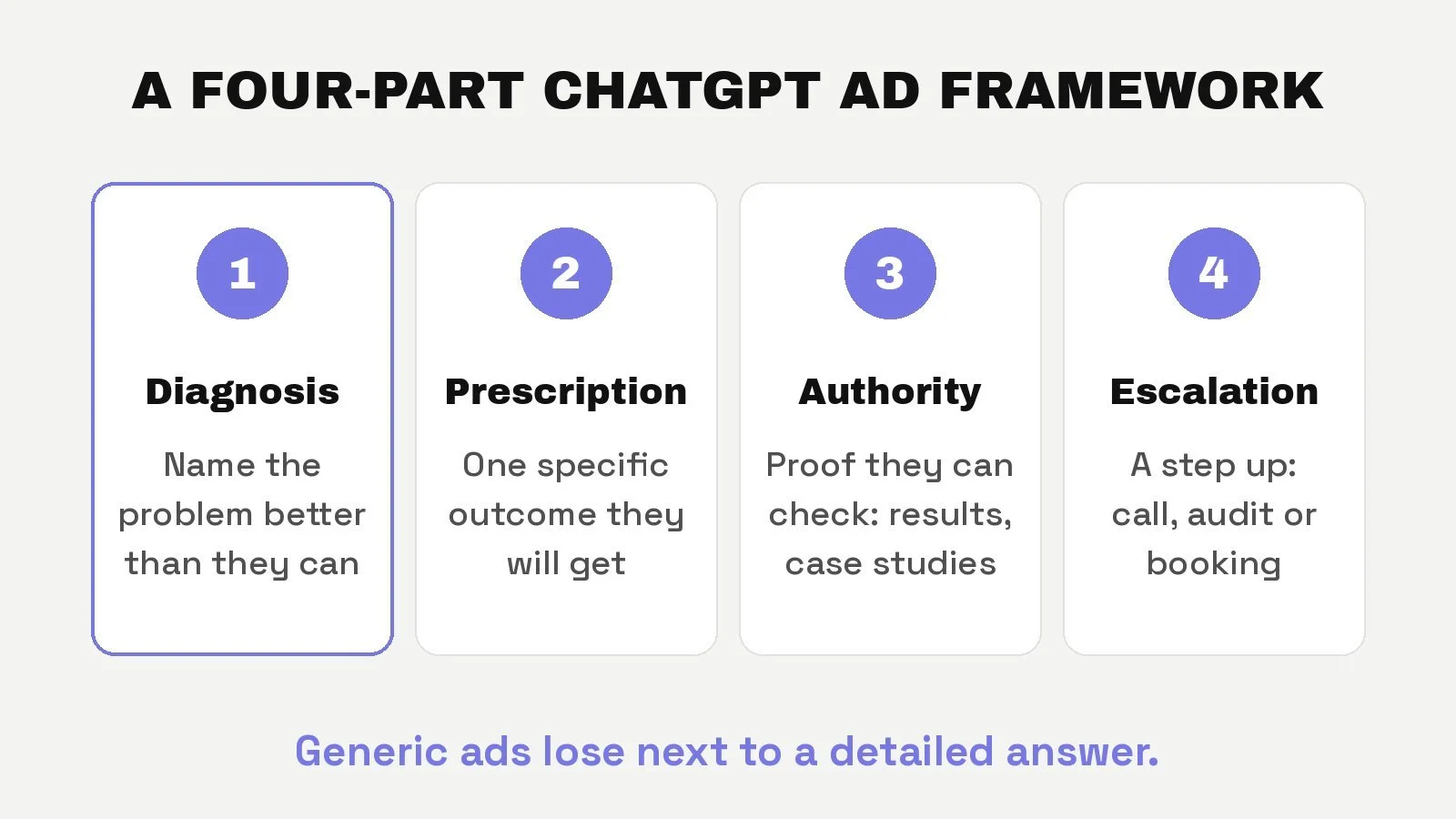
1. Diagnosis
Name the problem more precisely than the reader would. Not "struggling to grow?" but "Everything still runs through you, even with a team." You are not selling yet. You are proving you understand.
2. Prescription
State what they get, in one line. "We build outbound systems that book qualified meetings for B2B agencies." Specific beats clever. If your ad sounds like the general answer ChatGPT just gave, there is no reason to click.
3. Authority
Give a reason to trust you fast: a published result, a number of clients served, a credential, or a named case study. ChatGPT is already trusted. Your brand is not yet, so you have to earn it in a line or two, and every claim must be true and checkable on the landing page.
4. Escalation
The call to action is a step up, not an exit. The person is leaving a helpful conversation, so the next step has to be more valuable: a call with someone who has solved this exact problem, a tool or audit built for their situation, or a simple booking, quote or waitlist. Send each ad to the most relevant page, not the homepage.
Here is how that can look for an agency that sells outbound to B2B companies:
| Part | Example |
|---|---|
| Title | Outbound not booking meetings? |
| Description | Usually it's targeting, message or no system. We build outbound that books qualified B2B calls. |
| Landing page | A page that explains the three failure points, shows a published case study and offers a 20-minute diagnostic call. |
Write several distinct angles per offer. OpenAI recommends a high volume of varied ads, each with a different angle, so the system can find more conversations where one fits.
Two Ways Agencies Make Money From ChatGPT Ads
Advertise your own agency
If you sell to business owners, many of them already ask ChatGPT about hiring, pricing, sales and growth. Build one ad group per problem you solve, with a landing page for each. Lead with diagnosis, back it with a published case study and send people to a booking page.
Sell ChatGPT Ads as a service
Your clients will ask about this, if they have not already. The honest pitch is a pilot, not a promise:
- A paid setup and test phase. Scope it like paid discovery: account setup, conversion tracking, ad groups by problem, landing page fixes and a fixed test window. Credit it toward ongoing management if the test earns a second phase. Our pricing guide covers how to structure this.
- A management fee that doesn't depend on spend. At the minimum daily budget of $25, a month of spend is roughly $750. A percentage of that will not cover your time.
- Clear exclusions. Health, mental health and political clients may not be eligible, so check the policies before you sell.
- A decision date. Agree up front what result would justify scaling, what would justify stopping, and when you will decide. Put all four in writing; our guide to writing a marketing agency proposal shows how to lay out scope, timeline and success criteria.
Performance-based deals can work here too, but only when you control enough of the funnel. In our published Millennial Marketing case study, repositioning from standard retainers to performance funnels with a share of sales led to a $150K deal, the largest in the agency's history (case study).
Book a call to package a ChatGPT Ads pilot
A 30-Day ChatGPT Ads Pilot Plan
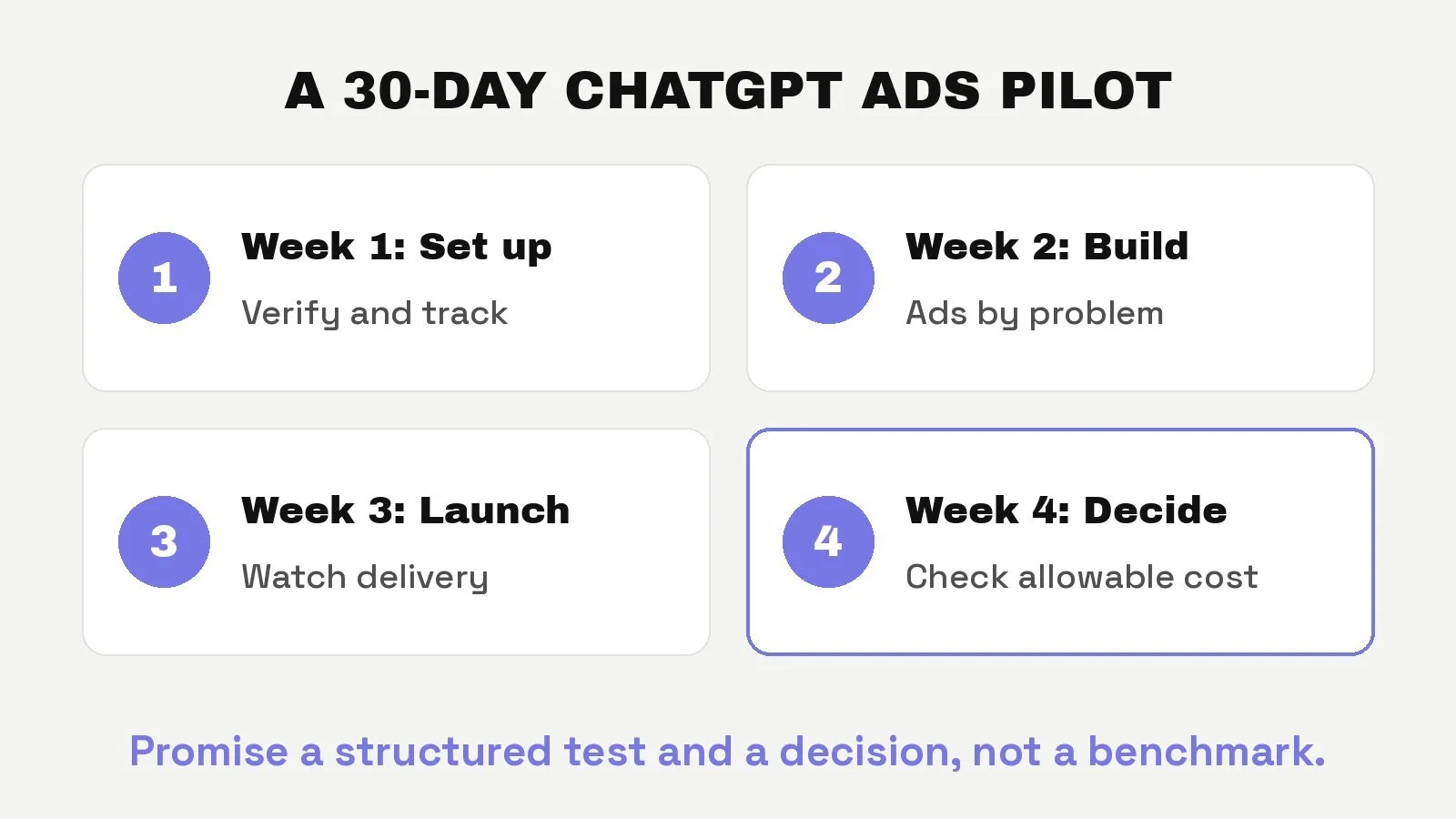
Week 1: Set up and verify. Create the Ads Manager account in the client's own name, complete verification and billing, and confirm the country the account can advertise in. Install conversion measurement, add UTM tags to every destination URL and check that robots.txt does not block OAI-AdsBot or OAI-SearchBot. Set the creative enhancements preference for the account and the campaign, and record it for the client.
Week 2: Build ads by problem. Split ad groups by the problems the client solves, not by keyword. Write at least five distinct title and description angles per ad group using diagnosis, prescription, authority and escalation. Match each ad to a specific landing page.
Week 3: Launch and watch delivery. Start at a budget the client can afford to learn with. OpenAI notes that daily spend can reach twice the daily budget on some days but will not exceed seven times it over a Sunday-to-Saturday week. Expect delivery to fluctuate during the beta. Start with Intelligent bidding until real conversion data comes in; OpenAI warns that a Target CPA or Target CPC set below recent performance may restrict delivery. Fix rejected ads and landing pages quickly.
Week 4: Read and decide. Compare cost per lead or sale against the client's allowable cost. Look at which problems and angles drew responses. Decide to scale, adjust or stop, and write down why.
How to Report ChatGPT Ads to Clients
There are no industry benchmarks yet, so your report cannot say "you beat the average." It has to explain what happened and what to do next. We use the same structure we teach for all client reporting: observation, insight, direction.
- Observation: spend, impressions, clicks, conversions and cost per conversion, next to the client's allowable cost.
- Insight: which problems and angles earned clicks and which landing pages converted, and why you think so.
- Direction: the one or two changes you will make next, and what result would trigger scaling.
Our guide to agency client reporting goes deeper on making reports that clients actually read, and our post on agency KPIs covers the numbers to track for your own agency.
Mistakes to Avoid
- Treating it like keyword search. Writing ten versions of the same keyword-stuffed headline misses how matching works.
- Promising benchmarks. OpenAI says there are none yet. Promise a structured test and a decision, not a cost per lead. A Target CPA is a goal for the system, not a guarantee you can pass on to a client.
- Sending every ad to the homepage. Link to the page that answers the problem in the ad.
- Ignoring policy fit. Some categories and topics are excluded. Check before you sell the service.
- Making claims you can't prove. Every number in an ad should be backed on the landing page. No invented reviews or results.
- Leaving leads waiting. Someone who just described their problem in detail expects a fast, relevant reply.
What Real Agencies Show About New Channels
New channels reward specialists. In our published Plateau PPC case study, a former media buyer launched a Google Ads agency focused on fintech and AI companies and reached $30K/month within four months (case study). The niche did the heavy lifting: a specific buyer, a specific problem and a specific promise. That is exactly what a ChatGPT ad needs.
The same lesson shows up across our case studies: agencies that grow fastest know who they serve, what result they sell and what a client is worth before they spend on acquisition. If you are still deciding on a niche, read how narrow focus drives agency growth. For the bigger picture on AI and agencies, see AI in agencies: from hype to real business impact.
Book a free call to map your 30-day pilot
Frequently Asked Questions
What are ChatGPT Ads?
ChatGPT Ads are clearly labelled ads shown alongside conversations to users on ChatGPT's Free and Go plans. Plus, Pro, Business, Enterprise and Edu accounts are ad-free. OpenAI says ads do not influence ChatGPT's answers and advertisers do not see users' conversations.
How much does it cost to advertise on ChatGPT?
You set your own budget in Ads Manager Beta. The minimum daily budget is $25 USD for US-dollar accounts, 25 CAD for Canadian-dollar accounts, and €15 or £15 for euro and sterling accounts. At the US minimum, a 30-day test is roughly $750 in media spend before any agency fees. You can let Intelligent bidding manage bids or set an average Target CPA or Target CPC; neither is a guaranteed price.
Can agencies run ChatGPT Ads for clients?
Yes. Self-serve Ads Manager Beta is available to advertisers in 89 countries, including Canada, the US, the UK and most of Europe, and OpenAI also works with agency and technology partners and, in 44 markets, a local reseller. Set the account up in the client's name, agree on a fixed test window and report against the client's allowable cost per sale.
Who can't advertise on ChatGPT?
Political advertising is not currently allowed, and ads do not appear near sensitive topics such as health, mental health and politics or to users identified or predicted to be under 18. Advertisers must also be based in a supported country to use self-serve. Check OpenAI's ads policies for your client's category before you sell a pilot.
How are ChatGPT Ads targeted?
Ads are matched to conversational intent and, when a user has ads personalization on, to select signals from their broader ChatGPT use. You choose countries (and, for most campaigns, states, cities, markets or postal codes), platforms, custom audiences, objectives and budgets, but you cannot target individual conversations. Ads personalization is currently unavailable in the EEA and Switzerland. Writing many distinct, specific ads per offer gives the system more chances to match.
Are ChatGPT Ads worth it for a small agency?
They can be, if your offer is specific, your margins can pay for acquisition and you know your allowable cost per client. If your offer is generic or delivery eats most of each retainer, fix that first. A new ad platform will expose those problems faster, not solve them.
Get Help Turning ChatGPT Ads Into Clients
ChatGPT Ads is the first major ad platform built around people explaining their problems in their own words. That favours agencies that can diagnose, prescribe and prove, and it punishes generic offers. A new channel only turns into clients when the offer, the economics and the follow-up are ready for it.
Our team has coached 700+ agencies in Canada, the US and Europe on offer, pricing and acquisition. There are two ways we can help:
- Marketing agency coaching: for owners who want to sharpen their offer, know their allowable cost per client and build an acquisition system they can run themselves, ChatGPT Ads included.
- Agency consulting: for agencies that want our team to work through the numbers with them and decide whether a ChatGPT Ads test, for the agency or for its clients, is worth running now.
Next steps: book a free strategy call to talk through your offer and a 30-day pilot, or send us a message if you would rather start in writing.