

An agency exit strategy is the work you do, usually one to two years before any sale, to make the business transferable: clean financials, recurring revenue, no single client carrying the firm, documented delivery and a team that sells and serves clients without the founder. Buyers pay for earnings they believe will continue after you leave. Everything in this guide is about making that belief easy.
Most agency owners think about selling only when they are tired, when a buyer calls out of the blue, or when a bad quarter makes them want out. That is the worst time to start. A rushed sale usually means a lower price, a longer earnout, or a deal that falls apart in diligence because the business still lives in the founder's head.
Our team has coached 700+ agencies in Canada, the US and Europe. Our firm BlueLock Consulting worked with Shopify's Plus team and was later acquired by Centro, so we have seen a sale from the inside as well as from the advisory side. The lesson is simple. The things that make an agency sellable are the same things that make it easier to run: predictable revenue, clear offers, systems, and a team that can deliver without you.
Even if you never sell, build as if you might. This guide expands Part 7 of the agency business guide into a full plan.
Why Most Agencies Are Hard to Sell
A buyer is not buying your logo or your portfolio. They are buying future cash flow and the risk that comes with it. The more of that cash flow depends on things that walk out the door with the founder, the less the business is worth, or the more of the price gets pushed into conditions.
The common problems we see when owners first ask about selling:
- The founder is the agency. They own the client relationships, close every deal, approve every deliverable and fix every fire. Remove them and nothing works.
- Revenue is lumpy. Project work comes and goes, so last year's profit is hard to project forward.
- One or two clients carry the firm. A buyer sees the largest account and immediately asks what happens if it leaves.
- The books are messy. Personal expenses run through the business, revenue recognition is inconsistent, and nobody can explain margin by client or by service.
- Nothing is written down. Onboarding, delivery, QA and reporting depend on who happens to be doing them.
None of these are unusual. Most are fixable. They just take time, which is why the exit strategy starts long before the exit.
What Buyers Look at in Due Diligence
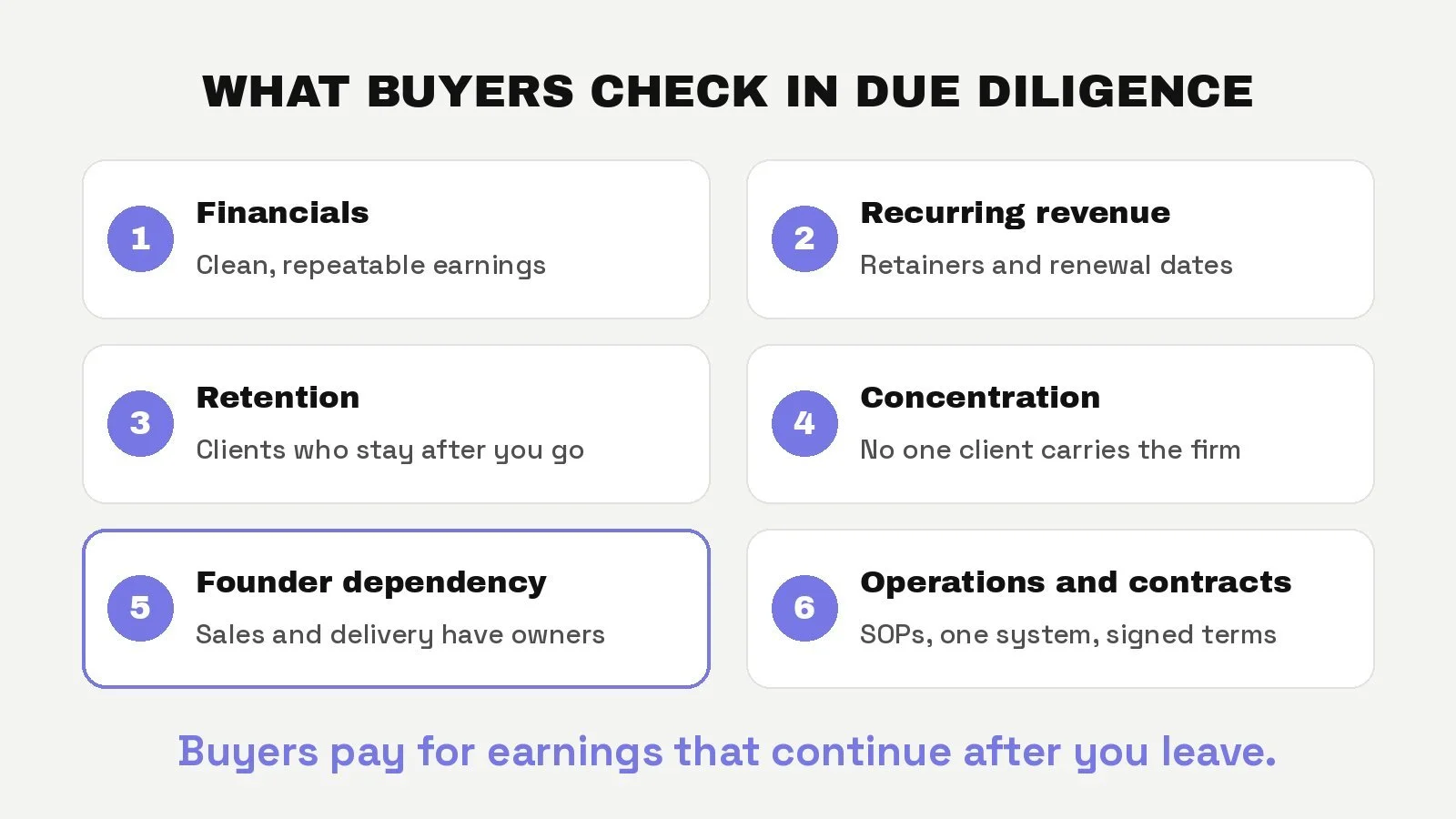
Every buyer has a different checklist, but the questions repeat. If you can answer these cleanly, you are ahead of most sellers.
| Area | What the buyer asks | What "ready" looks like |
|---|---|---|
| Financials | Are the earnings real and repeatable? | Clean, consistent books for at least the last two to three years, with owner add-backs listed and explained |
| Recurring revenue | How much of next year's revenue is already contracted? | A clear split of retainer vs project revenue, contract terms and renewal dates |
| Retention | Do clients stay after they sign? | Logo and revenue retention tracked monthly, with reasons for every loss |
| Client concentration | What happens if the largest client leaves? | No single account large enough to sink the business; the largest client's share shown and trending down |
| Founder dependency | Can the business sell and deliver without you? | Named owners for sales, delivery and client relationships; the founder out of day-to-day delivery |
| Operations | Is the way work gets done documented? | SOPs for onboarding, delivery, QA and reporting; one project management system |
| Team | Will the key people stay? | Written agreements, clear roles, and no one person holding all the client knowledge |
| Contracts and IP | Are agreements assignable and current? | Signed client contracts, contractor agreements with IP assignment, no handshake deals |
Most of these map directly to the six business numbers in our agency KPIs scorecard: average client value, retention, client concentration, pipeline coverage, delivery capacity and margin. If you already review that scorecard monthly, you are building diligence evidence every month without extra work.
Book a call to review your exit readiness
How Agencies Are Valued (Without the Hype)
You will see plenty of claims online about what agencies "sell for." We do not publish a single number, because the honest answer depends on the size of the business, the quality of the earnings, the buyer, the deal structure and the market at the time.
What we can tell you is how the conversation usually works:
- Smaller agencies are often priced on seller's discretionary earnings: profit plus the owner's salary and genuine one-off or personal expenses added back. The buyer is often an owner-operator, so they care about what the business pays the person running it.
- Larger agencies are usually priced on adjusted EBITDA: earnings before interest, tax, depreciation and amortization, after normalizing the owner's pay to a market salary. Buyers here are often other agencies, holding companies or private equity-backed platforms.
- The multiple moves with risk. Recurring revenue, strong retention, low concentration, documented operations and a leadership team that stays all push the number up. Founder dependence, lumpy project revenue and messy books push it down.
The practical takeaway: you raise the value of your agency less by negotiating hard at the end and more by removing risk in the two years before.
The Five Levers That Raise Your Agency's Value
1. Recurring revenue you can show
A buyer can underwrite a retainer book far more easily than a stream of one-off projects. That does not mean you need to drop projects. It means packaging work so clients have a reason to stay after the build: ongoing optimization, support, reporting, or a second phase. Our guide on how to price agency services covers retainers, scoped projects and contract length.
2. Retention and a clean client base
Retention is the number that tells a buyer whether revenue will survive the handover. In the published Apex Leads case study, client retention moved from around 30% to over 70% after onboarding, reporting and account management were rebuilt. For the operating habits behind that, read why agencies fail at retention and how to fix it.
3. Lower client concentration
If one account is a large share of revenue, spread the risk before you go to market: raise average client value across a wider base, lengthen other contracts and win a few more accounts at your current minimum. Orizon is a useful example of building a broader, process-driven book. It moved from referral-based, founder-dependent deals to a six-stage enterprise sales process and grew from $2M to $5.3M in annual revenue in 12 months. Deals now close without the founder in every room, which is exactly what a buyer wants to see.
4. A business that runs without the founder
This is usually the biggest lever and the slowest to pull. A buyer wants to see that sales, delivery and client relationships each have an owner who is not you. In the Apex Leads case study, the founder went from more than 60 hours a week in delivery to under 10, while revenue and retention rose. That shift is exactly what makes an agency transferable. Start with the agency bottleneck and time management for agency owners to get your own hours under control.
5. Documented operations and proof
Systems and proof are assets a buyer can inherit. Write SOPs for onboarding, delivery, QA and reporting, keep one project management system, and turn your best results into case studies. In the published AgilizeIQ case study, standardized onboarding, SOPs and operational playbooks scaled project management capacity 4X in 90 days, and new PMs were delivering within two to three weeks. That is the kind of evidence that shows a buyer the business does not depend on one person's memory. See agency project management for the SOPs to write first.
The 24-Month Exit-Readiness Plan
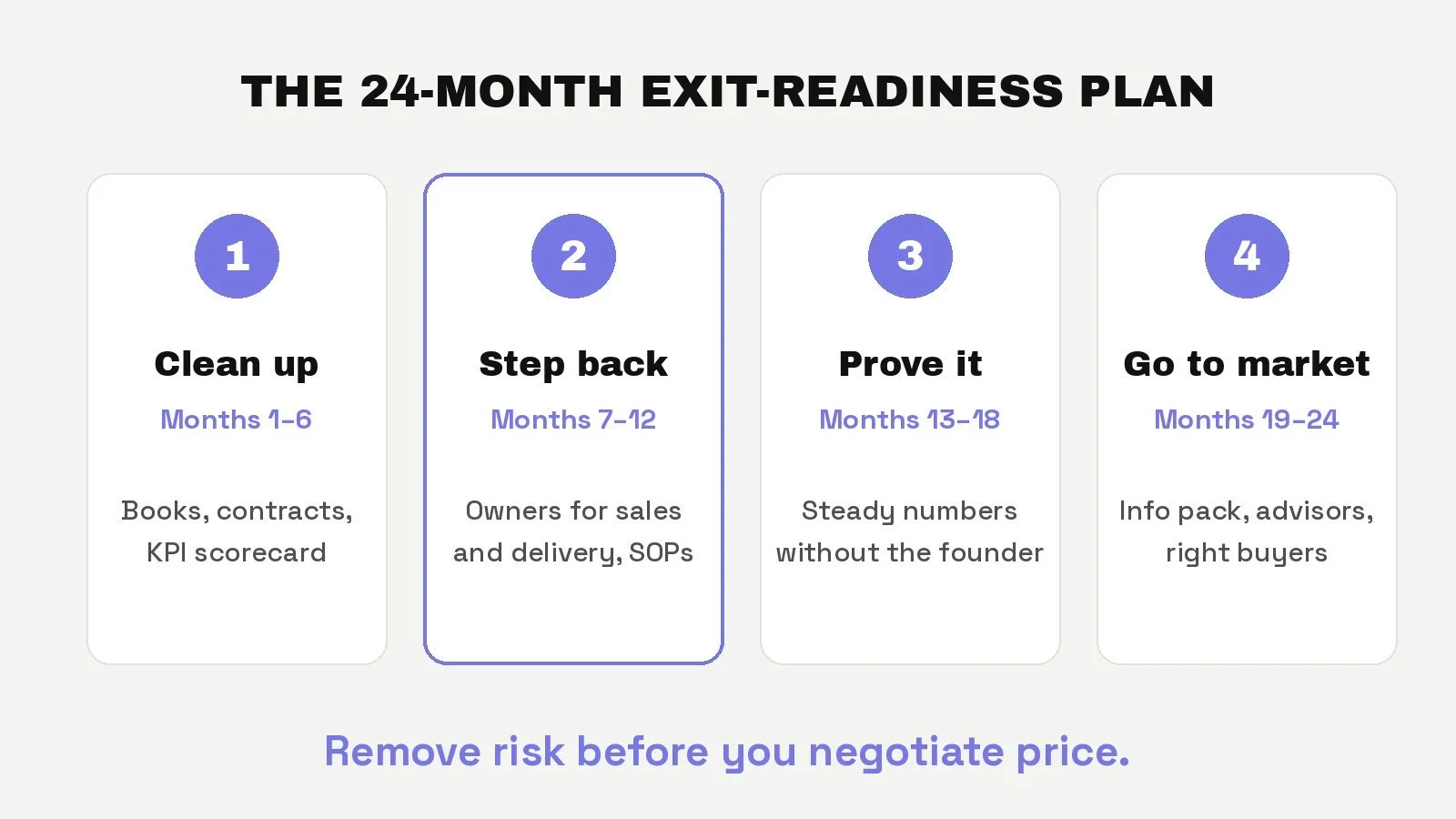
You can sell faster than this, but two years gives you enough time to change the numbers a buyer will look at, then show a track record of the new numbers. Use this as a planning frame, not a fixed rule.
| Phase | Months | Focus | Evidence you are building |
|---|---|---|---|
| 1. Clean up | 1–6 | Separate personal and business spending, tidy contracts, set up monthly financials and the KPI scorecard | Clean monthly books; signed contracts for every client and contractor |
| 2. Step back | 7–12 | Hire or promote owners for delivery and sales; move client relationships to account leads; document SOPs | Founder hours in delivery falling; named owners on the org chart |
| 3. Prove it | 13–18 | Grow recurring revenue, lift retention, reduce concentration, protect margin | Two or more quarters of steady numbers without the founder in delivery |
| 4. Go to market | 19–24 | Prepare the information pack, choose advisors, talk to the right buyers | Data room ready; clear story for why the business keeps growing after you |
Set agency OKRs for each phase so the work has owners and deadlines, not just good intentions.
Book a call to map your 24-month plan
What a Sellable Agency Looked Like in Practice
The published Ricochet case study is the clearest example on our site. The founder of a design-led studio was doing everything: delivery, outreach and client communication, with no positioning beyond "we do design." Over the engagement, our team sharpened positioning around high-velocity startups and premium DTC brands, built an outbound and LinkedIn funnel, installed pipeline tracking, helped hire and train delivery partners so the founder could step out of fulfillment, documented all processes and built case-study decks that added value for buyers. The studio posted 500% monthly revenue growth in three months, and we then advised through negotiations and due diligence leading to a sale to a larger agency.
Blue Collar Marketing shows the same principle from a different starting point. The agency had a large contractor client base but was only breaking even, with high costs and overlapping roles. We made the team leaner, grouped clients into pods with dedicated project managers, rebuilt delivery with paid discovery and formal QA, and rebuilt sales. The agency grew 50% from March to November 2026, moved from breakeven to, in the founder's words, "extremely profitable," and is now worth more than when we started.
Neither story starts with "find a buyer." Both start with fixing how the business runs.
Deal Structures You Should Understand
You do not need to be a dealmaker, but you should know the terms before a buyer uses them on you.
- Asset sale vs share sale. In an asset sale the buyer purchases the business's assets and contracts; in a share (or stock) sale they buy the company itself. The tax and liability outcomes are very different for each side, especially across Canada, the US and Europe.
- Cash at close. The part of the price paid on the day the deal closes.
- Earnout. Part of the price paid later if the business hits agreed targets. Earnouts are common when revenue depends on the founder or on a few clients. The less risk a buyer sees, the less of the price you should need to leave in an earnout.
- Seller financing (vendor take-back). You lend the buyer part of the price and get repaid over time.
- Equity rollover. You keep a stake in the combined business, common when selling to a larger agency or a platform.
- Transition period. How long you stay after closing and in what role. Expect a buyer to ask for one; the cleaner your handover, the shorter it can be.
Bring in an accountant and a lawyer who do agency or professional-services deals early, ideally during phase 1. Tax rules differ by country and change often, and the structure can matter as much as the headline price.
Book a call to pressure-test your sale plan
Common Exit Mistakes
Starting when you are burned out. Buyers can see a tired founder, and it weakens your negotiating position. Plan the exit while the business is growing.
Treating the sale as a sales pitch. A good story helps, but diligence will test every claim against the books, the contracts and the KPI history.
Hiding concentration or churn. It always comes out. Show it early with a plan to fix it.
Keeping every client relationship personal. If clients only know the founder, the buyer is buying a risk, not a book of business.
Ignoring the team. Key staff who learn about a sale late, or who have no reason to stay, can derail a deal.
Using vague contracts. Handshake agreements with clients and contractors without IP assignment are a diligence red flag.
Watch: Building an Agency Buyers Want
Watch: How I Built a $1M/Month Agency (Step-by-Step Blueprint). The exit section covers clean books, clean operations and a defined offer as the basis of valuation, and why you should build as if you will sell even if you never do.
Frequently Asked Questions
When should I start planning my agency exit strategy?
Ideally one to two years before you want to sell, and in practice as soon as the agency has a stable team. That gives you time to clean up the books, step out of delivery and show a track record of steady numbers. Starting earlier costs nothing, because the same work makes the agency easier to run.
How are marketing agencies valued?
Smaller agencies are often priced on seller's discretionary earnings, larger ones on adjusted EBITDA, with a multiple that rises or falls with risk. Recurring revenue, strong retention, low client concentration, documented operations and a team that runs without the founder push value up. We do not quote a single multiple because it varies by size, buyer and market.
What do buyers look for when buying a digital agency?
Clean financials, recurring revenue, solid retention, no single client carrying the business, a team that can sell and deliver without the founder, documented processes, and signed contracts with clients and contractors. Most of this shows up in a monthly KPI scorecard, which is why we recommend reviewing one long before any sale.
Can I sell my agency if I still do most of the client work?
You can, but expect a lower price, a longer transition or more of the price tied to an earnout, because the buyer is taking on the risk that clients leave when you do. The better route is to move delivery and relationships to named owners first. In the published Apex Leads case study, the founder went from more than 60 hours a week in delivery to under 10.
What is an earnout in an agency sale?
An earnout is part of the purchase price paid after closing, if the business hits agreed targets such as revenue or profit. It is common when the buyer sees risk in founder dependence or a few large clients. Reducing those risks before you sell is the most reliable way to get more of the price at close.
Should I hire a broker or M&A advisor to sell my agency?
For most owners, yes, along with an accountant and a lawyer who know agency deals. They help you prepare the numbers, find the right buyers and negotiate terms. They cannot fix an agency that depends on the founder, though. That work is yours, and it is what our agency consulting team helps owners with in the months before a sale.
An agency you can sell is an agency that runs without you: recurring revenue, clients who stay, no single account carrying the firm, documented delivery and a team with real ownership. Build that and you have options, whether you sell, bring in a partner, or simply step back and keep the cash flow.
If you want a second set of eyes on how sellable your agency is today, book your free strategy call. Our team will walk through your numbers and map the first 90 days of your exit-readiness plan.
Get Help Making Your Agency Sellable
Most owners do this work with outside help. Our marketing agency coaching helps you step out of delivery and build the team and systems buyers check, and our agency consultant work goes deeper on pricing, retention and the numbers before a sale.
Next step: book a free strategy call on our calendar, or send us a message and our team will reply.