

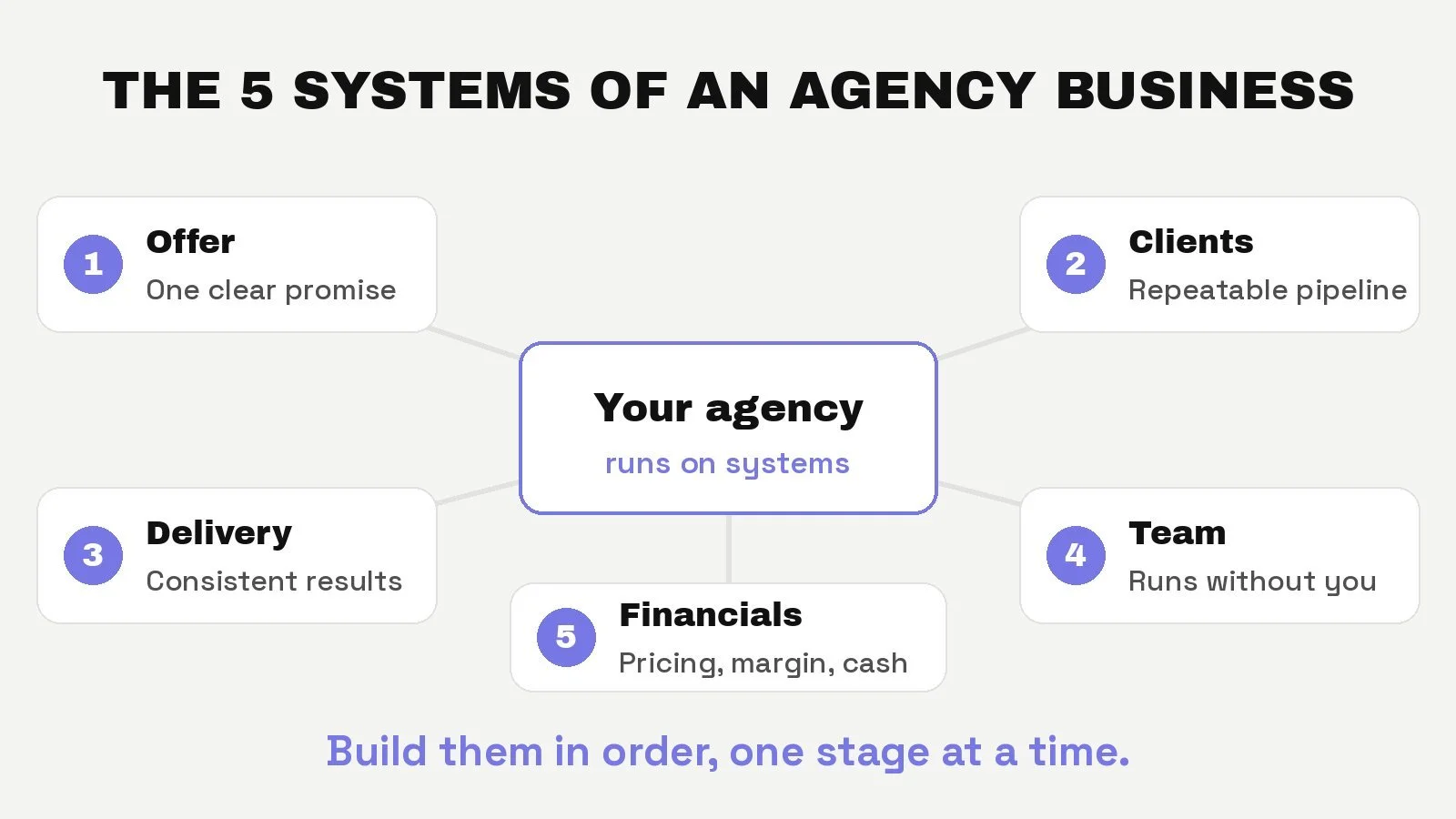
The agency business is selling expert services, such as marketing, design or development, to other companies, delivered by a team instead of by one person. A healthy agency has five systems: a clear offer, a predictable way to win clients, consistent delivery, a team that runs without the founder, and sound financials. Scaling means building those systems in the right order.
Starting an agency is easy. You can register a company, build a website and land a first client in a few weeks. Building one that grows past the founder, pays you well and could one day be sold is much harder. Most agencies stall because the business was built on hustle, not systems.
Our team has coached 700+ agencies in Canada, the US and Europe, from solo freelancers to firms doing $100K+ a month. This guide is the map we use with them. It covers what the agency business actually is, the five growth stages, and the playbook for each part of the business: the offer, sales, delivery, team, scaling and exit. Every section links to a deeper guide, so use this page as your starting point and come back to it as you grow.
What the Agency Business Is (and How Agencies Make Money)
An agency sells outcomes to clients and delivers them through people, processes and tools. That sounds obvious, but it explains most of the problems owners bring to us. If the outcome is vague, sales are slow. If delivery depends on the founder, growth stops when the founder's calendar is full. If pricing is tied to hours, revenue is capped by headcount.
Most digital agencies earn money through one or more of these models:
| Model | How it works | Best for | Watch out for |
|---|---|---|---|
| Monthly retainer | A fixed fee for an ongoing scope | SEO, paid media, content, social | Scope creep without a written "what's included" |
| Fixed-scope project | A set price for a defined deliverable | Websites, brand identity, builds | Lumpy cash flow between projects |
| Tiered ad-spend fee | Management fee rises with monthly ad spend | Paid media agencies | Tiers that don't keep pace with account growth |
| Performance or hybrid | A base fee plus a bonus tied to results | Lead gen, ecommerce growth | Results you can't fully control |
| Paid discovery | A paid strategy phase before a large engagement | Enterprise and complex work | Quoting a full package before you understand the problem |
| White-label | You deliver for another agency, or a partner delivers for you | Adding services without hiring | Losing control of scope and quality |
There's no single right model. What matters is that your price is tied to the value of the outcome, not to the hours you spend. Our guide on how to price agency services covers retainers, tiered ad-spend fees and performance deals in detail, and white-label agency partnerships explains how to add services without losing control.
The 5 Stages of an Agency Business
Agencies tend to break at the same points. Knowing your stage tells you which problem to solve next and, just as important, which problems to ignore for now.
| Stage | Monthly revenue | The main job | The usual bottleneck |
|---|---|---|---|
| 1. Launch | $0 to $10K | Package one skill into one offer and win first clients | No clear offer; trying to sell everything |
| 2. Traction | $10K to $30K | Replace referrals with a repeatable way to win clients | The founder does sales and delivery |
| 3. The plateau | Around $30K | Hand off delivery and project management | Everything runs through the founder |
| 4. Growth | $30K to $100K | Build a lean team, cascading goals and bigger deals | No management layer or operating rhythm |
| 5. Scale and exit | $100K+ | Enterprise sales, leadership team, a sellable business | The business still depends on the founder |
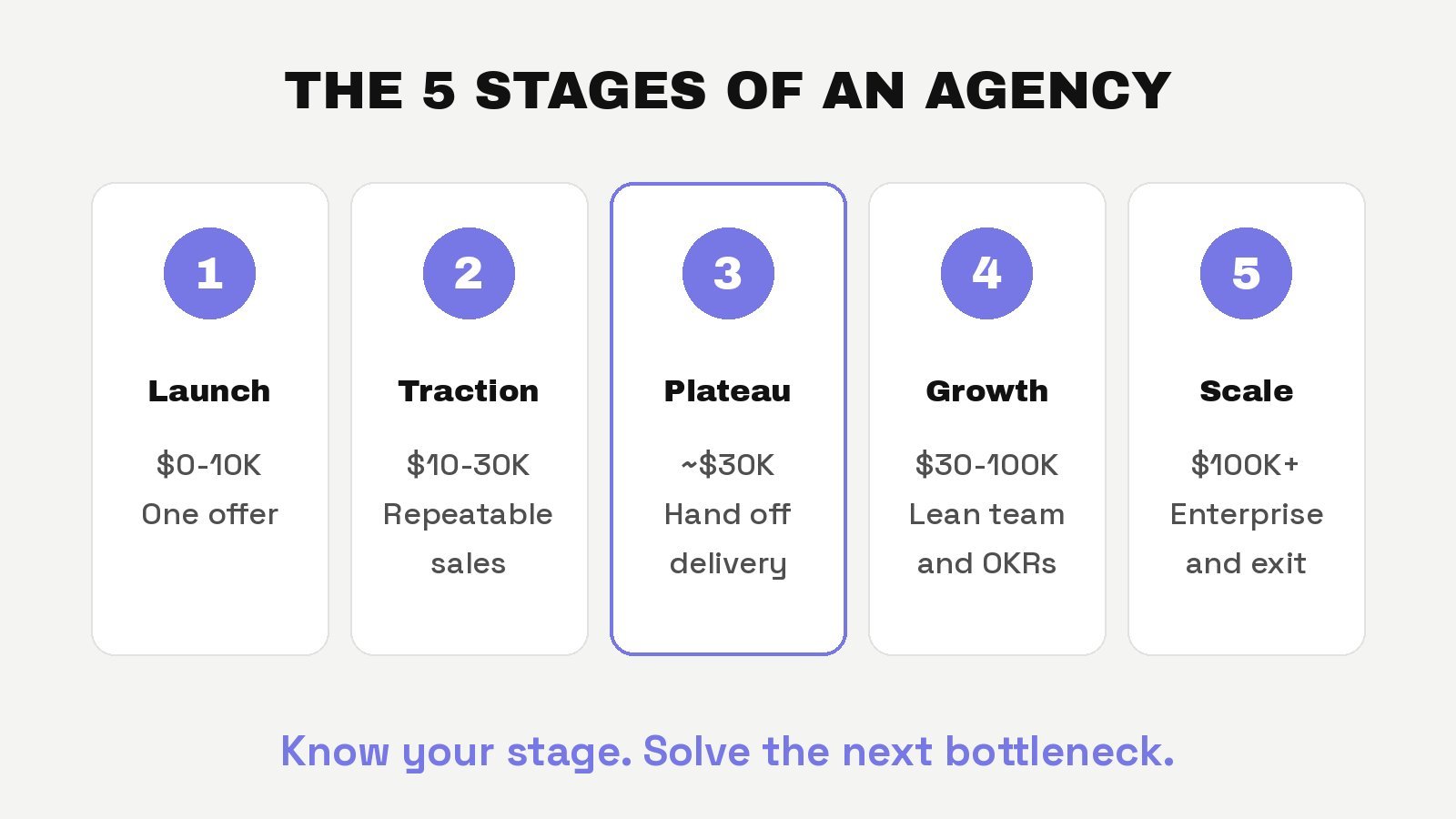
These ranges are guides, not rules. A two-person studio selling $50K projects will hit them differently from a paid-media shop on $3K retainers. The bottlenecks, though, are remarkably consistent. If you're stuck, read why most agencies plateau at $30K/month first.
Part 1: Start the Agency on the Right Foundation
The best agencies start with a skill someone is already paying for. You don't need to learn a new service. You need to package the one you have.
Start with one skill and one buyer. Our guide on how to start a marketing agency walks through the first offer, first clients and the first $30K a month.
Plan the exit from your job. If you're employed today, leaving your job to start an agency shows how one media buyer did it. In the published Plateau PPC case study, the agency went from $0 to over $30K a month in recurring revenue within four months. Read the Plateau PPC case study.
Think like an owner from day one. The skills that make you a great freelancer are not the ones that build an agency. See from freelancer to agency owner.
Niche once you have data. Don't niche down at zero clients. Go broad enough to get paid, then narrow to the clients who pay the most and get the best results. Our post on niche specialization explains when and how.
Part 2: Build an Offer Clients Want to Buy
Most agencies list services like a restaurant menu: SEO, PPC, social, email, websites. That makes you a vendor competing on price. An offer is different. It's a clear promise to a specific buyer, tied to a result they care about.
A strong agency offer has four parts:
A specific client. Who you serve, by industry, size or situation.
A painful, urgent problem that client already knows they have.
A measurable outcome, such as qualified leads, revenue or launch speed.
Optional risk removal, like performance terms. Once you have strong case studies, you need it less.
When owners tell us lead gen is broken, the offer is often the real problem. Start with your offer is the problem, not your lead gen, then rebuild it with our agency offer design framework.
The offer has to show up clearly in your proposals too. Prospects ask "what's included?" and many agencies can't answer cleanly. List the fees, the exact deliverables and the cadence. Our guide on how to write a marketing agency proposal has a structure you can reuse.
The payoff is real. In the published Höski case study, a Canadian branding studio was stuck around $15K a month across too many industries. After repositioning around the verticals where it had momentum and packaging its work into clear offers, Höski grew from $15K to $50K a month in 4 months. Millennial Marketing repositioned its offer and closed its first $150K deal.
Part 3: Win Clients Without Relying on Referrals
Referrals are great until they stop. Every agency past the launch stage needs at least one repeatable way to start new conversations. Lead generation has two branches, and the strongest agencies run both:
Systems: outbound email and LinkedIn, content, funnels and ads.
People: networking, partners, events and referrals you actively ask for.
Pick one or two channels and run them consistently before adding more. Track what you send, the new responses you get and the calls you book, so you can see what actually works.
Here's where to go deeper:
How to get clients for your marketing agency: the full acquisition playbook beyond referrals.
Agency cold outreach: outbound that doesn't feel like spam.
Agency go-to-market strategy on LinkedIn: building a B2B pipeline where buyers show up under their real names and job titles.
Funnels for agencies: which funnel you need and how to build it.
How to find and win marketing RFPs in Canada: a bid/no-bid approach to public contracts.
How to land enterprise clients as a small agency: bigger deals without faking size.
The best digital agency conferences in 2026: where to meet partners and buyers in person.
Our published case studies show what a real system does. OU2there went from relying on friends-of-friends to closing its first $70,000 outbound deal within 3 months. Orizon, a digital product studio, grew from $2M to $5.3M in annual revenue in 12 months with a 6-stage enterprise sales process, and its average deal size more than doubled.
Not sure which channel fits your agency? Our team can review your pipeline with you.
Part 4: Deliver Work Clients Stay For
Winning a client is expensive. Losing one after 60 days is worse. Most churn doesn't come from poor results. It comes from clients who feel uninformed and can't see the value.
Report on value, not activity. A good client report covers what happened, why it happened and what you'll do next. See agency client reporting.
Design retention into onboarding. Set expectations early, communicate proactively and make the wins visible. Read why agencies fail at retention, and how to fix it.
Use partners for gaps. If you deliver through a partner, white-label the project manager along with the specialist so scope and timelines stay under control. Our white-label partnerships guide covers it.
Retention compounds. In the published Apex Leads case study, clearer onboarding, structured reporting and proactive account management lifted client retention from 30% to over 70%, while Apex Leads grew from $15K to over $90K a month in 8 months.
Part 5: Build a Team and Operations That Run Without You
The test is simple: if you disappeared for two weeks, what would break? Whatever breaks is the real size of your business. Our post on building a scalable agency without becoming the bottleneck goes deeper on that test.
A few principles hold at almost every stage:
Hire a project manager early. A common milestone is around $10K a month in recurring revenue. A healthy PM spends roughly 70% of their time on client work and 30% on internal work.
Stay lean. You don't need a big team to build a $100K-a-month agency. See agency team structure: a $100K/month agency with 4 people.
Document before you hire. Most gaps are process gaps, not people gaps. Write the SOPs, then hire people to run them.
Set goals that cascade. Agency goals should feed lead gen, sales, project management and delivery goals. Our guide to agency OKRs shows how.
Vet remote hires carefully. Check identity, references and access, especially for developers. Read that developer you hired for $25 an hour before your next contractor hire.
Use AI where it adds leverage. AI helps most with research, first drafts, creative iteration and prospecting. People still win on judgment and relationships. See AI in agencies: from hype to real business impact.
Operations is where growth either holds or leaks. In the published AgilizeIQ case study, an operational consulting firm was winning enterprise contracts but couldn't deliver at scale. With new senior PMs, standardized onboarding and SOPs, AgilizeIQ scaled its project management capacity 4X in 90 days.
Part 6: Scale Past the Plateau
Most agencies plateau somewhere between $20K and $30K a month. It's rarely a revenue problem. It's a system problem: the founder is still the engine behind every sale and the safety net for delivery.
Ask yourself one question: can this business double its revenue without doubling your time? If the answer is no, that's your ceiling, and no funnel hack will fix it.
Scaling from there comes down to a few moves:
Raise prices and deal size. Ten clients at $10K a month is a better business than twenty at $5K.
Get out of delivery so you can focus on sales, partnerships and strategy.
Focus. One core client type, one core offer, one growth priority per quarter.
Build a management layer with clear roles, an operating rhythm and goals that cascade.
Sell bigger deals with an enterprise sales process.
Read how to scale a marketing agency to $100K/month for the full playbook, and the harsh truth about running an agency for the mindset side.
Two published examples of what scaling looks like: PN Digital, a UK SEO agency, grew from $30K to over $200K a month in recurring revenue over 8 months, including its first $40K-a-month enterprise contract. Spring Media grew from $10K to $150K a month over 24 months by moving to larger growth retainers.
If you're stuck between $20K and $50K a month, this is the work our programs are built for.
Part 7: Build an Agency You Could Sell
Even if you never plan to sell, building a sellable agency makes it a better business. Buyers look for the same things that make an agency easier to run: recurring revenue, documented processes, a team that delivers without the founder, and a strong portfolio of case studies.
Start preparing early:
Document every process so knowledge lives in systems, not in your head.
Build proof: case study decks and results that add to the agency's value.
Reduce founder dependence in sales and delivery.
Protect the business with clear contracts and careful partner and client vetting. For a cautionary story, read the rise and fall of Burke Decor.
In the published Ricochet case study, a design studio stuck around $5K a month moved from hourly work to fixed-scope projects, hired and trained delivery partners, and documented its processes. Ricochet grew from about $5K to $30K a month within 5 months and was then acquired by a larger agency.
Results From Agencies We've Advised
These numbers all come from our published case studies:
| Agency | Result | Timeframe | Main lever |
|---|---|---|---|
| Plateau PPC | $0 to $30K+/month | 4 months | Packaged an existing skill into one offer |
| Ravon | $0 to $35K+/month | 5 months | Pricing, deal structure and delegation |
| Ricochet | About $5K to $30K/month, then acquired | Within 5 months | Fixed-scope offers and delivery partners |
| Höski | $15K to $50K/month | 4 months | Vertical positioning and a clean funnel |
| Apex Leads | $15K to $90K+/month | 8 months | Structure, onboarding and retention |
| PN Digital | $30K to $200K+/month | 8 months | Enterprise positioning and sales system |
| Spring Media | $10K to $150K/month | 24 months | Larger growth retainers |
| Orizon | $2M to $5.3M/year | 12 months | 6-stage enterprise sales process |
| AgilizeIQ | 4X PM capacity | 90 days | PM hiring, SOPs and delivery model |
See all of them on our case studies page.
Who We Are
The Agency Business is a growth consulting firm for owners of digital marketing and development agencies in Canada, the US and Europe. Our team has coached 700+ agencies. Our founder, Damiano Raveenthiran, founded Startup Slang, an AI-first Shopify agency, in 2017, sold it and bought it back in 2026. Our firm BlueLock Consulting worked with Shopify's Plus team and was acquired by Centro.
We give you strategy, frameworks and ongoing support, and your team executes. Compare our programs by revenue stage on our services page.
Watch the Full Video
In this video, Damiano shares lessons from years of building agencies: be great at one thing and delegate the rest, run your company like a team with clear standards, and focus on one client type, one offer and one priority at a time.
Frequently Asked Questions
What is an agency business?
An agency business sells expert services, such as marketing, design, development or media buying, to other companies and delivers them through a team, processes and tools rather than one person's time. Most digital agencies earn revenue through monthly retainers, fixed-scope projects, ad-spend-based fees or performance deals.
Is an agency a good business to start in 2026?
It can be, because startup costs are low and you can begin with a skill you already have. The challenge is building systems so the agency doesn't depend on you for every sale and every deliverable. Start with one skill, one buyer and one clear offer, then add structure as you grow.
How do digital agencies make money?
Most combine a few models: monthly retainers for ongoing work, fixed-scope projects for builds, tiered management fees based on ad spend, performance bonuses tied to results, and paid discovery for complex work. The most important rule is to price the outcome, not your hours.
Why do most agencies get stuck around $30K a month?
Usually because the founder is still the engine behind sales and the safety net for delivery. Lead generation, sales, project management and delivery were never turned into systems. The fix is to hand off delivery, hire a project manager, build a repeatable acquisition channel and raise deal size.
How many people does an agency need to reach $100K a month?
Fewer than most owners think. With strong pricing, a focused offer, AI and specialist freelancers, a lean core team of about four people (operator, delivery lead, project manager and acquisition) can support a $100K-a-month agency. Underpricing is what forces agencies to hire too many people.
When should an agency owner hire a consultant or coach?
When you're stuck at the same revenue for several months, when you're the bottleneck in sales or delivery, or before a big move like going after enterprise clients or preparing to sell. A good consultant should give you frameworks, accountability and an outside view your team can execute on.
Ready to build the next stage of your agency? Our team will help you find your biggest bottleneck and map the next 90 days.