

Most agencies start as one talented person with more work than they can handle. The waitlist grows, the hours grow, and the income stops growing. You can't take on more clients because every client needs you.
That's the point where many freelancers call themselves an agency. They have a logo, a website and maybe a contractor or two. But everything still runs through them: the sales calls, the delivery, the project management, the invoices and the follow-ups. It isn't an agency yet. It's a very demanding job.
Across 700+ agencies coached in Canada, the US and Europe, our team has seen the same pattern: the skills that make you a great freelancer are not the skills that build an agency. This guide covers how the two mindsets differ, how to audit where your time goes, what your role should become, how to make your first hires and which systems let the agency run without you.
Freelancer vs Agency Owner: What Actually Changes
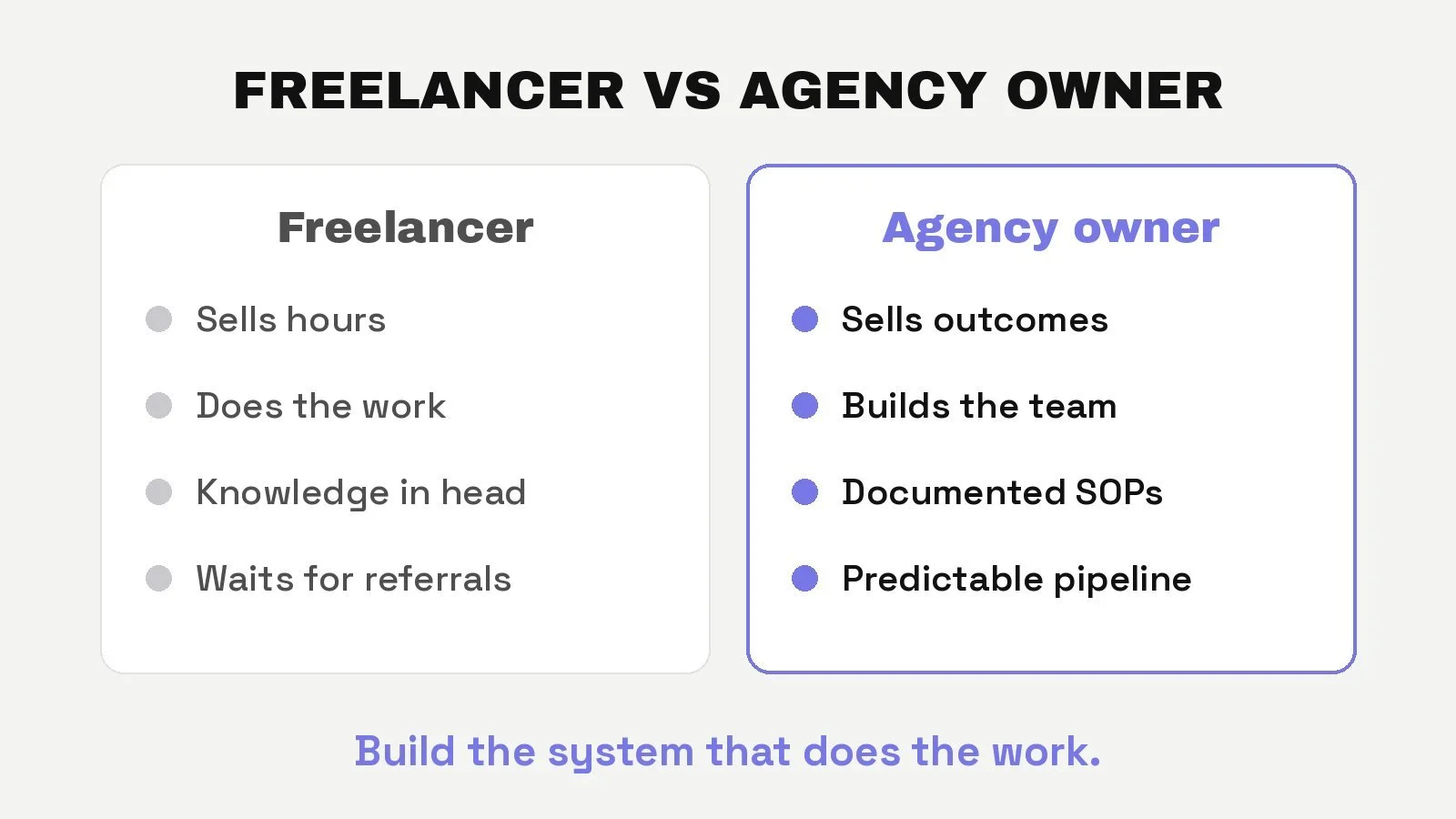
A freelancer sells their own time and skill. An agency owner builds a business that delivers results through a team and systems. The work may look the same from the outside, but the decisions are different:
| Freelancer mindset | Agency owner mindset | |
|---|---|---|
| What you sell | Your hours | An outcome, delivered by a team |
| Where your time goes | Doing the work | Sales, team, systems and cash flow |
| Pricing | Hourly or day rates | Fixed-scope packages and retainers |
| Hiring | "I'll do it myself, it's faster" | Hire before it feels comfortable |
| Knowledge | In your head | Documented in SOPs and frameworks |
| New clients | Referrals when they come | A predictable acquisition system |
| Quality | Perfect, because you did it | Consistent, because the system does it |
The most expensive sentence in a freelancer's vocabulary is "I'll just do it myself, it's faster." It is faster today. But every time you say it, you don't build capacity, you don't train anyone, and you stay the ceiling on your own revenue.
There's a simple test: if you disappeared for two weeks, what would break? Whatever breaks is the real size of your business. Our article on the agency bottleneck goes deeper on that test.
Step 1: Audit Where Your Time Actually Goes
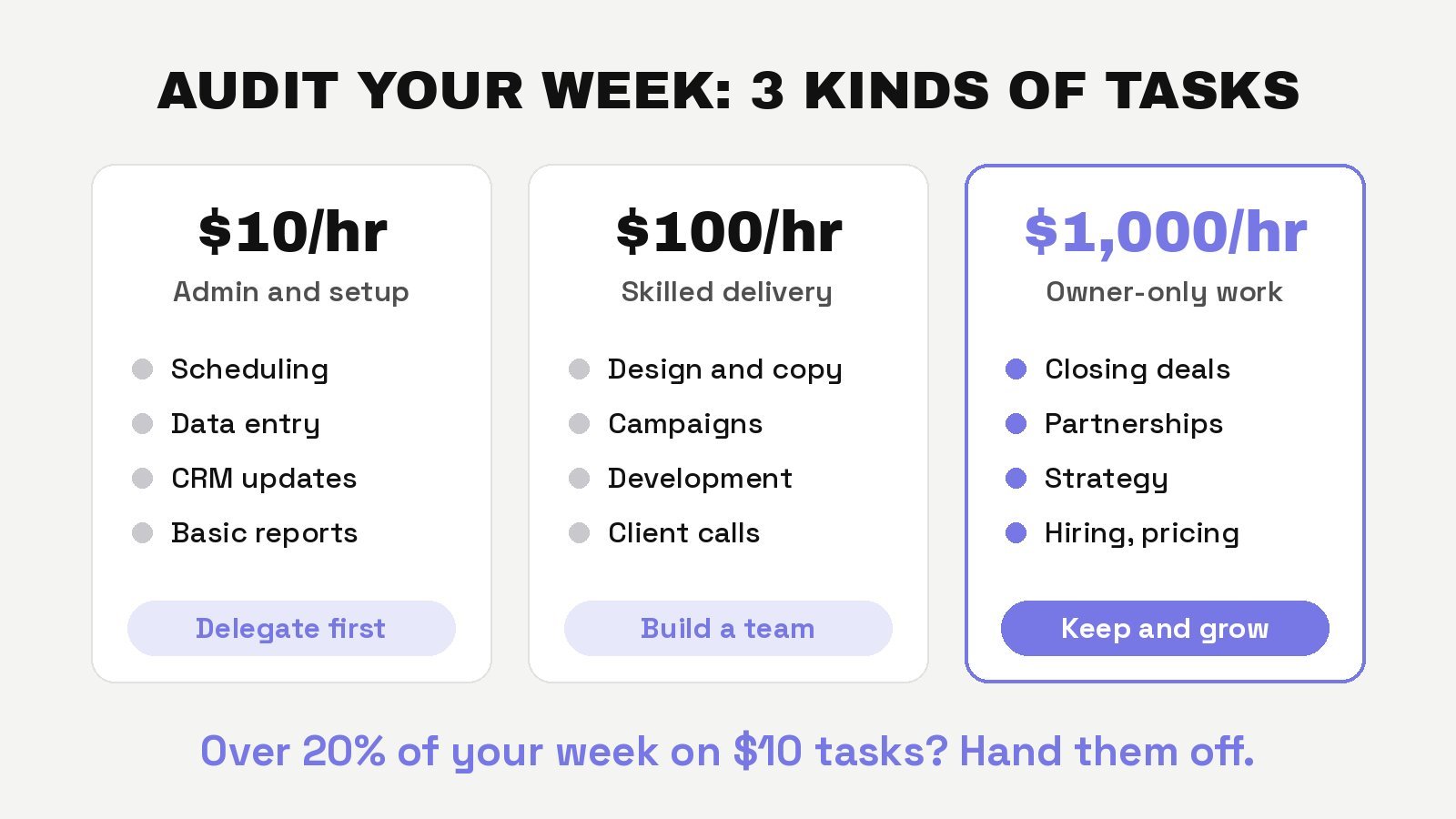
You can't change what you don't measure. For one week, list every task you do, then sort each one into three buckets:
$10-an-hour tasks. Admin, list building, data entry, scheduling, CRM updates, basic reporting and setup work.
$100-an-hour tasks. Skilled delivery: design, copywriting, campaign management, development and client calls.
$1,000-an-hour tasks. Work only the owner can do: closing deals, building partnerships, setting strategy, hiring and pricing.
Then add up the hours in each bucket. If more than about 20% of your week goes to $10 tasks, you're still running a freelance practice. Those tasks are the first ones to hand off, and they're usually the easiest: a part-time assistant can take them over with a simple checklist.
Run the audit again every quarter. As the agency grows, today's $100 tasks become the next things to delegate.
Step 2: Redefine Your Role as the Owner
Once you see where your time goes, decide what your job actually is. In a growing agency, the owner's job comes down to five things:
Set the direction. Who you serve, what you sell and where the agency is going. Our guide to offer design helps you get the offer right first.
Build the team that can deliver that offer.
Create the systems that let the business run without you in every conversation.
Manage cash flow so you can afford to hire and never run out of runway.
Bring in clients predictably instead of waiting for referrals.
Everything else should be on a path to someone else. That doesn't mean you never touch delivery again. It means delivery stops being the thing your week is built around.
This is also where pricing has to change. Hourly pricing caps your income at your hours. When Ricochet's founder was doing everything himself, including delivery, outreach and client communication, the studio was stuck around $5K a month. Part of the fix was moving from hourly work to fixed-scope projects starting at $5K, and hiring and training delivery partners so the founder could step out of fulfillment. Ricochet grew from about $5K to $30K a month within 5 months and was later acquired by a larger agency. Our guide on how to price agency services covers packages and retainers in detail.
Step 3: Make Your First Hires Before It Feels Comfortable
The first hire is the moment that separates freelancers from agency owners. It's expensive, risky and uncomfortable, and it almost never feels like the right time. A practical order for most service agencies:
An assistant or virtual assistant for the $10 tasks from your audit. This is usually the cheapest hour you'll ever buy back.
A project manager once client work fills your week. A PM takes over client communication, timelines and quality checks so you can focus on sales. A common milestone is to hire one around $10K a month in recurring revenue. A healthy PM spends roughly 70% of their time on client work and 30% on internal work.
Specialists or delivery partners for the core service, so the work no longer depends on your hands. Our guide to a lean agency team structure shows how a small core team can carry a lot of revenue.
Expect three internal battles along the way:
Losing control. Your first hires won't do things exactly your way. Work that's 80% as good as yours, done by someone else, beats 100% done by you, because you can only do one at a time.
Letting go of perfection. Mistakes will happen. You can have perfection or growth, not both. The answer is a better system, not taking the work back.
Bad hires. At some point you'll hire the wrong person. That's a reason to improve how you hire and document, not a reason to stop building a team.
Book a call to plan your first hires
Step 4: Build Systems That Live Outside Your Head
Hiring without systems just moves the chaos to someone else. Leverage comes from three places:
Systems. Write SOPs for the things that happen every week: onboarding a client, kicking off a project, delivering the core service, reporting and offboarding. Start with client onboarding. It's where new clients form their first impression and where founders get pulled in most.
People. Hire early, delegate often and give people clear ownership. When AgilizeIQ's founder was the one holding enterprise delivery together, our team helped recruit and onboard 4 senior project managers, a business analyst and 2 project assistants, then standardized onboarding and delivery. AgilizeIQ scaled its project management capacity 4X in 90 days, so the company could take on more enterprise work without overloading the founder.
Processes and tools. Automate what repeats: follow-ups, reminders, reporting and first drafts of briefs. Use project management software so work is visible without you asking for updates.
Step 5: Replace Referrals With a Predictable Pipeline
Most freelancers live on referrals. Referrals are great, until they stop. An agency needs a pipeline it controls, so you can hire with confidence.
That doesn't have to be complicated. Pick one or two channels you can run every week, such as LinkedIn outreach, cold email, partnerships or events. Track the basics: messages sent, new replies and calls booked. And narrow your positioning so your outreach speaks to one type of client. Höski, a branding studio, was stuck around $15K a month with too many industries and no repeatable acquisition system. After repositioning around a few verticals, packaging its offer and building a top-of-funnel system, Höski grew from $15K to $50K a month in 4 months.
For channel ideas, see our guide on how to get clients for your marketing agency.
Common Mistakes When Moving From Freelancer to Agency
Calling it an agency while still doing all the work. A new name doesn't change the business model.
Hiring before documenting. New people need something to follow, or they'll copy your habits and your bottlenecks.
Keeping hourly pricing. Hours cap your revenue and make every hire feel like a cost instead of capacity.
Hiring a "mini me". Your first hires should cover your weaknesses, not duplicate your skills.
Waiting until you're burned out. By the time you're working every evening and weekend, you're making decisions from exhaustion.
Saying yes to every client. The wrong clients take the most time and pay the least. A clear offer makes it easier to say no.
If you're past the first hires and stuck at the next ceiling, our article on why agencies plateau at $30K a month covers what usually comes next.
Watch the Full Video
In this video, our founder breaks down the freelancer mindset, the internal battles that come with your first hires, and the three-step framework our team uses with agency owners: audit your time, redefine your role and build leverage.
How We Help Freelancers Become Agency Owners
Our team helps founders make this shift with a clear plan. If you're still employed or just starting out, our Agency Ignition program covers the offer, first clients and the systems to grow. If you're already making $15K to $50K a month, our Agency Builder program helps you install a repeatable offer, lead generation and a sales process so the agency grows without everything running through you.
Frequently Asked Questions
What is the difference between a freelancer and an agency owner?
A freelancer sells their own time and skills, so income is capped by their hours. An agency owner builds a business that delivers results through a team and documented systems, and spends most of their time on sales, hiring, systems and cash flow rather than doing the client work.
When should a freelancer start an agency?
When demand regularly exceeds the hours you have, you turn work away, and clients would buy a bigger scope than you can deliver alone. A common sign is a waitlist or a full calendar for several months in a row. Start by handing off admin tasks, then hire a project manager or delivery help.
Who should a freelancer hire first?
Usually an assistant for low-value admin tasks, then a project manager once client work fills your week. A project manager takes over client communication, timelines and quality checks so you can focus on sales. Specialists or delivery partners for your core service come next.
How do I stop trading time for money?
Move from hourly rates to fixed-scope packages or retainers priced on the outcome, document how the work is done, and hand delivery to a team or partners. Your income then depends on the system's capacity, not on your personal hours.
How much revenue do you need before your first hire?
There's no fixed number, but many agencies hire part-time admin help early and a project manager around $10K a month in recurring revenue. Waiting until you're fully booked and exhausted usually means you hire in a rush and train badly.
How do I keep quality high when other people do the work?
Write down what good looks like for each deliverable, use SOPs and checklists, review work at set checkpoints rather than all the time, and give a project manager ownership of quality. Accept that early work may be 80% of what you'd do, then improve the system.
Ready to stop being the bottleneck in your own business? Book a free strategy call