

Sooner or later, a good client asks for something you don't do. Your SEO client wants paid ads. Your Shopify build client wants email marketing. Your content client wants a new website.
You have three options. Say no and watch another agency get a foot in the door. Hire a specialist before you have enough work to keep them busy. Or deliver it through a partner, under your brand, while your team stays in charge of the client.
That third option is a white-label partnership. Done well, it lets a small team offer a bigger menu, raise account value and keep clients longer, without the payroll risk. Done badly, it hands your client relationship, your margin and your reputation to someone you barely know.
Across 700+ agencies coached in Canada, the US and Europe, our team has seen both. This guide covers when white-labeling makes sense, how to choose and vet partners, how to price it, and the operating rules that keep you in control.
What a White-Label Agency Partnership Is (and Isn't)
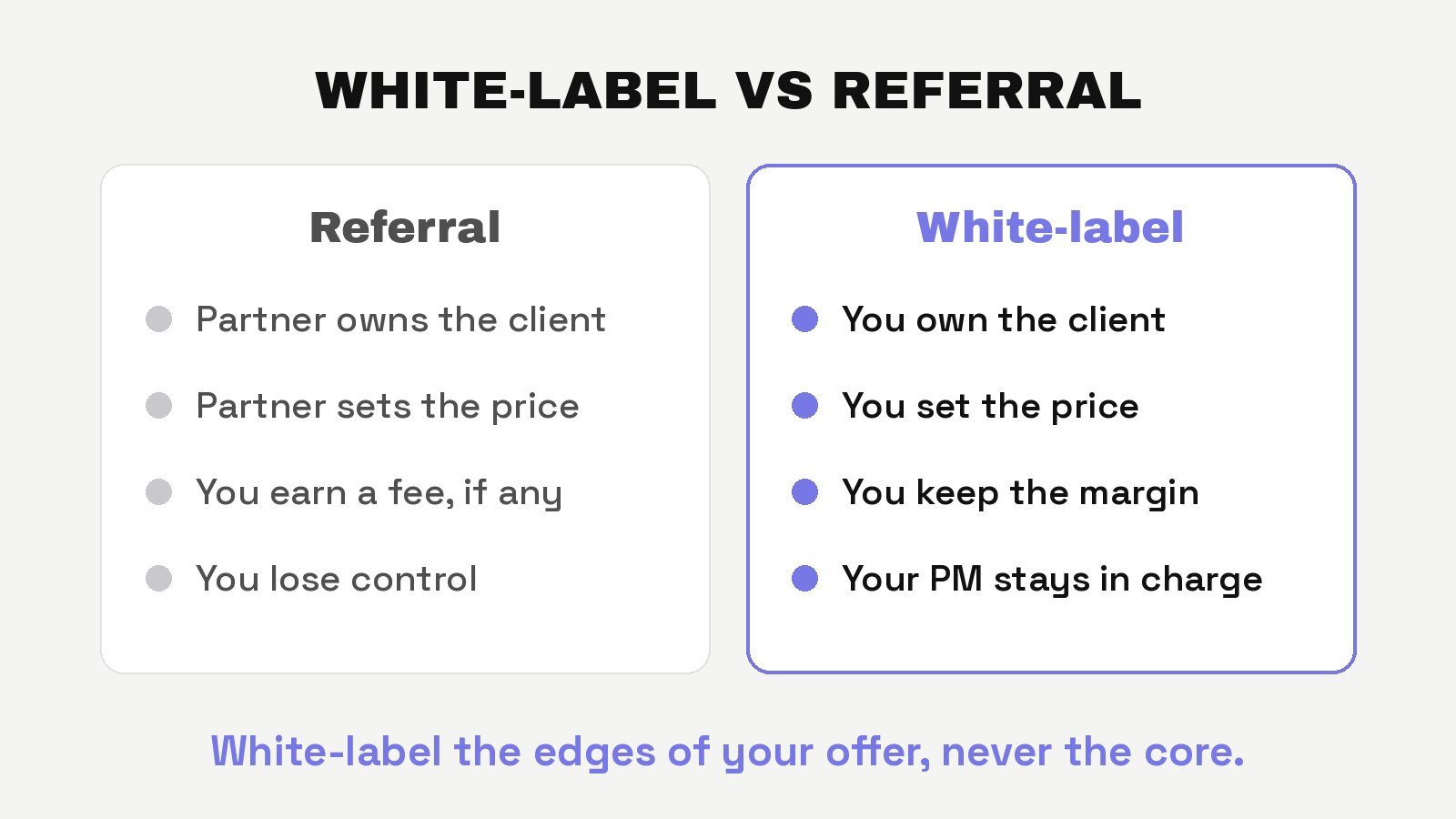
In a white-label partnership, a partner delivers part of the work and your agency presents it to the client as your own service. The client signs with you, pays you and talks to your team. You pay the partner.
It's one of several ways to work with other agencies and freelancers:
| White-label | Subcontract (named) | Referral | |
|---|---|---|---|
| Who the client sees | Your agency only | Your agency, with the partner introduced | The partner directly |
| Who owns the client | You | You | The partner, for that service |
| Who sets the price | You | You | The partner |
| Your income | Your margin on the work | Your margin on the work | A referral fee, if any |
| Your risk | Quality and delivery | Shared, but still yours | Low, but you lose control |
None of these is always right. Referrals are fine for work far outside your lane. White-label makes sense when the service sits close to what you already sell, the client expects one team, and you want to own the whole account.
When White-Labeling Makes Sense
White-label partnerships work best in a few situations:
Clients keep asking for the same adjacent service. If three clients asked for paid ads this quarter, that's demand, not a distraction.
You can't keep a full-time specialist busy yet. A partner turns a fixed salary into a variable cost until volume justifies a hire.
You want to own more of the outcome. Clients who buy several services from you see you as a growth partner, not a vendor. That's how an email agency like Spring Media moved toward full-stack eCommerce growth and bigger retainers.
You need specialist depth on demand. Technical SEO audits, app development, data work or translation are often better handled by people who do nothing else.
It's the wrong move when the service is your core offer. If clients hire you for paid social, your paid social team should be yours. White-label the edges, not the center. Our guide to offer design helps you decide what sits in the core.
Build a Bench Before You Need It
In our founder's current agency, the very first hire wasn't a designer, developer or salesperson. It was a partnership manager whose full-time job, 40 hours a week, was to build a bench of vetted freelancers, specialists and white-label partners. That bench was built before there was a paying offer in the market, and the offer was then designed around the talent the agency already had access to.
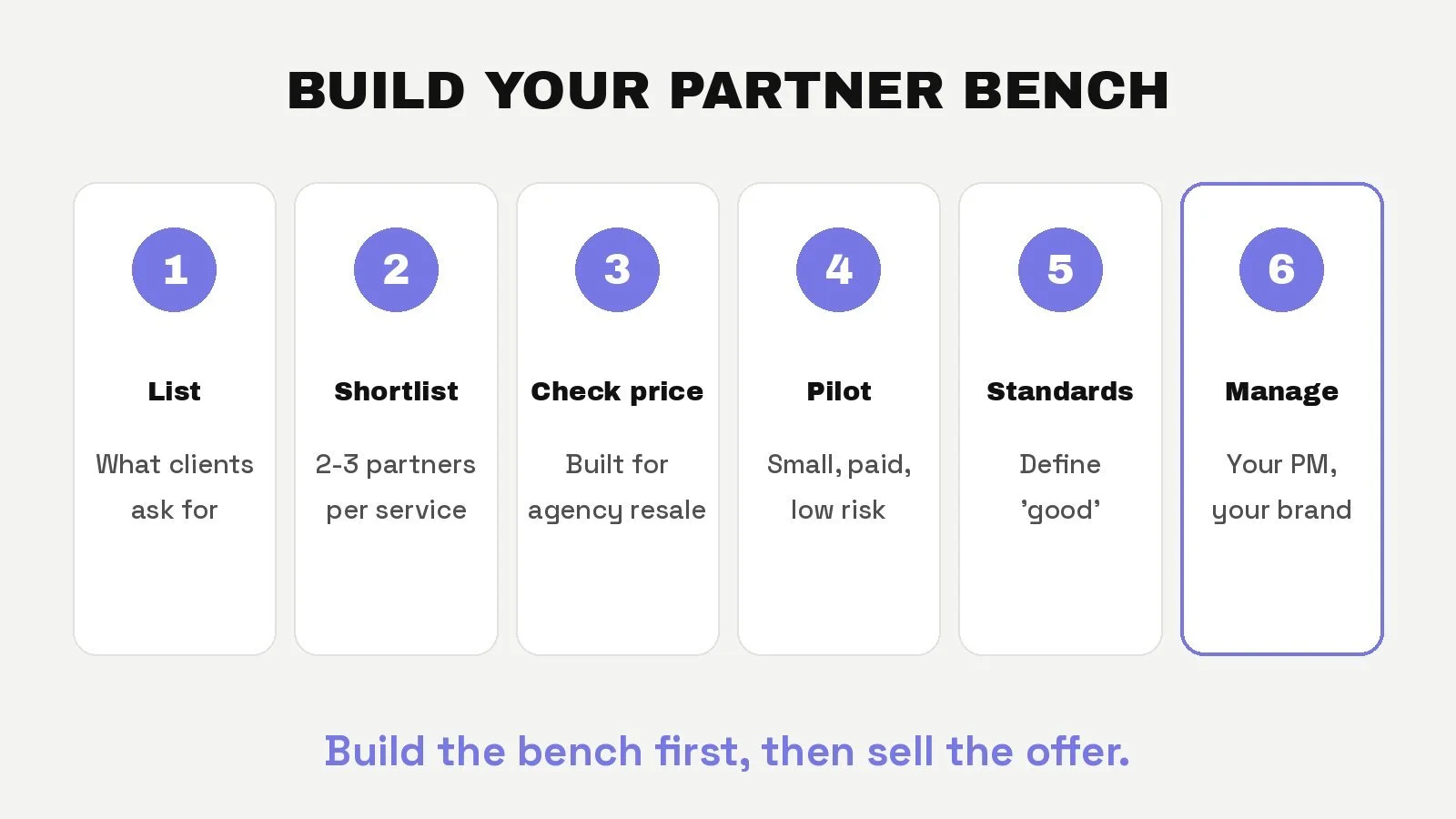
That order matters. Most agencies sell first, scramble to deliver after and end up learning how to fulfill on the client's dime. Build the bench first:
List the services clients ask for that you don't deliver today.
Shortlist 2 or 3 partners per service so you're never dependent on one.
Pick partners whose pricing is built for agency resale. Many specialist shops publish wholesale or agency pricing; if a partner only quotes retail rates, your margin disappears.
Run a small paid pilot on an internal project or a low-risk client task before anything important.
Write down what "good" looks like for each service: deliverables, turnaround times and quality checks.
How to Vet a White-Label Partner
A partner's portfolio tells you they can do the work. It doesn't tell you they can do it on your schedule, under your brand, without going around you. Before you sign, ask:
Visibility: Will they be fully invisible to clients, introduced as a contractor, or presented as part of your team? Under whose brand?
Communication: Will they use a branded email address on your domain? Do they join client calls always, by invite or never?
Branding: Do reports, decks and documents go out under your branding?
Rhythm: What's their standard response time? How often do you sync internally? Who is your single point of contact?
Process: Do they have an intake document, or will you build intake for every account?
Capacity: How many accounts like yours can they take on this quarter? Who covers holidays and sick days?
Proof: Can you speak to another agency that resells their work?
Get these answers in writing before the first client project. Most white-label blow-ups we see trace back to one of these questions never being asked.
Pricing White-Label Services Without Killing Your Margin
The math is simple: your price to the client has to cover the partner's fee, your team's time managing the work, and a healthy margin. The mistake is forgetting the middle part.
Every white-label service needs someone on your side to brief the partner, check the output, handle revisions and talk to the client. That's real time. If you price the service as "partner cost plus a little", the account looks profitable on paper and loses money in practice.
A few rules our team uses:
Price on the outcome you sell, not the partner's cost. Clients buy results, not hours. See how to price agency services.
Include project management in the price. Don't give your oversight away for free.
Bundle when it makes sense. A retainer that combines your core service with a white-labeled one is easier to sell and harder to cancel than two separate invoices.
Know your floor. Decide the minimum margin you'll accept per service, and walk away from deals below it.
Book a call to map your partner bench and pricing
Keep Control: White-Label the Project Manager Too
The single most useful rule we give agencies: when you white-label a specialist, keep a project manager between the partner and the client, and white-label that PM too.
When a partner's specialist works directly with your client, two things tend to happen. The client starts asking for extra work outside the scope, and the specialist says yes because they're used to taking orders. Then the client starts seeing the partner, not you, as the people who do the work.
A project manager who represents your agency fixes both. They own the timeline, they protect the scope and they keep the relationship with you. The client gets one team, one point of contact and consistent communication.
Your operating rules should cover:
One point of contact on your side for the partner, and one for the client.
Your tools, your channels. Client work runs through your project management tool and your shared channels, not the partner's.
Your reporting. Results go to the client in your format. Our guide to agency client reporting shows what to include.
Your quality check before anything reaches the client.
Clear contracts. Use a written agreement that covers confidentiality, ownership of the work, non-solicitation of your clients and what happens if the partnership ends. Have a lawyer review it for your jurisdiction.
Turn Partnerships Into Upsells and Retention
Once the bench is in place, white-label partners become a growth lever, not just a way to say yes.
Upsell inside existing accounts. Look at each client's funnel and ask what's missing. An eCommerce client on SEO might need email flows; a Shopify build client might need CRO.
Package the combinations clients buy most often into a single offer with a single price.
Use partnerships to reach bigger clients. Larger buyers want one accountable partner for several services. A vetted bench lets a lean team say yes to that scope with confidence.
Retention follows. Clients who rely on you for several connected services churn less, because leaving means replacing more than one vendor. See why agencies fail at retention.
This is also how you grow without your team becoming the bottleneck. Our article on the agency bottleneck and our guide to a lean agency team structure go deeper on structuring a small core team with a flexible bench around it.
Common White-Label Mistakes
Choosing partners on price alone. Cheap partners make expensive mistakes with your best clients.
Only one partner per service. If they get busy or disappear, you're stuck.
Letting partners talk to clients without your PM. Scope creep and lost relationships follow.
No written standards. If "good" isn't defined, you'll argue about it on every project.
Underpricing management time. The account grows, but the margin doesn't.
White-labeling your core service. If you can't deliver your main offer in-house, you don't own your agency's quality.
Hiding a partner when the client asks directly. Be honest about working with specialists when asked. Trust matters more than the illusion of size.
Watch the Full Video
In this video, our founder explains why "boring", well-systemized agencies win, and why the first hire at his current agency was a partnership manager who built a bench of vetted partners before the offer went to market.
How We Help Agencies Build Partner Benches
Our team helps agency owners decide what to keep in-house, what to white-label and how to price and package it. In our Agency Builder program, for agencies making $15K to $50K a month, we audit your offer, sales process and delivery system and help you install the structure to scale without chaos.
Frequently Asked Questions
What is a white-label agency partnership?
A white-label agency partnership is an arrangement where a partner delivers part of a service and your agency presents it to the client as your own. The client signs with you, pays you and talks to your team, and you pay the partner. It lets agencies add services without hiring full-time specialists.
Is white-labeling dishonest to clients?
No, as long as you own the outcome and don't lie when asked. Agencies have always used specialists and contractors. Your agency is accountable for quality, deadlines and results. If a client asks directly who does the work, be honest that you work with vetted specialists.
What services do agencies white-label most?
Common white-labeled services are those close to an agency's core offer but needing specialist skills: paid ads, SEO, email marketing, web and app development, content production and design. The best choices are services your clients already ask you for.
How do agencies price white-label services?
Price on the outcome you sell, not the partner's cost. Your price needs to cover the partner's fee, your team's time to brief, check and manage the work, and your margin. Pick partners whose pricing is designed for agency resale so there's room for that margin.
How do I stop a white-label partner from taking my clients?
Keep your own project manager between the partner and the client, run communication through your channels and tools, report results in your format, and use a written agreement with confidentiality and non-solicitation terms reviewed by a lawyer.
Should I white-label or hire?
White-label while demand for a service is new or uneven, and hire when you have steady, predictable work for a full-time specialist. Many agencies white-label a service first, prove the demand, then bring it in-house once the numbers justify a hire.
Ready to add services without adding chaos? Book a free strategy call