

Most agency owners we talk to want bigger clients. Fewer, larger retainers. Longer contracts. Less churn. Less chasing.
Then they try. They send a deck to a brand they admire, get one polite call with a marketing coordinator, and the deal quietly disappears for six months. The conclusion they reach is "we're too small for enterprise."
Usually that's not the problem. Across 700+ agencies coached in Canada, the US and Europe, we see small teams win enterprise work all the time. What they change isn't their headcount. It's how they pick accounts, who they talk to inside them, how they scope the first engagement and how ready they are for procurement.
This guide shows the process our team uses with marketing and dev agencies: how to tell if you're ready, how to map and enter an account, why paid discovery beats a free proposal, how to get through procurement and how to price so a big contract doesn't sink your margins.
Why Enterprise Clients Change an Agency
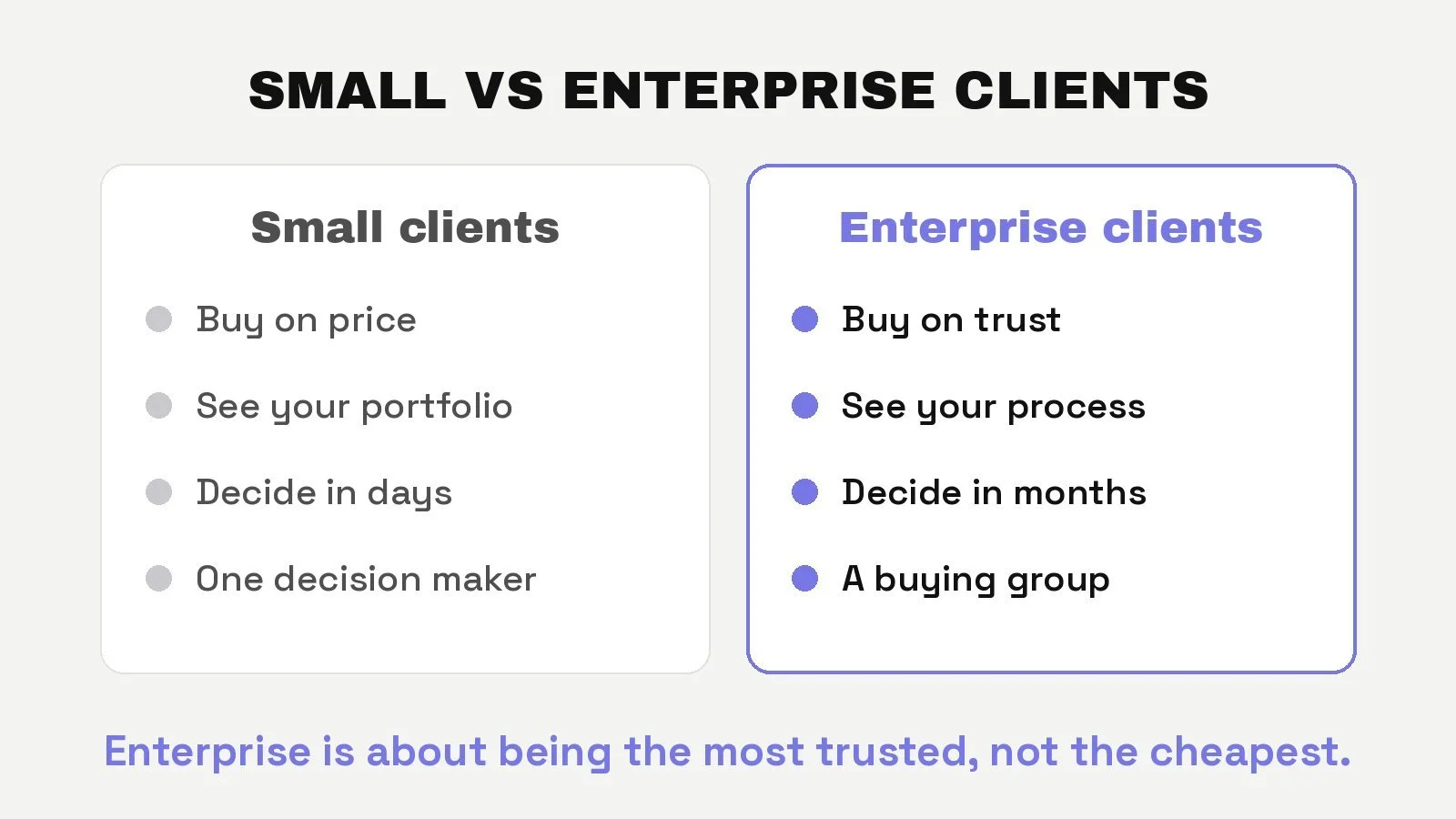
Small clients and enterprise clients buy in completely different ways:
| Small clients | Enterprise clients | |
|---|---|---|
| Buy on | Price | Trust and outcomes |
| Want to see | Your portfolio | Your process |
| Decide in | Days | Months |
| Decision makers | One owner | A buying group (marketing, finance, IT, legal, procurement) |
| Typical engagement | A project or small retainer | Multi-phase programs and multi-year relationships |
That's why enterprise is worth the effort. One account can change your year, and good enterprise clients stay because switching agencies is painful for them too.
Our founder has personally closed more than $25 million in enterprise contracts over the last decade. Before The Agency Business, his firm BlueLock Consulting worked with Shopify, helping its Plus team nurture and close high-value enterprise clients, and was later acquired by Centro. The lesson from all of it is simple: enterprise sales is not about being the cheapest. It's about being the most trusted.
Are You Ready for Enterprise? A Quick Checklist
Before you go after a single logo, be honest about these six things. Gaps here are what kill deals in month four, not your pitch.
A clear, outcome-based offer. Enterprise buyers don't buy "social media management." They buy a result in their language: more qualified pipeline, a faster product launch, lower acquisition cost. If you can't say it in a sentence, start with offer design.
Proof that matches the buyer. Two or three case studies with real numbers, ideally from companies with similar complexity. Logos help, but the story of how you got the result helps more.
A documented delivery process. Enterprise teams will ask how you onboard, report, escalate and handle change requests. If the answer lives in the founder's head, it's not ready.
Delivery capacity beyond the founder. At least one project manager who can run the account day to day. When our client AgilizeIQ started winning bigger contracts, the bottleneck was delivery, not sales. We helped them 4X their PM team in under 4 months so they could deliver on enterprise contracts.
Basic procurement paperwork. Insurance, a standard MSA and SOW, a data and security summary, W-9 or tax details, and banking info. More on this below.
Cash flow for longer payment terms. Net 45 to net 90 terms are common. If one late invoice would hurt payroll, fix that first.
You don't need all six to be perfect. You do need to know where you're weak before a buyer finds out.
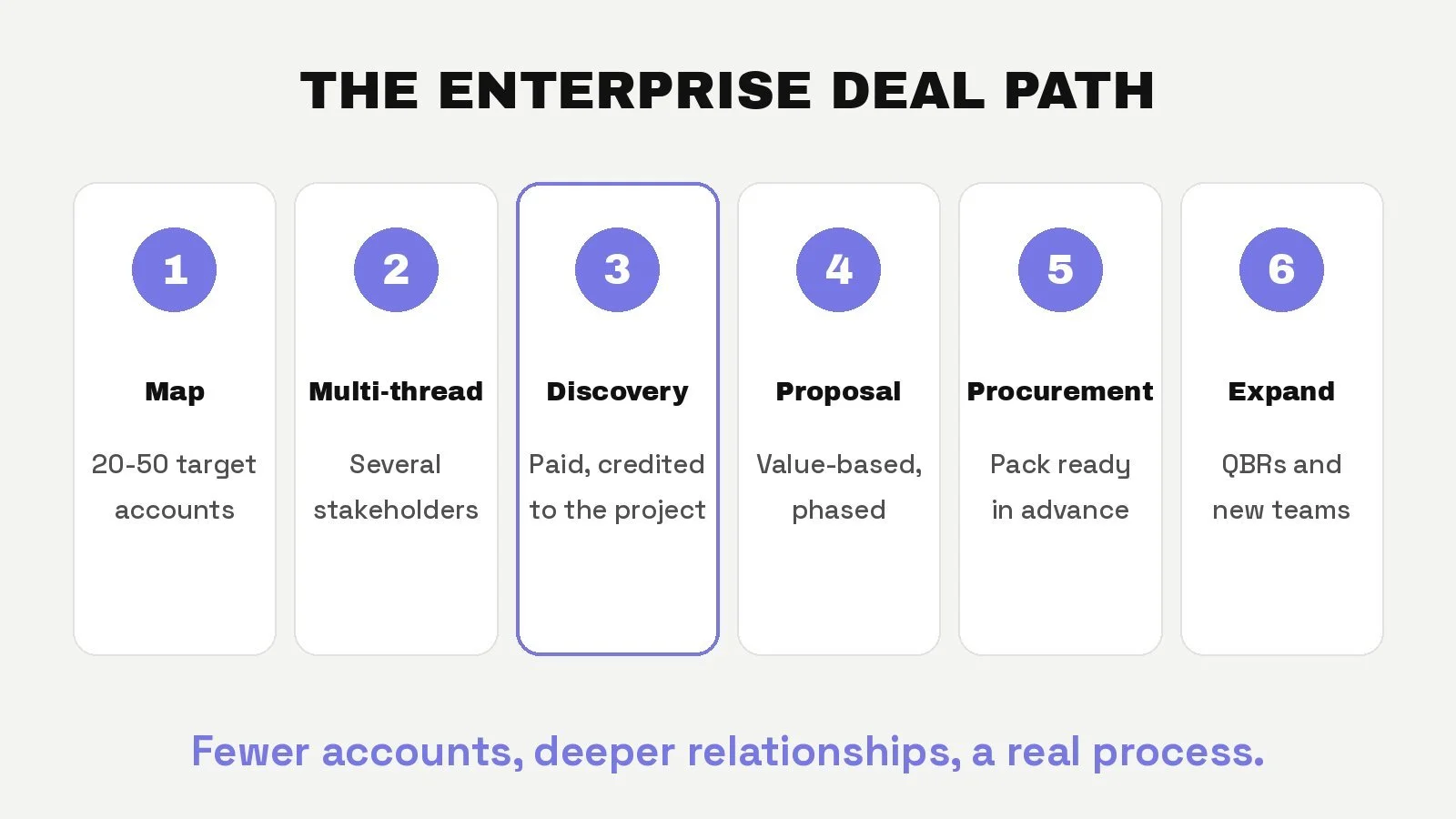
Step 1: Pick Fewer Accounts and Map Them Properly
Enterprise sales is a deep-water game. Fewer fish, but each one matters. That means you stop blasting hundreds of companies and start working a short list.
Build a target list of 20 to 50 accounts where your offer, proof and industry experience fit. Look for signals: a new marketing leader, a funding round, a product launch, a replatforming project, a job posting that describes a problem you solve.
Map the buying group for each account. Who owns the budget? Who feels the problem day to day? Who will block it (IT, legal, procurement)? Who influences the decision without signing anything?
Research the people, not just the company. Read what they post, what their team announced and what their earnings calls or press releases say about priorities. Your first message should prove you did this.
For the outreach itself, see our guide to cold outreach that wins enterprise clients. LinkedIn is where most enterprise buyers show up under their real names and titles, so pair it with a LinkedIn go-to-market plan.
Step 2: Multi-Thread the Deal
The single biggest mistake we see is a one-contact deal. Your champion loves you, then goes on leave, changes jobs or loses a budget fight, and the deal dies with them.
In enterprise, you're not closing one decision maker. You're building consensus across marketing, finance, operations, IT and legal. Multi-threading means you deliberately build relationships with several of them:
Ask your champion who else cares. "Who else would need to be comfortable with this for it to move forward?" is one of the most useful questions in enterprise sales.
Give each stakeholder what they need. Finance wants cost and risk. IT wants security and integration answers. The executive sponsor wants the business outcome. One generic deck doesn't serve any of them.
Run a mutual action plan. A shared document with the steps, owners and dates both sides agree to: discovery, security review, legal review, decision date. It turns "we'll get back to you" into a timeline.
Nurture over months, not days. Enterprise deals can take six months or more. Stay useful with insights and short updates, not "just checking in."
Step 3: Sell Paid Discovery, Not a Free Proposal
When an enterprise prospect asks for a proposal for something complex, don't guess at a package. You'll either underprice it or scare them off, and you'll do weeks of free strategy work.
Instead, sell a paid discovery or strategy phase: a few weeks of workshops, audits and stakeholder interviews that end with a clear roadmap, scope and price for the full engagement. Credit the discovery fee toward the full engagement if they go ahead.
Why it works:
It lowers the buyer's risk. A smaller first purchase is easier to approve, often without full procurement.
It proves how you work. They see your process, not just your portfolio.
It gets you to more stakeholders. Workshops put you in the room with the buying group.
It protects your margin. You scope the big project with real information.
Skip discovery for simple, well-defined tasks. Use it when the problem is complex, the budget is large or the client isn't sure what they need.
Good discovery questions are the same ones a strong project manager would ask: where the business is today, where it wants to be, what's been tried, what's in the way and how success will be measured.
Book a call to plan your enterprise sales process
Step 4: Get Through Procurement Without Losing the Deal
Plenty of agencies win the room and then lose the deal in procurement. Vendor onboarding at a large company can include security questionnaires, insurance certificates, supplier diversity forms, legal redlines and payment-term negotiations.
Prepare a procurement pack before you need it:
Company details, tax forms and banking information.
Certificates of insurance (general liability, professional liability or E&O, and cyber if you touch customer data). Check what limits your target industries usually ask for.
A standard MSA and SOW template, so you're redlining your paper or reviewing theirs from a position of knowledge.
A one-page data handling and security summary: where data lives, who has access, which tools you use and how you offboard.
References from two or three clients who agreed to take a call.
Ask early: "What does your vendor onboarding process look like, and who runs it?" Then put procurement steps into the mutual action plan, so they don't surprise anyone in the final week.
Public-sector buyers work through formal tenders instead. If you're bidding on those, our guide to finding and winning RFPs in Canada covers bid/no-bid decisions and mandatory requirements.
Step 5: Price Enterprise Work for Value and Margin
Enterprise clients don't care about your hourly rate. They care about the outcome and the risk. That gives you room to price on value, but it also comes with hidden costs.
Anchor on the outcome. Frame the investment against what the result is worth to them, not against your hours.
Use phases and milestones. Discovery, then implementation, then optimization. Milestone billing keeps cash moving on long projects.
Price in the overhead. More meetings, more stakeholders, more reporting, longer approvals and slower payment terms all cost you time. A price that works for a $5K-a-month client usually doesn't work for an enterprise account with the same scope.
Set clear change-request rules. Scope creep is the biggest margin killer on large accounts. Define what's included and how extra work is quoted.
For the full framework, see how to price agency services.
Step 6: Deliver, Then Land and Expand
The first enterprise contract is rarely the biggest one. Most large accounts grow because a team inside the company had a great experience and told another team.
Over-deliver on communication. Reports should explain what happened, why and what's next. Our guide to client reporting shows how.
Hold quarterly business reviews. Tie results back to the outcomes you agreed in discovery, and bring ideas for the next phase.
Ask for introductions to other teams and regions. A happy stakeholder is your best route into the next budget.
This is how a small team ends up with a few enterprise accounts that make up a stable base of revenue.
A Real Example: Orizon
Orizon, a digital product and innovation studio, was doing $2M a year, mostly through referrals and the founder's personal network. Deals were unpredictable and the sales cycle was gut-driven.
Over 12 months, our team helped them:
Reposition as a strategic innovation partner focused on outcomes, not a design vendor.
Build a 6-stage sales process with target account mapping, outbound sequences, sales enablement and pipeline tracking.
Create pitch decks, one-pagers and proposal frameworks for CTOs, heads of product and innovation leads.
Train the sales team to run consultative discovery and close with confidence.
Shift pricing toward value-based retainers and milestone billing.
Orizon grew from $2M to $5.3M in annual revenue in 12 months, more than doubled its average deal size and now closes $250K+ projects with enterprise clients. Read the full Orizon case study.
Common Mistakes Agencies Make With Enterprise Clients
Pretending to be bigger than you are. Buyers find out in procurement. Position your size as focus and senior attention instead.
Single-threading. One contact is one point of failure.
Free strategy in the proposal. Sell discovery instead.
No procurement pack. Weeks of delay at the finish line can kill momentum.
Underpricing the overhead. Enterprise accounts need more meetings, reporting and patience.
Founder-only delivery. If the founder is the account manager, the deal caps the agency instead of growing it. See lean agency team structure.
Giving up at month two. Enterprise cycles are long. Consistency wins.
Watch the Full Video
In this video, our founder shares 13 years of agency lessons, including why learning to sell to enterprise is the skill that changes an agency's growth curve.
How We Help Agencies Win Enterprise Clients
Our team trains agency founders and their sales teams on outbound, pitching and closing high-ticket enterprise contracts. In our Agency Scale Program, for agencies over $100K a month, we install an enterprise sales system and company-wide OKRs, the same approach behind Orizon's growth. You can see more results in our case studies.
Frequently Asked Questions
Can a small agency win enterprise clients?
Yes. Enterprise buyers care more about trust, process and proof than headcount. A small agency with a clear outcome-based offer, relevant case studies, a documented delivery process and a project manager who can run the account can compete, especially when it sells a paid discovery phase first.
How long does it take to close an enterprise client?
Expect months, not days. Nurturing an enterprise lead for six months or more before it signs is normal, depending on budget size, the number of stakeholders and procurement. A mutual action plan with agreed dates helps keep the deal moving.
What is paid discovery?
Paid discovery is a short, fixed-fee strategy phase, often a few weeks of workshops, audits and stakeholder interviews, that ends with a roadmap, scope and price for the full engagement. Many agencies credit the discovery fee toward the full project if the client goes ahead.
What is multi-threading in enterprise sales?
Multi-threading means building relationships with several people in the buying group, such as the executive sponsor, the day-to-day owner, finance, IT and procurement, instead of relying on one contact. It reduces the risk of a deal dying when your champion leaves or loses a budget fight.
What documents do enterprise clients ask agencies for?
Common requests include certificates of insurance, tax forms and banking details, a master services agreement and statement of work, a security or data handling questionnaire, and client references. Preparing them in advance as a procurement pack saves weeks.
How should an agency price enterprise work?
Price on the value of the outcome, break the work into phases with milestone billing, and include the extra overhead that comes with enterprise accounts: more stakeholders, meetings, reporting and longer payment terms. Define change-request rules to protect your margin.
Ready to go after bigger clients with a real process? Book a free strategy call