

Most agencies have a revenue goal. Very few have a plan that tells each person on the team what to do about it this week.
The owner says "we're going to hit $100K a month this year." The team nods. Then delivery gets busy, outreach stops, sales calls dry up, and by the end of the quarter nobody can say whether the agency moved closer to the goal or further away. The goal was real. It just never reached the people doing the work.
Across 700+ agencies coached, we see this pattern in marketing and dev agencies in Canada, the US and Europe at every stage, from $10K a month to seven figures. The fix is not a bigger goal or a better spreadsheet. It's a simple system that turns one agency goal into a few measurable targets for lead gen, sales, delivery and project management, then tracks them every week.
That system is OKRs: objectives and key results. This guide shows how we set agency OKRs with our clients, how to cascade them from revenue to every team, real examples you can adapt, how to score them, and the mistakes that make OKRs feel like paperwork.
What OKRs Are (and Why Agencies Need Them)
OKRs are a goal-setting framework with two parts:
The objective (O) is the outcome you want, written in plain, motivating language. "Build a pipeline we don't have to chase" is an objective.
The key results (KRs) are how you'll know you got there. They're numbers, not tasks. "20 qualified sales calls a week by the end of Q2" is a key result.
The framework started at Intel in the 1970s. Investor John Doerr brought it to Google in 1999 and later wrote the book Measure What Matters about it. Google's own re:Work guide to OKRs recommends three to five objectives with about three key results each.
As the OKR coach who joined our workshop put it, OKRs are the bridge between strategy and execution. Agencies need that bridge more than most businesses, for three reasons:
Client work always feels more urgent. Without a weekly number for the agency's own growth, delivery wins every time and the pipeline dries up a few months later.
The founder is the strategy. If the plan lives only in the owner's head, the team can't act on it without asking. OKRs write it down where everyone can see it.
Revenue goals are lagging. You only find out you missed $100K a month after the month is over. Good key results include leading indicators you can move this week.
OKRs vs KPIs: You Need Both
A useful way to think about it, borrowed from the workshop: KPIs are your car's dashboard and OKRs are your GPS.
KPIs are health metrics you watch all the time: utilization, gross margin, churn, average retainer, cash in the bank. They tell you if the engine is OK.
OKRs are the few things you're deliberately changing this quarter. They tell you if you're heading toward the destination.
You can't reach the destination by watching the fuel gauge, and you can't ignore the fuel gauge because the GPS says you're on track. When a KPI goes red (say, churn jumps), that's a good candidate for next quarter's OKR. Once it's fixed, it goes back to being a KPI.
How to Write a Good Agency Objective
A good objective is something your team can recite. When we review agency OKRs, we check every objective against six rules:
Outcome, not task. "Launch a newsletter" is a task. "Become the go-to Shopify agency for home-goods brands" is an outcome.
Ambitious but achievable. It should feel like a stretch, not a fantasy.
Qualitative. Save the numbers for the key results.
Time-bound. Usually one quarter.
Short and memorable. No acronyms or jargon.
Limited. Three to five objectives at most. If everything is a priority, nothing is.
How to Write Key Results That Actually Measure Progress
Key results turn the objective into numbers. The test is simple: if you hit every key result, would everyone agree the objective is done? If not, something is missing.
The best sets mix three types:
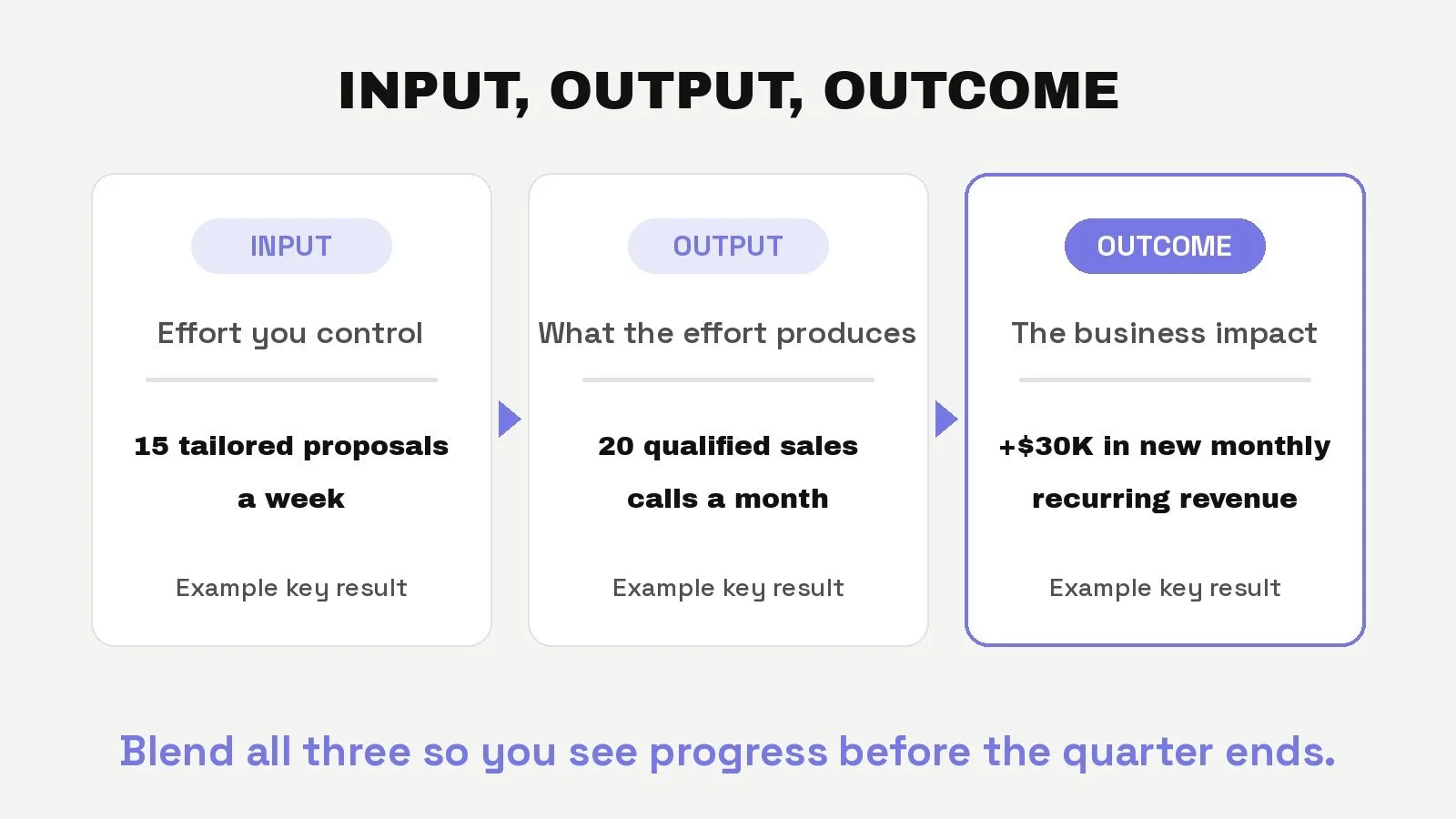
Input key results (effort)
What you'll do. Fully in your control. Example: "Send 15 tailored proposals a week."
Output key results (what the effort produces)
What you expect the effort to create. Example: "Book 20 qualified sales calls a month."
Outcome key results (business impact)
The change you really want. Example: "Sign $30K in new monthly recurring revenue."
All-input key results keep the team busy without proving anything. All-outcome key results tell you nothing until the quarter is over. A blend gives you early signals and a real finish line.
How to Cascade OKRs From Revenue to Every Team
This is where most agencies go wrong. The owner writes a goal, splits it into numbers and hands one to each team. That's delegation, not alignment, and the team has no ownership of numbers they didn't help set.
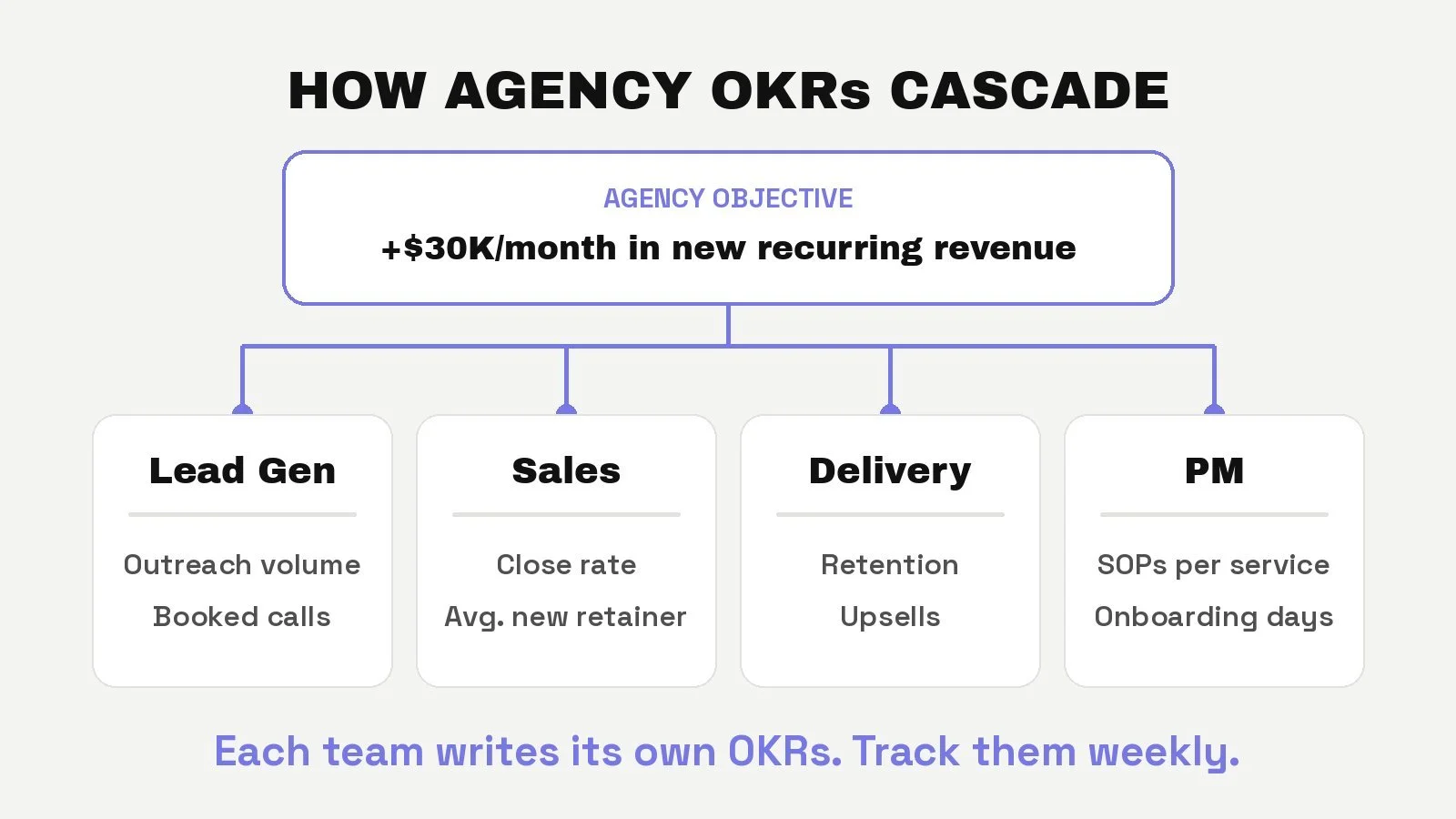
The better way: the owner shares the agency objective and how it will be measured. Then each team writes its own OKRs that support it, and the owner reviews them. Here's how that looks in a typical marketing or dev agency.
1. Start with one agency objective and a revenue number
Work backwards from the annual goal. If you want to add $30K a month in recurring revenue this quarter and your average retainer is $5K, you need six new clients, plus whatever you lose to churn. That one calculation drives every number below.
2. Lead generation OKR
Objective: "Fill the pipeline without the founder." Key results: outreach to a set number of target businesses a week, a set number of booked calls, and a source for every lead logged in the CRM. A classic example from our coaching calls: "Outreach to X businesses to generate 20 sales calls a week." For outreach methods, see our guides on cold outreach and how to get clients for your marketing agency.
3. Sales OKR
Objective: "Close the right clients at the right price." Key results: close rate on qualified calls, average new retainer, and proposal turnaround time. If your close rate is the bottleneck, the problem is often the offer, not the pitch. Our guide to offer design covers that, and our pricing guide covers minimum retainers.
4. Delivery OKR
Objective: "Clients who stay and grow." Key results: client retention, results against each client's own goal, and upsells to existing accounts. A strong delivery OKR anchors on the client's goals, not your task list. That's also what makes client reporting worth reading.
5. Project management OKR
Objective: "Delivery that runs without the founder." Key results: documented SOPs for each core service, onboarding time for new clients, and the number of accounts each PM can run well. This is the OKR that gets the owner out of delivery. See our guide to lean agency team structure.
Book a call to map your agency's OKRs
Agency OKR Examples You Can Adapt
Here are four sample OKRs for a marketing or dev agency. The numbers are illustrations. Set yours from your own baseline.
Agency objective: "Grow to a predictable, founder-free pipeline." - KR1: Add $30K in new monthly recurring revenue by the end of the quarter. - KR2: Book 20 qualified sales calls a month from outbound and referrals combined. - KR3: Keep client retention at or above last quarter's level.
Lead gen objective: "Own our niche on LinkedIn." - KR1: Publish a post every weekday. - KR2: Start 50 conversations a month with people who engaged. - KR3: Book 8 calls a month from LinkedIn.
Delivery objective: "Make every client's win obvious." - KR1: 100% of clients get a monthly report with observation, insight and direction. - KR2: Hold a quarterly business review with every client. - KR3: Upsell 3 existing clients to a larger scope.
PM objective: "Onboarding in days, not weeks." - KR1: Document SOPs for our three core services. - KR2: Cut onboarding from first payment to kickoff to a target number of days. - KR3: Move all account onboarding off the founder's calendar.
Quarterly planning is a core part of how our team works with agencies. With Apex Leads, a Montreal-based B2B outbound agency, quarterly planning and client reviews were part of the restructure that took them from $15K to $90K a month in 8 months, along with a rebuilt offer, a real sales system and minimum retainers raised from $1.5K to $4K a month.
How to Score Agency OKRs
Grade each key result from 0 to 1.0 at the end of the quarter and average them for the objective. Google's guidance is that the "sweet spot" is 0.6 to 0.7. If your team hits 1.0 on everything, the goals weren't ambitious enough. Low scores are data for next quarter, not a reason to punish anyone.
Two rules keep scoring honest:
Separate committed from aspirational OKRs. Some goals must be hit (for example, a cash target that keeps the doors open). Mark those as committed and expect 1.0. Use them sparingly.
Keep OKRs out of performance reviews. If people are paid on OKR scores, they'll set easy ones.
The Weekly OKR Check-In Rhythm
OKRs fail when they're set in January and reviewed in December. The rhythm we recommend for agencies:
Weekly (15 minutes): each team lead updates their key results in a shared doc. Green, yellow or red. One line on what's blocking anything red.
Monthly: the owner reviews trends and moves people or budget if a key result is stuck.
Quarterly: score the quarter, keep a snapshot, and write the next set of OKRs from what you learned.
You can't improve what you don't measure, and you can't measure what you only look at once a quarter.
Common Agency OKR Mistakes
Writing tasks as key results. "Redesign the website" is a project. "Double inbound leads from the website" is a key result.
Too many OKRs. Ten objectives means no focus. Three is plenty for most agencies under $100K a month.
Top-down only. Teams that don't help write their OKRs don't own them.
No leading indicators. If every key result is revenue, you'll find out you missed after it's too late to fix.
Setting and forgetting. No weekly check-in means no OKRs.
Ignoring the founder bottleneck. If every key result depends on the owner's time, the plan is capped by one calendar. See the agency bottleneck.
Watch the Full Video
Our free OKR workshop goes deeper on the outcome mindset, writing objectives and key results, scoring, and connecting teams to your clients' goals.
How We Help Agencies Set and Hit Their OKRs
Our team works with marketing and dev agency owners to turn a revenue goal into a plan the whole team can run. In Agency Builder, for agencies between $15K and $50K a month, we build a week-by-week roadmap and the offer, lead gen and sales systems behind each key result. If you're stuck at a plateau, start with our guide to scaling a marketing agency.
Frequently Asked Questions
What are OKRs for a marketing agency?
OKRs (objectives and key results) are a goal-setting framework. The objective is the outcome the agency wants, such as a predictable pipeline. The key results are three to five numbers that prove you got there, such as qualified sales calls a month or new recurring revenue.
How many OKRs should an agency have?
Three to five objectives at most, each with about three key results. Most agencies under $100K a month do best with one agency objective and one objective each for lead gen, sales, delivery and project management.
What is the difference between OKRs and KPIs?
KPIs are health metrics you monitor all the time, like utilization, margin and churn. OKRs are the few things you're deliberately trying to change this quarter. When a KPI goes red, fixing it can become next quarter's OKR.
How do you cascade OKRs in an agency?
The owner sets the agency objective and how it will be measured. Each team then writes its own OKRs that support it, and the owner reviews them. Work backwards from the revenue goal so every team's key results connect to it.
What is a good OKR score?
Grade each key result from 0 to 1.0. Google's guidance puts the sweet spot at 0.6 to 0.7 on average. If the team always hits 1.0, the goals aren't ambitious enough. Committed OKRs that must be hit are the exception and should score 1.0.
How often should an agency review OKRs?
Update key results weekly in a short check-in, review trends monthly, and score and reset OKRs every quarter.
Ready to turn your revenue goal into a plan your team can run? Book a free strategy call