

Most agency proposals lose before the prospect reaches the price.
They open with an "About Us" page, list every service the agency offers, show a portfolio, explain the process, and then go quiet on the one question the buyer actually has: what exactly am I getting, and why is it worth it? The prospect says "let me think about it," and the deal fades.
Across 700+ agencies coached, we've seen the same pattern from marketing and dev agencies in Canada, the US and Europe: the proposal isn't a document problem. It's a clarity problem. When the offer, the scope and the outcome are clear, the proposal gets short and the close gets easy.
This guide covers how to write a marketing agency proposal that wins: what to do before you write, the 7-part structure we use, how to write a scope that answers "what's included," how to present price, and the mistakes that stall deals.
Why Most Marketing Agency Proposals Lose
When we review proposals with agency owners, the same four problems come up again and again:
They're about the agency, not the client. Pages of history, values and team bios before a single line about the prospect's business.
The scope is vague. "Social media management" or "SEO retainer" with no deliverables, quantities or cadence. The most common question prospects ask after reading a proposal is "what's included?" If they have to ask, the proposal didn't do its job.
There's no cost of inaction. The proposal shows what the agency can do but never shows what the prospect is losing today by not fixing the problem.
Every proposal is custom from scratch. Constant custom proposals are a symptom of an unclear offer. They take days to write, they can't be delegated, and pricing drifts from deal to deal.
Fix those four and you'll win more deals with less writing.
Before You Write: Earn the Right to Send a Proposal
A proposal should confirm a conversation, not replace one. Sending a deck to someone you haven't qualified is how you end up writing proposals for people who were never going to buy.
Run a real discovery call
Brief the project like a project manager would. Ask how long they've been in business, where they want to go, what they've already tried and what happened, who else is involved in the decision, and what budget range they've set aside. Then summarize their problem back to them and ask, "Does that resonate?" Collect a few yeses before you talk about your solution.
Find the gap and put a number on it
This is the single biggest upgrade most agencies can make. Before you pitch, audit the prospect's current state (website, SEO, ads, funnel, whatever is relevant to your service) and find the gap between where they are and where they could be. Then attach a number to it.
In our video on client reporting, we walk through an illustrative SEO example: a prospect ranks on page two for a keyword with about 8,000 monthly searches, while a competitor on page one captures roughly 30% of that traffic, about 2,400 visitors a month. At a 2% conversion rate and a $500 average order value, that's about $24,000 a month the prospect isn't getting. Now you're not selling SEO. You're showing a revenue gap and offering to close it. With today's AI tools, a meaningful audit like this takes an hour or two, not days.
Decide whether a proposal is even the right next step
For complex or enterprise work, don't quote a package off one call. Sell a paid discovery or strategy phase and credit it toward the full engagement. For simple, well-defined work, skip the formal proposal and send a one-page scope.
The 7-Part Agency Proposal Structure
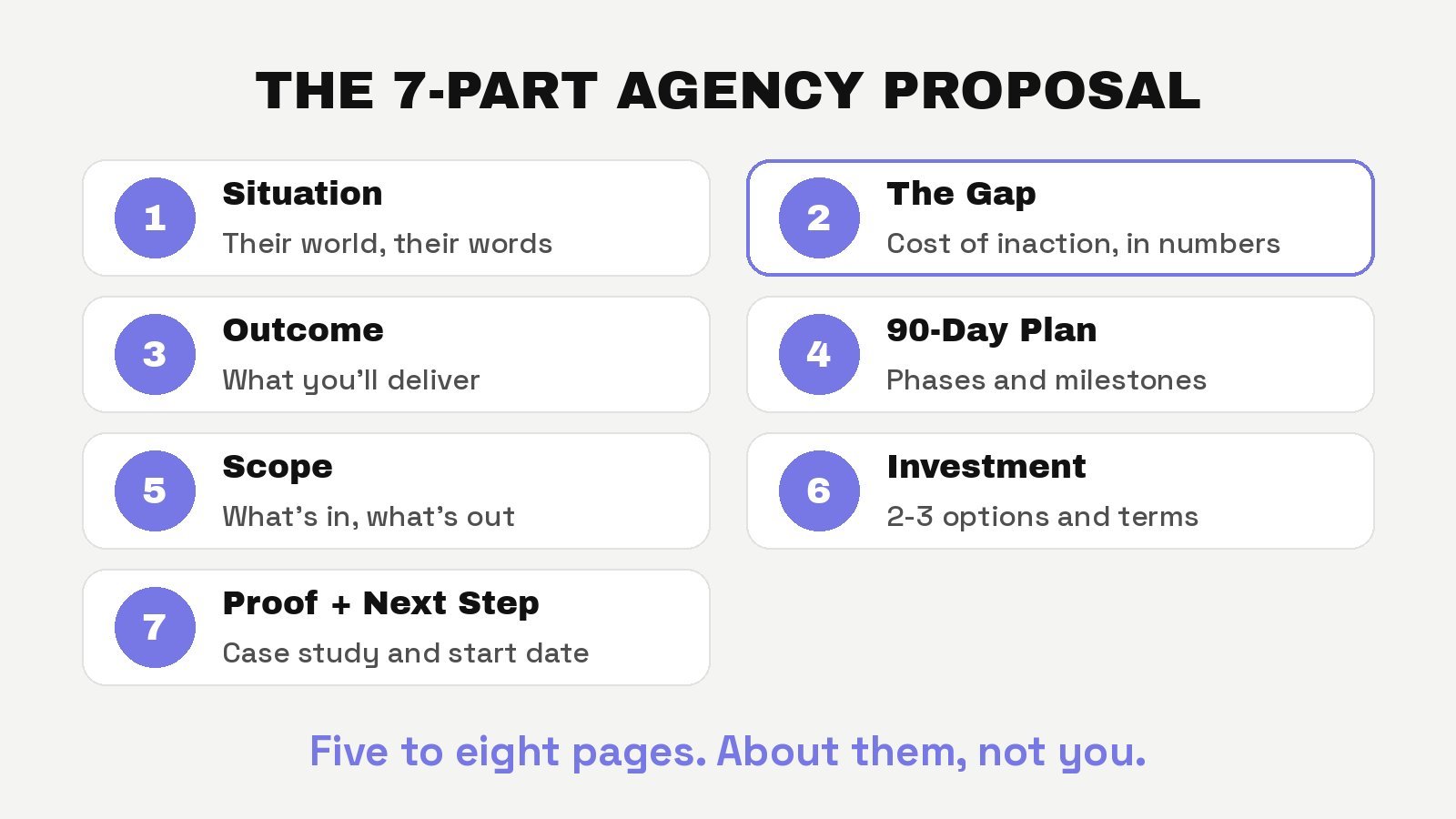
Here's the structure we use with agencies. Most winning proposals fit on five to eight pages.
1. The client's situation
Open with their world, in their words, from the discovery call. Two or three short paragraphs: where they are, what they've tried, and why now. If the prospect reads this and thinks "they get it," you've won the first page.
2. The gap and the cost of inaction
Show the audit findings and the number. Keep it to the one to three gaps that matter most, each with a clear estimate and your assumptions stated plainly. Conservative, transparent math builds more trust than a big headline number.
3. The outcome you'll deliver
State the result you're working toward and how you'll measure it: qualified leads, booked calls, revenue from a channel, a launch date. Outcomes, not activities. This is where a clear offer does the heavy lifting. If yours needs work, start with The Agency Offer Rebuild.
4. The plan
Show the phases of the work for the first 90 days: what happens in month one, two and three, and what the client will see at each stage. A simple timeline beats a long methodology section.
5. Scope: what's included (and what isn't)
The section most proposals skip. We cover it in detail below.
6. Investment and options
Price, payment terms and contract term, ideally with two or three options. See the pricing section below.
7. Proof and next steps
One or two relevant case studies with real numbers, then a clear next step: "Sign here and we kick off on [date]," with the onboarding steps listed. Don't end on "let us know your thoughts."
Book a call to review your proposal structure
How to Write the Scope: Answer "What's Included" in Plain Language
A clear scope prevents two problems at once: deals that stall after a verbal yes, and scope creep after the contract is signed.
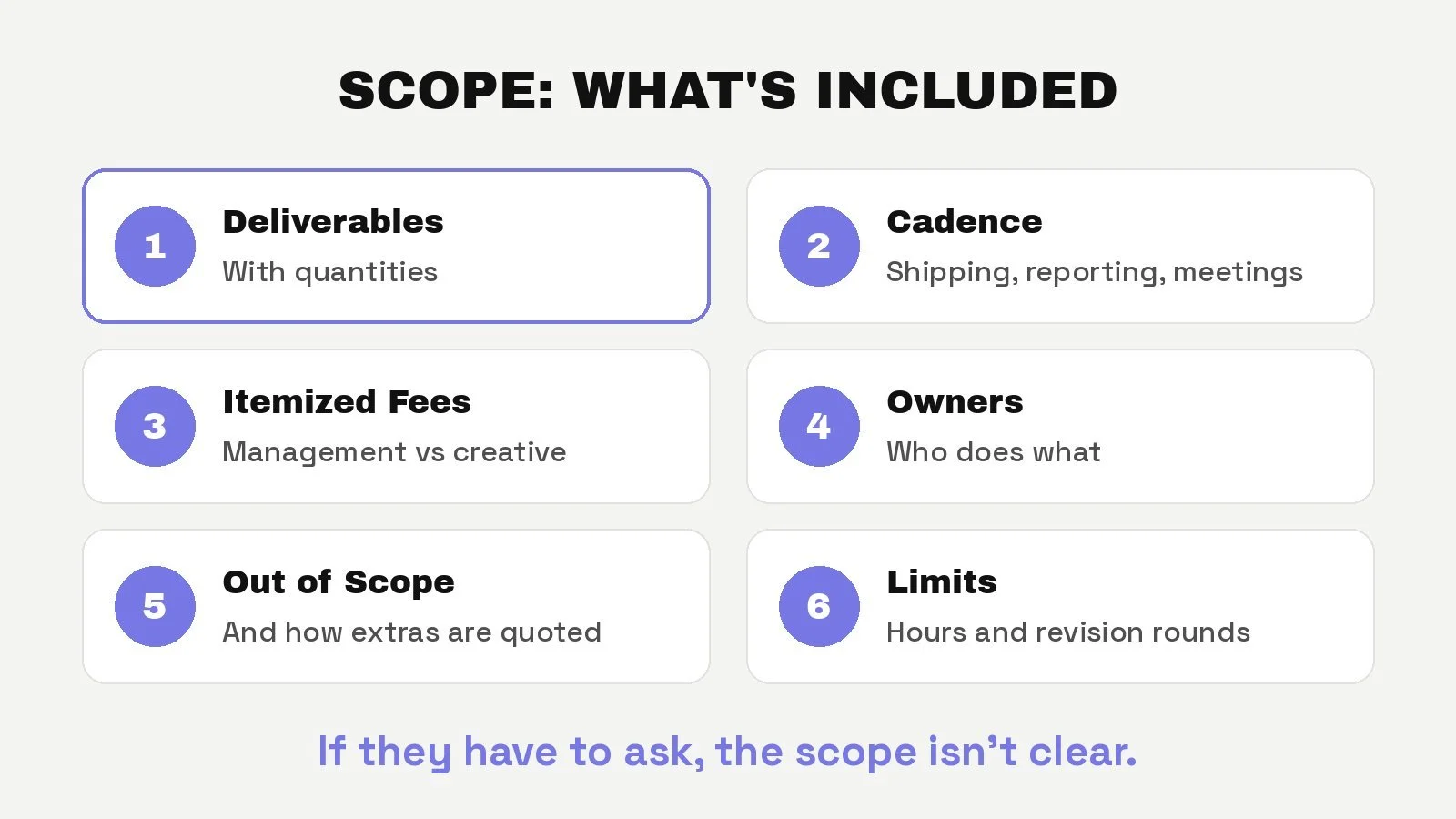
For every engagement, list:
Deliverables with quantities. Not "creative," but "8 static ads and 4 short videos per month."
Cadence. How often things ship, how often you report and how often you meet.
Fees itemized. For ad management, separate the management fee from the creative fee so the prospect can see what each covers.
Owners. Who on your team does what, and who the client's point of contact is.
What's out of scope. Name the things that are not included, and how extra work is quoted.
Limits on flat fees. Even a flat-rate website project should state the included hours, rounds of revisions and pages.
A simple written list beats a vague, beautiful deck. If two people on your team would read the scope and deliver the same thing, it's clear enough.
How to Present Price in a Proposal
Price is where most proposals wobble. A few rules we use with agencies:
Price the outcome, not your hours. If the gap you found is worth tens of thousands a month, your fee is judged against that, not against an hourly rate.
Offer two or three options. For example, a core option, a growth option with more volume or channels, and a smaller starter scope. Options shift the question from "yes or no" to "which one."
Set a floor. Know your minimum retainer before you write, and don't go below it. Apex Leads raised its minimum retainers from $1.5K to $4K a month with zero pushback after rebuilding its offer around outcomes.
Make the term easy to say yes to. Instead of forcing a 12-month contract and meeting resistance, ask what term the client is comfortable with, then renew on results.
For the full playbook on retainers, tiered ad-spend fees, performance deals and scoped flat fees, read How to Price Agency Services.
Proof: What Winning Proposals Look Like in Practice
The agencies we've worked with didn't win bigger deals by writing longer proposals. They won by changing what the proposal sold.
Millennial Marketing stopped pitching standard retainers and repositioned around performance funnels with a share of sales. The first time the founder pitched the new model, he closed a $150,000 deal, the biggest in the company's history.
Orizon built new pitch decks, one-pagers and proposal frameworks written for CTOs and heads of product, alongside a 6-stage sales process. In 12 months it grew from $2M to $5.3M in annual revenue, its average deal size more than doubled, and it now consistently closes $250K+ enterprise projects.
Writing RFP Proposals: What Changes
Public-sector and enterprise RFPs follow the same principles, with stricter rules. The evaluation criteria are published, so answer exactly what was asked, in the order it was asked, and build a compliance matrix that maps every requirement to the page where you answer it. Missing a mandatory requirement or a submission rule can disqualify an otherwise strong bid.
We cover where to find Canadian RFPs, a 20-minute bid/no-bid check and how to treat RFPs as a repeatable system in How to Find and Win Marketing RFPs in Canada. If you want RFPs delivered and proposals written for you, The Deal Flow offers a full plan at $249 CAD a month that adds proposal writing for a 10% success fee, charged only on contracts won.
Common Agency Proposal Mistakes
Sending a proposal before qualifying budget, timing and the decision-maker.
Leading with your agency instead of their problem.
Listing services instead of outcomes.
A scope with no quantities, cadence or exclusions.
One take-it-or-leave-it price with no options.
No clear next step or start date.
Waiting a week to follow up. Book the review call before you send the proposal.
Make Proposals a System, Not a Project
Once your offer is clear, 80% of every proposal should be reusable: the structure, the scope templates, the pricing options and the proof. Only the situation, the gap and the plan change per prospect. That's what lets you send proposals the same day as the discovery call, and eventually hand proposal preparation to a team member while you stay on strategy and closing.
Watch the Full Video
Frequently Asked Questions
What should a marketing agency proposal include?
Seven parts: the client's situation, the gap and the cost of inaction, the outcome you'll deliver, a 90-day plan, a clear scope of what's included and excluded, investment options with terms, and proof plus a clear next step.
How long should a marketing agency proposal be?
Most winning proposals fit on five to eight pages. For simple, well-defined work, a one-page scope is enough. Length should come from specifics about the client, not from pages about your agency.
How do I make my agency proposal stand out?
Audit the prospect before you write and put a number on the gap between where they are and where they could be. A proposal that shows what the client is losing today is far more persuasive than a list of services.
Should I include pricing options in a proposal?
Yes. Two or three options, such as a starter, core and growth scope, move the decision from yes or no to which one. Keep a minimum fee you won't go below.
How do I avoid scope creep after the proposal is signed?
List deliverables with quantities, cadence, owners and what's out of scope, and state how extra work is quoted. Even flat-fee projects should include limits on hours and revision rounds.
Want a second set of eyes on your offer, proposal and pricing? Book a free strategy call or see how our team works as an agency consultant.