

Agency project management is the system that turns a signed deal into delivered results: onboarding, planning, task flow, client communication and reporting. It scales when one person owns it, works from documented SOPs and keeps about 70% of their time on client work and 30% on improving the system.
Most agencies don't lose clients because the work is bad. They lose them because the experience around the work falls apart. Deadlines slip, nobody answers the client's question for three days, onboarding is different every time, and the founder ends up jumping in to fix things at 11 PM.
That's a project management problem, and it gets worse with every new client you sign. Our team has coached 700+ agencies in Canada, the US and Europe, and project management capacity is one of the issues owners bring to us most often. PMs are overloaded with accounts and onboarding at the same time, processes live in people's heads, and the founder is still the safety net for delivery.
This guide covers what agency project management actually includes, the 70/30 rule for PM capacity, when to hire your first project manager, the five-stage delivery system we install with clients, the SOPs to write first and the KPIs that keep delivery honest.
Why Project Management Breaks First When an Agency Grows
Every agency, whatever it sells, runs on four departments:
Lead generation: how people find out you exist.
Sales: how you turn that attention into revenue.
Project management: how you make sure the client's experience doesn't fall apart.
Delivery: how you actually fulfill the promise you made.
Most agencies start with one person doing all four. That works at $5K or even $10K a month. The moment you try to grow, one department breaks, and project management is usually the quiet one. Sales feels urgent and delivery feels like the real work, so nobody owns the space in between: kickoffs, timelines, status updates, scope changes and handoffs.
The cost shows up as churn. As Damiano explains in the video below, a client paying $5K a month who leaves after 60 days brings in $10K. The same client kept for 12 months brings in $60K, for the same acquisition cost. Good project management is how you get the second outcome.
If you're not sure which of your four departments is breaking, our guide to the agency business maps all five systems a healthy agency needs and the order to build them.
What an Agency Project Manager Actually Owns
A common mistake is hiring a PM and then using them as an assistant, a junior account manager or a second pair of hands on delivery. A project manager owns the client experience and the flow of work. Specialists own the craft. The founder owns strategy and the relationship at the top.
| Area | Project manager owns | Delivery team owns | Founder owns |
|---|---|---|---|
| Onboarding | Welcome, access, kickoff, timeline | Technical setup and audits | The promise made in the sale |
| Planning | Scope, milestones, task assignments | Estimates for their work | Which clients and offers to take on |
| Communication | Weekly updates, meeting notes, escalations | Answers on the work itself | Senior check-ins on key accounts |
| Quality | Checklists and review steps run on time | Doing the work to standard | Setting the standard |
| Reporting | Pulling the report together and sending it | Results and insights | Strategy direction for the next quarter |
| Change | Logging scope changes and getting sign-off | Flagging extra work early | Pricing the change |
When roles are this clear, the founder can step out of daily delivery without the client feeling the difference. That's the core idea behind our guide on building an agency where you're not the bottleneck.
The 70/30 Rule for Project Manager Capacity
A question we hear constantly is "how many clients should one PM handle?" There is no single number, because a $2K social account and a $40K enterprise build are not the same load. A better rule is about time, not account count.
A healthy agency PM spends roughly 70% of their time on client work and 30% on internal work: improving SOPs, refining templates, training juniors, planning capacity and fixing the process issues that caused last month's fires.
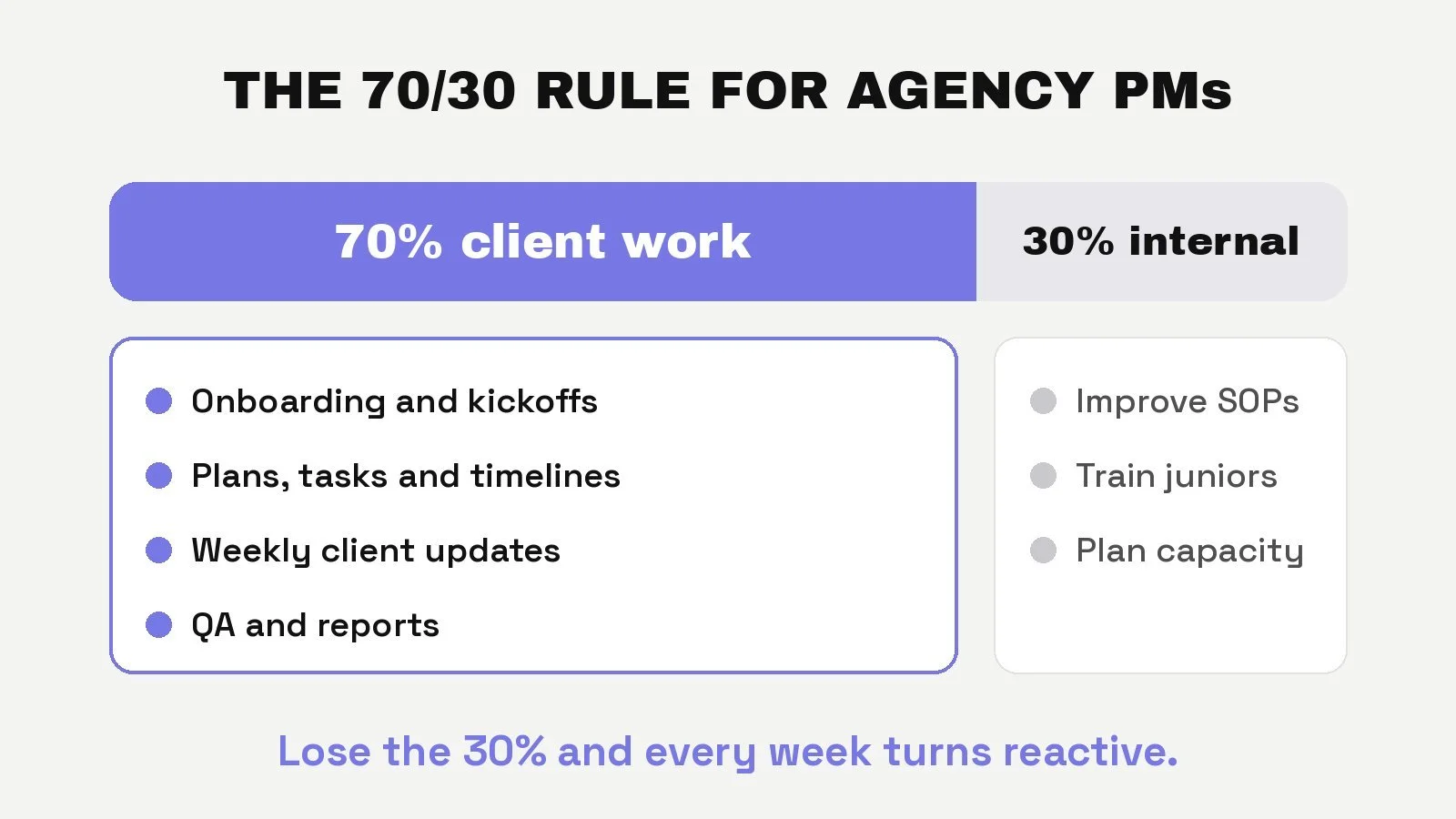
When the 30% disappears, the system stops improving and every week becomes reactive. Watch for these signs that a PM is over capacity:
They're onboarding a new client while also carrying your heaviest account.
Client updates go out late or get skipped.
Internal work (SOPs, templates, retros) hasn't been touched in weeks.
Specialists are taking ad hoc requests straight from clients because the PM can't keep up.
The founder is back in client threads "just to help."
When you see two or more, don't ask the PM to work harder. Rebalance accounts, move onboarding to someone else for a few weeks, or hire the next PM. If a heavy client consistently needs more than its share, that's also a pricing signal: our guide to pricing agency services covers how to price for the real workload.
When to Hire Your First Project Manager
Hire too early and you burn cash. Hire too late and you burn clients. Damiano's rule from the video is simple: hire a project manager once you've hit a consistent $10K a month for three months in a row, not before. Below that, revenue is too uneven to carry the salary. Above it, you need someone to own the client experience so you can focus on sales and strategy.
Who to hire matters as much as when:
Hire for systems, not just organization. You want someone who can build SOPs and take a messy project and make it repeatable. You don't need to know every system yourself. You need someone who does.
Interview a lot of people. Don't hire the first decent candidate. Talk to 10, 20 or 30.
Ask about metrics. Strong PMs can tell you exactly what they track and why. If they can't explain what they measure, they don't know how to do the job.
Ask how the role makes money. A good PM connects on-time delivery and clear communication to retention and renewals.
Give them a ramp. In the published AgilizeIQ case study, new PMs were fully embedded in client accounts within 2 to 3 weeks of onboarding because the SOPs and playbooks were ready before they started.
If you're still the person doing the delivery, read our guide on going from freelancer to agency owner first. And for where the PM sits in a small core team, see our lean agency team structure guide.
The 5-Stage Agency Delivery System
Every client project, whether it's a retainer or a one-off build, should move through the same five stages. The stages stay identical across clients. Only the details inside them change.
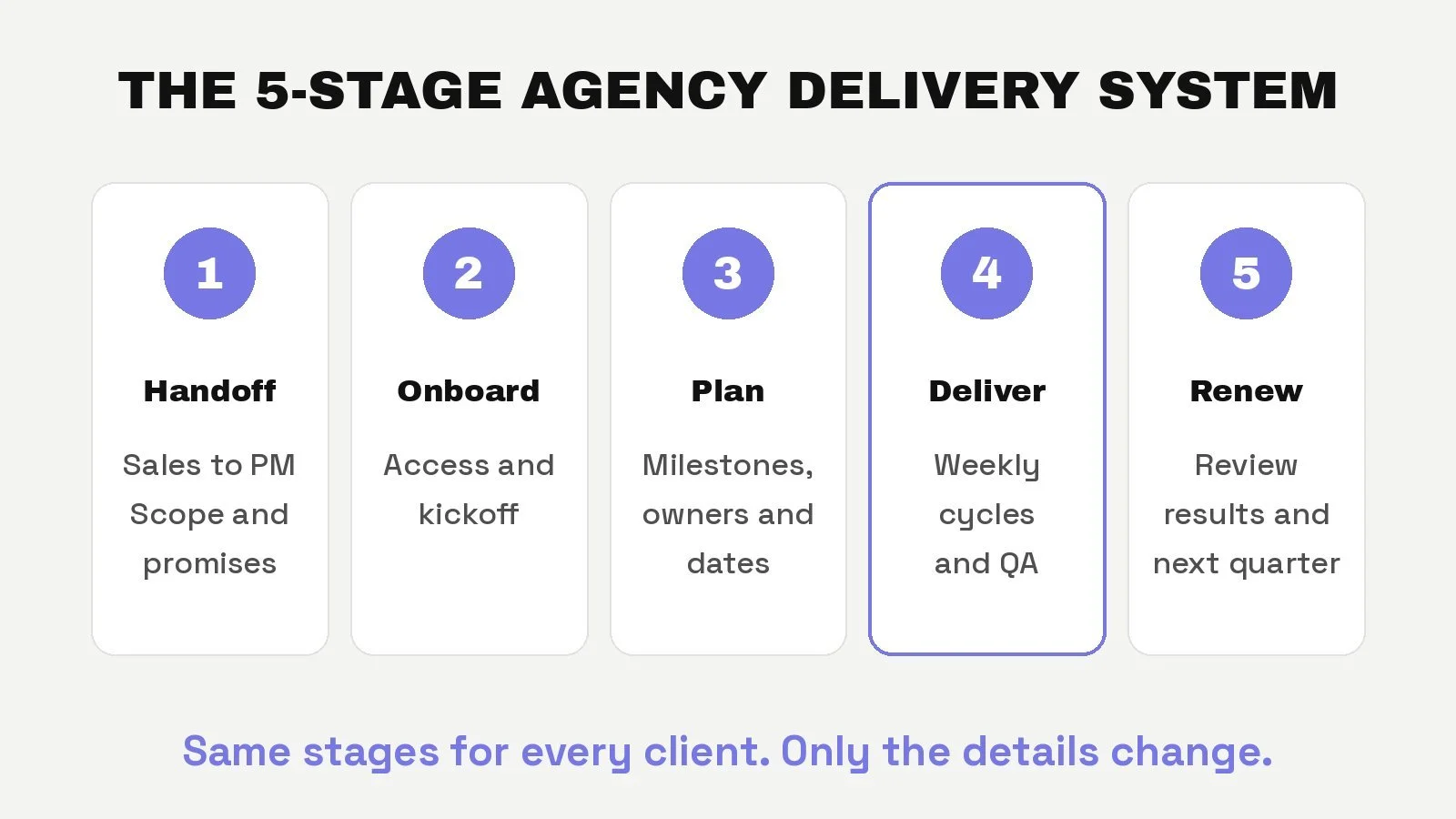
| Stage | What happens | Owner | Output |
|---|---|---|---|
| 1. Handoff | Sales passes over the scope, goals, promises and contacts | Sales to PM | One-page handoff note |
| 2. Onboarding | Welcome, access, assets, kickoff call | PM | Kickoff deck and timeline |
| 3. Plan | Milestones, tasks, owners, dates and review points | PM with delivery lead | Project plan everyone can see |
| 4. Deliver | Weekly work cycles, quality checks and client updates | Delivery team, run by PM | Work shipped on schedule |
| 5. Review and renew | Report, results review, next-quarter plan, upsell or renewal | PM with founder | Renewal or expansion conversation |
A few rules make the system work:
Never skip the handoff. Most "the client expected something else" problems start because the PM never heard what sales promised. A proposal that spells out exactly what's included makes this easy, which is why we push owners to write proposals with clear scope.
Onboarding is a product. A standard checklist, welcome email and kickoff agenda make your agency feel bigger and more reliable from week one.
Put reviews on the calendar. In the Apex Leads case study, quarterly planning and client reviews were part of what lifted client retention from 30% to over 70%.
Log every scope change. If it's not in the plan, it's a change, and changes get approved and priced before anyone starts work.
SOPs: Document Before You Hire More People
When agencies feel overloaded, the instinct is to hire. More often, the gap is process, not people. Teams have the right headcount, but the way work gets done was never written down. Everyone assumes "we all run it the same way," and nobody does.
Before your next hire, score your agency against a simple checklist. Is onboarding documented? Is there a standard project plan for each offer? Is there a written QA step before work goes to the client? Is there a reporting template?
Write these SOPs first, in this order:
Sales-to-delivery handoff: what sales must capture and pass on.
Client onboarding: access list, welcome email, kickoff agenda.
Project plan template for each core offer.
Weekly client update: what goes in it and when it's sent.
QA checklist for each deliverable type.
Monthly or quarterly report template.
Offboarding and renewal: the review meeting and next-step proposal.
Keep each SOP short: a checklist, a template and, if possible, a five-minute screen recording. When we worked with AgilizeIQ, the SOPs and operational playbooks we built together are what let the leadership team step back from daily delivery.
This is also where AI earns its keep. In the video on AI and agencies, Damiano names reporting, client onboarding and project management as the three workflows he systemized first when scaling his own agency. Start with one repetitive workflow and automate it this month.
Project Manager KPIs That Keep Delivery Honest
Clear roles need clear numbers. In his video on running an agency like a sports team, Damiano gives example PM targets: all projects on schedule, client satisfaction scores at or above 90%, and issues flagged before they become problems. Pick a short list and review it weekly.
| KPI | What it tells you | How to track it |
|---|---|---|
| Projects on schedule | Whether planning and capacity are realistic | Milestones hit vs planned, weekly |
| Client satisfaction | Whether clients feel the value | Short score after milestones or each quarter |
| Issues flagged early | Whether the PM is ahead of problems | Risks logged before the client raises them |
| Update cadence | Whether communication is reliable | Weekly updates sent on the agreed day |
| Scope changes approved | Whether margin is protected | Changes logged and signed off before work |
| Retention and renewals | Whether delivery keeps clients | Clients renewed or expanded each quarter |
| PM time split | Whether the system is still improving | Client work vs internal work, roughly 70/30 |
To connect these numbers to company goals, cascade them from your agency targets into a PM objective each quarter. Our guide to agency OKRs shows how.
Tools: Standardize the Workflow, Not Just the Software
Owners often think a new project management tool will fix delivery. It rarely does. The tool only holds the system; it doesn't create one.
Pick one internal stack for tasks, documents and communication, and make it the single source of truth.
Stay flexible on the client side. Enterprise clients often bring their own tools. AgilizeIQ's clients used Smartsheet, JIRA, G Suite and Microsoft Project, so we standardized the onboarding and delivery workflow while keeping room for client-specific tools.
Build templates inside the tool for every SOP above: a project template per offer, an onboarding checklist and a report template.
Track time where it matters. Even on retainers, a few weeks of time tracking shows which clients break the 70/30 balance.
How Project Management Drives Retention
Retention is a delivery outcome. Clients rarely leave because of one bad week. They leave when they stop seeing progress, stop hearing from you or feel like one client among many.
Project management fixes that with rhythm: a predictable weekly update, a monthly report that explains what happened and why, and a quarterly review that plans what's next. Our guides on why agencies fail at retention and client reporting clients actually read go deeper on both.
In the published Apex Leads case study, the agency productized delivery with SOPs, trained a new client success lead to take fulfillment off the founder, and added quarterly planning and client reviews. Client retention rose from 30% to over 70%, and the founder went from 60+ hours a week in delivery to fewer than 10.
Project Management for White-Label and Partner Work
If you deliver for a partner's clients, or use a partner to deliver for yours, project management decides whether the arrangement works. Our rule: white-label the PM along with the specialist. One PM should manage scope and timelines for the partner relationship, so the specialist isn't taking ad hoc orders from three directions. Our white-label agency partnerships guide covers contracts and communication.
The same discipline matters when you start winning bigger accounts. Enterprise buyers judge you on process as much as on creative, and a clean delivery system is part of what lets you land enterprise clients as a small agency.
Results From Agencies We've Advised
These numbers all come from our published case studies:
| Agency | Result | Timeframe | Delivery lever |
|---|---|---|---|
| AgilizeIQ | 4X project management capacity | 90 days | Recruited 4 senior PMs, a business analyst and 2 project assistants, plus SOPs and a PM evaluation framework |
| Apex Leads | $15K to $90K+/month; retention 30% to 70%+ | 8 months | Productized delivery, a client success lead, quarterly planning and client reviews |
| Ricochet | About $5K to $30K/month, then acquired | Within 5 months | Fixed-scope offers, trained delivery partners and documented processes |
See more on our case studies page.
Who We Are
The Agency Business is a growth consulting firm for owners of digital marketing and development agencies in Canada, the US and Europe. Our team has coached 700+ agencies. Our founder, Damiano Raveenthiran, founded Startup Slang, an AI-first Shopify agency, in 2017, sold it and bought it back in 2026. Our firm BlueLock Consulting worked with Shopify's Plus team and was acquired by Centro.
We give you strategy, frameworks and ongoing support, and your team executes. Compare our programs by revenue stage on our services page.
Watch the Full Video
In this video, Damiano breaks down the four departments every agency runs on (lead generation, sales, project management and delivery), why delivery comes first, and when to hire your first project manager.
Frequently Asked Questions
What is agency project management?
Agency project management is the system that moves client work from signed deal to delivered results. It covers the sales handoff, onboarding, planning, task flow, quality checks, client communication, scope changes and reporting. It is owned by a project manager so specialists can focus on the work and the founder can focus on growth.
How many clients can one agency project manager handle?
It depends on the size and complexity of the accounts, so count time instead of clients. A healthy PM spends roughly 70% of their time on client work and 30% on internal improvements. If onboarding and a heavy account are crowding out that 30%, rebalance accounts or hire the next PM.
When should an agency hire its first project manager?
Hire your first project manager once the agency has reached a consistent $10K a month for three months in a row. Before that, revenue is usually too uneven to support the role. Look for a systems-oriented person who can build SOPs and make projects repeatable.
What does a project manager do in a marketing agency?
A marketing agency project manager runs onboarding and kickoffs, builds project plans, assigns tasks, sends weekly client updates, runs quality checks, logs scope changes and pulls together reports. Specialists own the craft, and the founder owns strategy and senior relationships.
What KPIs should an agency project manager track?
Track projects on schedule, client satisfaction scores, issues flagged before clients raise them, weekly update cadence, approved scope changes, client renewals and the PM's own split between client and internal work. Review them weekly and tie them to quarterly goals.
What is the best project management process for an agency?
Use one five-stage process for every client: sales handoff, onboarding, planning, delivery cycles, and review and renewal. Keep the stages identical across clients, document each one as a short SOP, and change only the details inside each stage.
Ready to take delivery off your plate? Our team will review how work moves through your agency and map the next 90 days.