

To network at conferences as an agency owner, treat the event like a short sales campaign. Pick an event your buyers or partners attend, book meetings before you arrive, set a target for valuable conversations per hour, log each contact's problem, and follow up the next morning with one specific next step.
Most agency owners have the same complaint about events: "Conferences never produce anything." They buy the ticket, collect a stack of business cards, enjoy the talks, and three weeks later nothing has happened.
The problem usually isn't the event. It's the lack of a plan. Our team has coached 700+ agencies in Canada, the US and Europe, and the owners who get clients from conferences do the same three things: they do the work before they arrive, they measure the conversations they have on the floor, and they follow up faster than anyone else.
This guide walks through the full playbook: choosing the right events, the prep, the conversations, the follow-up, and the numbers to track. If you're still deciding which events to attend, start with our list of the best digital agency conferences in 2026.
Why Conferences Still Work for Agencies
Agency services are a trust purchase. Buyers rarely sign a retainer because of a price list. They sign because they trust you and they've seen your name enough times to feel familiar with you. A 20-minute face-to-face conversation builds more of that than a dozen cold emails.
Events also put the right people in one room for a day or two. Both sides are usually there to do business: sponsors want customers, speakers want to be seen, and attendees want solutions to problems they're living with right now. That's why a well-run conference can produce some of the warmest conversations you'll have all year.
In our guide to the agency business, we split lead generation into two branches: systems (outbound, content, funnels, ads) and people (networking, partners, events, referrals you actively ask for). Strong agencies run both. Conferences are the highest-leverage part of the "people" branch, as long as you run them like a campaign rather than a day out.
Pick the Right Events (and Skip the Wrong Ones)
Not every event is worth your time. Before you buy a ticket, ask one question: will the people who buy from us, or refer work to us, be in the room?
There are three kinds of events worth an agency owner's time, and each one needs a slightly different approach:
| Event type | Who you'll meet | Best for | How to work it |
|---|---|---|---|
| Industry events where your clients go (for example, an e-commerce, SaaS or trades show) | Potential buyers, plus sponsors with marketing budgets | New clients | Book meetings with buyers before you arrive and walk the sponsor floor with a short list |
| Agency-owner events (peer conferences and retreats) | Other agency owners, specialists and service providers | White-label and referral partners, plus operating ideas | Look for partners whose services complement yours, not competitors with the same offer |
| Platform ecosystem events (for example, Shopify partner meetups and side events) | Platform staff, app and tech partners, other agencies in the ecosystem | Referral partnerships and co-marketing | Meet the app and tech partners who serve the same merchants you do |
A good rule of thumb: if you sell to e-commerce brands, an agency-owner conference teaches you how to run a better agency, but an e-commerce industry event is where you'll meet buyers. You need both kinds over a year, but go in knowing which one you're at.
Don't forget smaller formats. Local meetups, ecosystem side events and invite-only dinners often produce more deals per hour than a big expo hall, because the conversations are longer and the room is smaller.
Before the Event: Book the Meetings Before You Arrive
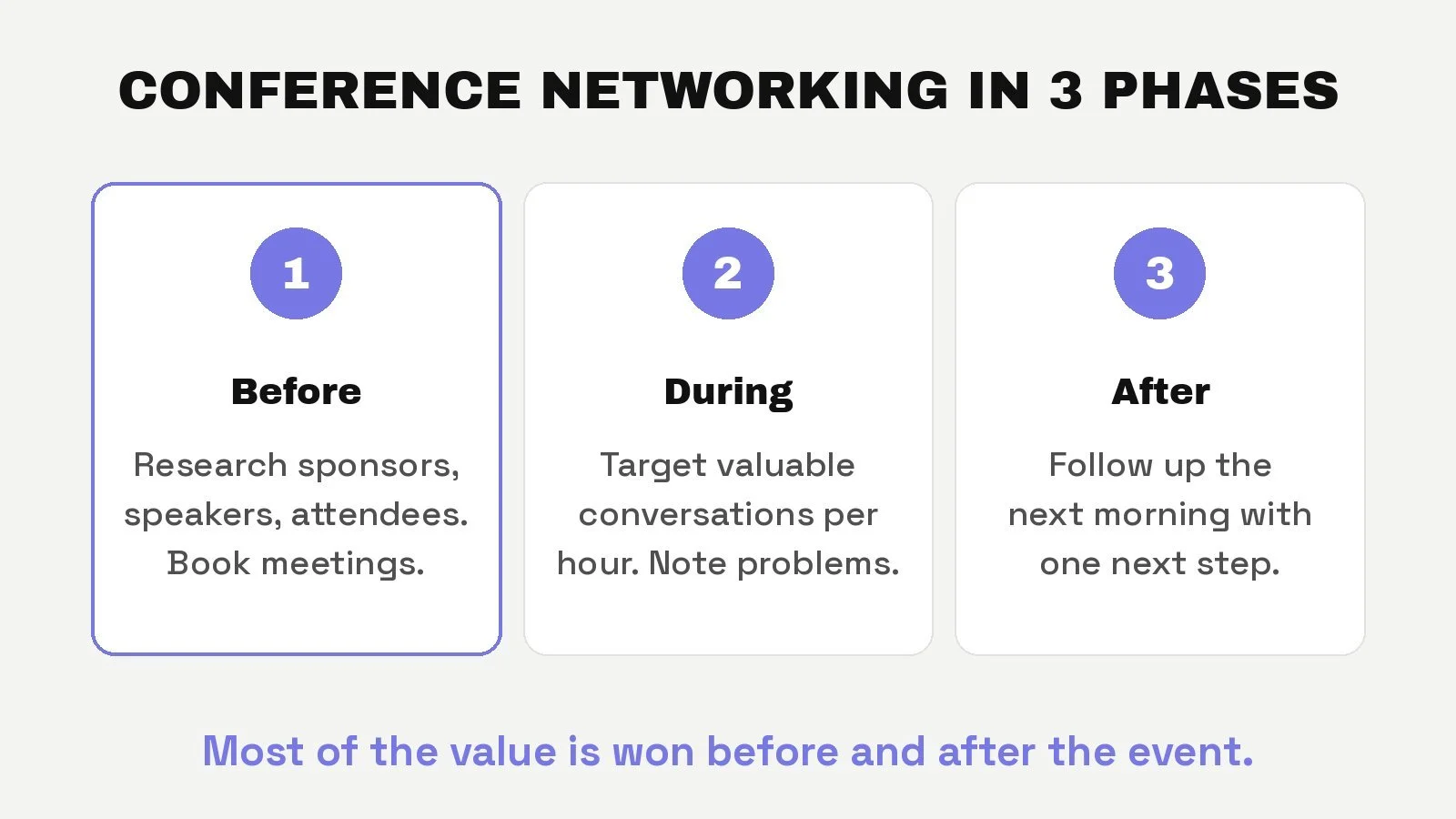
The biggest difference between owners who win clients at events and owners who don't happens before they get on the plane. Plan to spend a few hours on prep for every day you'll be at the event.
1. Set a goal you can measure
Decide what a good event looks like in numbers. For example: "10 conversations with potential buyers, 3 with potential partners, and 2 follow-up calls booked within a week." Write it down and share it with anyone from your team who's coming. Every person who attends should have their own targets for new opportunities and new partners.
2. Research sponsors, speakers and attendees
Go through the sponsor list, the speaker list and any attendee app or online group the organiser provides. Build a short list of the most valuable people:
- Sponsors. Companies that pay to sponsor an event already have marketing budgets. Some may also co-fund events or dinners with partners later on.
- Speakers. They're easier to approach than you think, especially when you've read or watched something they've published.
- Attendees who match your ideal client. Look at job titles, company size and industry, the same way you'd build an outbound list.
Aim for a list of 15 to 30 names. More than that and you won't prepare properly for any of them.
3. Message people in advance and book time
Reach out one to two weeks before the event. Keep it short and specific: who you are, why you want to meet them, and a suggested time slot. For example:
"Hi Sam, I saw you're speaking on retention at the conference next week. We run retention programs for DTC brands and I'd love 15 minutes to compare notes. Would Tuesday at 10:30 near the registration desk work?"
A booked 15-minute coffee is worth more than an hour of hoping to bump into someone. LinkedIn works well for this. Our guide to LinkedIn outreach for agency owners covers how to write a connection note and first message that get replies.
4. Prepare your one-sentence answer
Someone will ask "So what do you do?" about 50 times. Have one clear sentence ready that names who you help and the outcome you get, such as "We help Shopify brands doing $1M to $10M a year grow repeat revenue with email and SMS." If you can't say it in one sentence, fix your positioning first. Our guide to offer design walks through how.
Book a call to plan your next event →
During the Event: Have Fewer, Better Conversations
Once you're on the floor, your job isn't to hand out as many business cards as you can. It's to have useful conversations with the right people and leave each one with a clear next step.
Set a conversations-per-hour target
Give yourself a simple KPI, such as two valuable conversations per hour in the networking sessions. "Valuable" means the person fits your ideal client or partner profile and you learned what problem they're dealing with. That target keeps you from spending three hours talking to the same friendly person at the coffee station.
Ask more than you talk
The best networking conversations sound like discovery calls, not pitches. Ask:
- What brought you to this event?
- What are you working on this quarter?
- What's been harder than expected?
- What have you already tried?
When you hear a real problem, summarise it back: "So the paid social is working, but you can't tell which campaigns drive repeat customers. Is that right?" Then offer something useful, such as an idea, an intro or a resource, before you mention what you sell.
Capture notes right away
After each conversation, take 30 seconds to note three things: who they are, the problem they mentioned, and the next step you agreed on. A quick voice note or a line in your phone's notes app is enough. If you scan a badge or connect on LinkedIn, add the note there too. By the end of day two, you won't remember who said what.
Work the edges of the event
Some of the best conversations happen outside the main sessions: breakfast, the sponsor floor in quieter hours, side events and dinners. If you're part of a platform ecosystem such as Shopify, check for partner meetups and side events in the same city during the conference week.
After the Event: Follow Up the Next Morning
Most of the value from an event is lost in the follow-up. People go home, catch up on client work and send a vague "great to meet you" email two weeks later. By then, the other person has met 100 people and forgotten the conversation.
The 24-hour rule
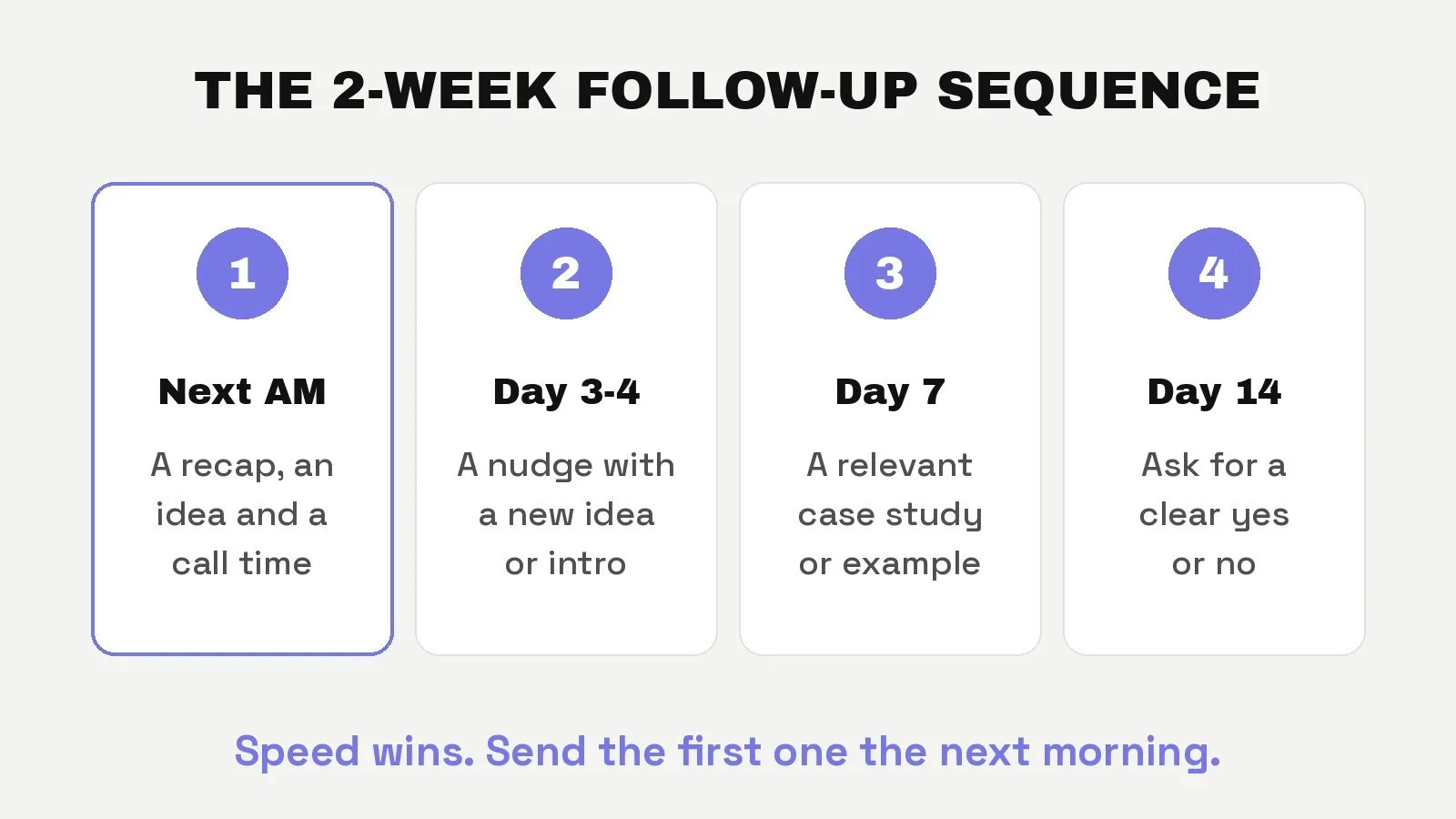
Send your follow-ups the next morning, while the conversation is still fresh for both of you. Every follow-up should include:
- A reminder of the conversation. "Great talking about your repeat-purchase problem at the Shopify meetup."
- Something useful. An intro, a short idea, an article, or a quick teardown of what you discussed.
- One specific next step. "Would a 20-minute call on Thursday or Friday work to walk through it?"
Log every contact in your CRM
Add every valuable contact to your CRM with the event name, the problem they mentioned and the next step. Then connect on LinkedIn so they keep seeing your name and content. This turns one conversation into an ongoing relationship instead of a one-off. Event contacts also belong on your warm call list: our guide to cold calling for agencies shows how to prioritise them alongside opt-ins and quiet proposals.
Keep your follow-up emails on the right side of the rules
A business card or a badge scan is not a blanket licence to add someone to your newsletter. A personal follow-up about the conversation you had is fine. Adding everyone to a marketing list is a different matter, especially in Canada:
| Market | What the rules say | What it means for your follow-up |
|---|---|---|
| Canada | Under Canada's Anti-Spam Legislation (CASL), a business card may give you implied consent to send commercial emails, as long as the message relates to the person's role or business and they didn't say they don't want marketing messages. Commercial messages still need sender identification and an unsubscribe option. Maximum penalties reach $10 million per violation for a business (>CRTC) | Keep follow-ups tied to their role and your conversation. Ask before adding anyone to a newsletter, and keep a record of where you met them |
| United States | CAN-SPAM requires accurate sender details, a valid physical postal address and a working opt-out in commercial email, and you must honour opt-out requests within 10 business days (>FTC) | Use your real name and business address, and remove anyone who asks |
| Europe and the UK | Rules vary by country and are often stricter for individuals than for companies | Ask for permission before adding anyone to a marketing list, and check local rules first |
This isn't legal advice. If you're unsure, ask a lawyer. The simplest white-hat habit is to send one personal follow-up, then ask: "Would you like me to send you our monthly notes on this topic?"
Run a follow-up sequence for two weeks
One email isn't a follow-up system. Use a simple sequence:
| When | What to send | Goal |
|---|---|---|
| Next morning | Personal email or LinkedIn message with a recap, something useful and a suggested call time | Book the call while you're top of mind |
| Day 3 to 4 | A short nudge with one new idea or an intro you promised | Show you follow through |
| Day 7 | A short case study or example relevant to the problem they mentioned | Build trust with proof |
| Day 14 | A final check-in: "Should I close the loop on this for now?" | Get a clear yes or no |
After that, keep them in your nurture: LinkedIn content, your newsletter if they've opted in, and an invitation to your next event or dinner.
Host Your Own Small Event
Once you've worked a few conferences, the next step is to host something yourself. A small dinner for 8 to 12 target clients, co-hosted with a partner who serves the same buyers, often produces more deals than a booth at a big expo. Expect a few no-shows, so invite a couple more people than you have seats for.
Sponsors you've met at conferences are good co-host candidates. They already have marketing budgets and want to be in front of the same buyers you do.
Measure Whether Events Pay Off
If you don't track events, you'll either keep going to the wrong ones or stop going altogether. Keep a simple scorecard for every event:
| Metric | What to track | Why it matters |
|---|---|---|
| Meetings booked before the event | Count of confirmed coffees or calls | Shows whether your prep is working |
| Valuable conversations | People who fit your client or partner profile | Measures the quality of the event, not just the crowd |
| Follow-ups sent within 24 hours | Percentage of valuable contacts | The habit that separates good events from wasted ones |
| Calls booked within 14 days | Count of discovery or partner calls | The first real sign of pipeline |
| Pipeline and revenue | Proposals sent and deals closed from event contacts | Tells you whether to attend next year |
| Total cost | Ticket, travel, hotel and time | Lets you compare events and channels |
Review the scorecard 90 days after each event. Agency deals often take weeks or months to close, so judging an event the week after you get home is too early. For more on setting targets that cascade into weekly numbers, see our guide to agency OKRs.
Results From Agencies We've Advised
OU2there, a Canadian creative studio, came to us 100% dependent on referrals and repeat business, with no experience with outbound, conferences or marketplaces. We built a hybrid growth model around high-trust networking, outbound partnerships and freelance marketplaces, including a conference and event strategy with warm-up messaging, pitch angles and lead capture flows. Within 3 months, they closed their first big outbound deal, a $70,000 contract, and their pipeline now delivers opportunities from both freelance platforms and networking events.
Orizon was already at $2M a year, but its deals were mostly referral-based and relied heavily on the founder's personal network. With a structured enterprise sales system, it grew from $2M to $5.3M in annual revenue in 12 months and now consistently closes $250K+ projects. If bigger accounts are your goal, read our guide to landing enterprise clients as a small agency.
The lesson in both cases: networking works best as one part of a system, with clear positioning, a plan for each event and follow-up that actually happens.
Book a free call to review your pipeline →
Common Conference Networking Mistakes
- Going without a list. If you don't know who you want to meet, you'll end up talking to whoever is closest.
- Pitching in the first minute. Ask about their problems first. The pitch can wait for the follow-up call.
- Sitting with your own team. If three of you attend, split up and give each person their own targets.
- Collecting cards instead of next steps. A conversation without an agreed next step is just a nice chat.
- Following up a week later. Send it the next morning, while you're still memorable.
- Bulk-adding everyone to your newsletter. Ask first, especially in Canada and Europe.
- Judging the event too early. Give it 90 days before deciding if it paid off.
Watch: Why Relationships Beat Random Leads
In our video Why Your Agency Is Stuck at $10–20K/Month (And How to Break Through), we cover building an acquisition engine with events, partnerships and content.
Frequently Asked Questions
How do agency owners get clients from conferences?
Pick events where your buyers or partners attend, research sponsors, speakers and attendees, and book short meetings before you arrive. On the floor, aim for a set number of valuable conversations per hour, note each person's problem, and send a personal follow-up with one specific next step the next morning.
Which conferences should agency owners attend?
Mix two kinds over the year: industry events where your clients go, so you can meet buyers, and agency-owner events, where you can meet partners and learn how to run a better agency. Platform ecosystem events, such as Shopify partner meetups, are good for referral partnerships.
How many people should I try to meet at a conference?
Quality matters more than volume. Build a target list of 15 to 30 people, try to book meetings with a handful of them in advance, and set a simple goal such as two valuable conversations per hour in networking sessions.
How soon should I follow up after a networking event?
The next morning. Remind them of the conversation, share something useful such as an intro or an idea, and suggest a specific time for a short call. Then follow up again around day 3 to 4, day 7 and day 14 if you haven't heard back.
Can I add people I met at an event to my email list?
Not automatically. In Canada, CASL may give you implied consent from a business card if your message relates to their role and they didn't refuse marketing messages, but commercial emails still need identification and an unsubscribe option. The safest habit is to send a personal follow-up and ask before adding anyone to a newsletter.
Are conferences worth the cost for a small agency?
They can be, if you treat each event like a campaign with a goal, a target list and a follow-up plan. Track the meetings booked, the calls that follow and the pipeline created, then review the numbers 90 days later to decide whether to go back next year.
Get Help Turning Events Into Clients
An event only pays off when your positioning, your target list and your follow-up line up. That’s the work we do with agency owners every week, and our team has coached 700+ agencies in Canada, the US and Europe on building client acquisition systems that don’t depend on referrals.
- Marketing agency coaching: for owners who want to sharpen their one-sentence answer, build their target list and run the before, during and after plan themselves.
- Agency consulting: for agencies that want our team to build the full event plan with them: target lists, outreach messages, conversation goals and the follow-up sequence.
For agencies doing $50K to $100K a month, our Founder’s Circle includes priority access to in-person strategy days and events, plus introductions to vetted contractors, systems and vendors.
Keep reading: our guide to the agency business for the full playbook, how to get clients for your marketing agency for every acquisition channel, and cold calling for agencies for following up event contacts by phone.
Next steps: book a free strategy call to plan your next event, or send us a message if you’d rather start in writing.