

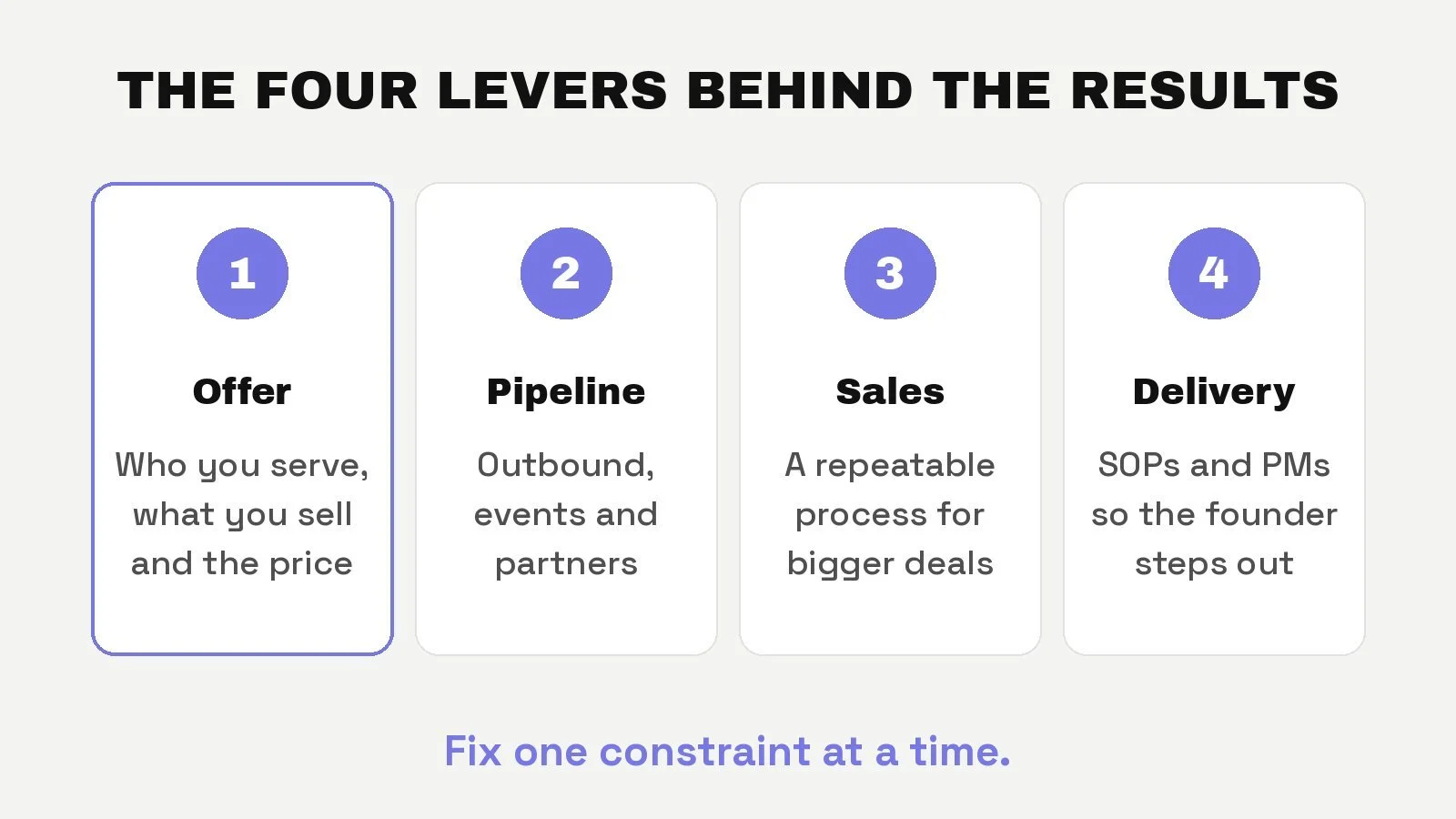
These 13 agency growth case studies show what changed and what it produced. Spring Media went from $10K to $150K a month, PN Digital from $30K to $200K+ a month, and Orizon from $2M to $5.3M in 12 months. Each result came from fixing one constraint at a time: the offer, the pipeline, the sales process or delivery.
Most agency owners we talk to already work hard. What they usually can't see is which part of the business is holding growth back. Is it the offer? The lack of a pipeline? A founder who still runs every client account?
Our team has coached 700+ agencies in Canada, the US and Europe. This page collects the 13 agencies whose results we've published, groups them by the problem they were solving, and links to each full case study. Every number here comes from those published case studies. Where an agency didn't publish a revenue figure, we don't give one.
If you want the full framework behind these results, start with our guide to the agency business.
The 13 Agencies at a Glance
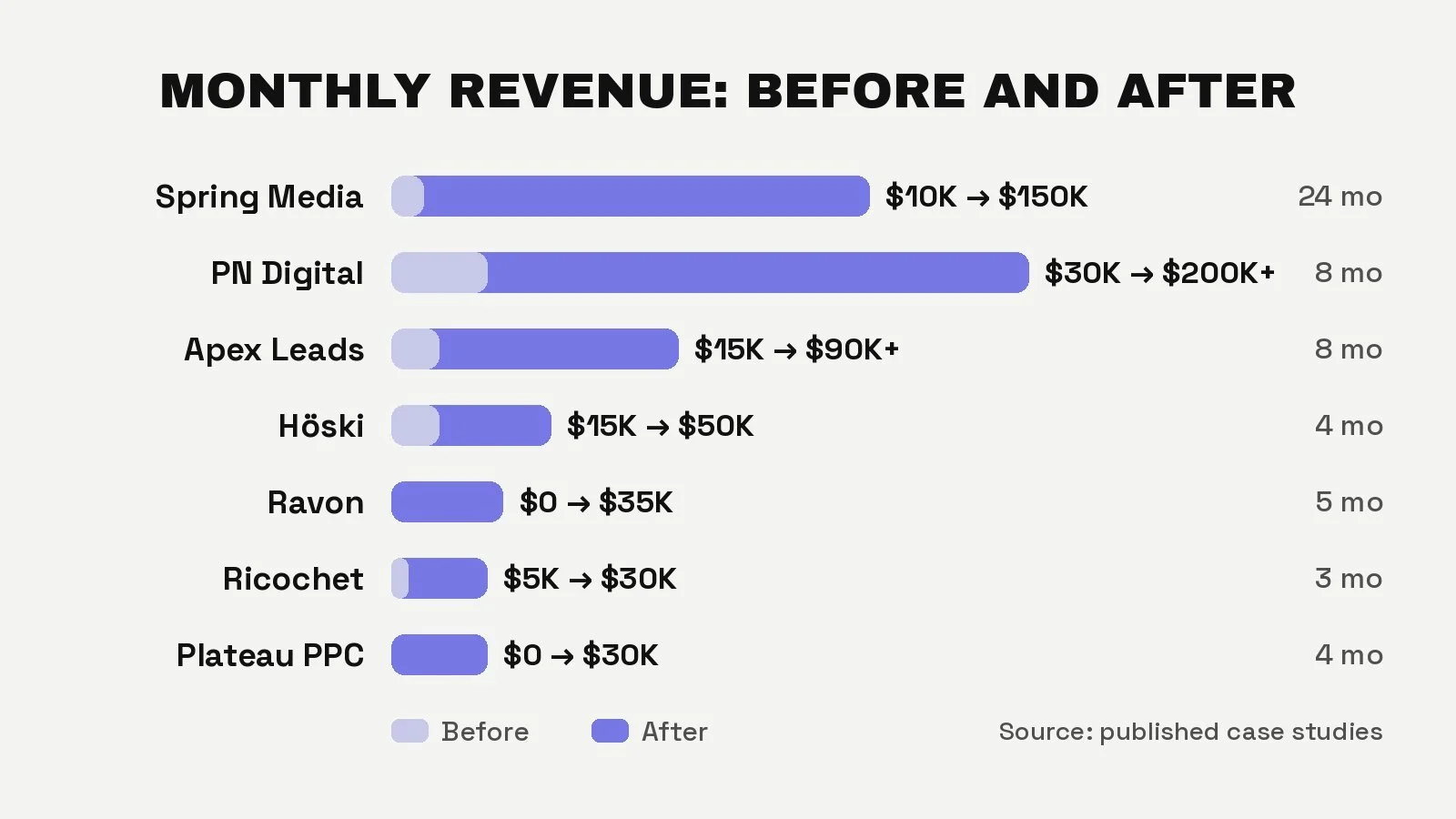
| Agency | What they do | Starting point | Result | Timeframe |
|---|---|---|---|---|
| Plateau PPC | Google Ads for fintech and AI companies | Founder still employed, $0 | $30K months | 4 months |
| Ravon | Performance marketing | New agency, $0 | $35K a month | 5 months |
| Ricochet | Design-led creative studio | $5K a month | $30K a month, then sold | 3 months, sold after 6 |
| Höski | Branding studio, Canada | $15K a month | $50K a month | 4 months |
| Millennial Marketing | Personal brand and lead gen for coaches | Retainers below the value delivered | $150,000 deal, its biggest ever | — |
| Spring Media | Email agency turned full-stack e-commerce growth | $10K a month | $150K a month | 24 months |
| OU2there | Creative studio, Canada | 100% referrals | First $70,000 outbound contract | 3 months |
| PN Digital | SEO and PPC, UK | $30K a month | $200K+ a month, first $40K/month enterprise contract | 8 months |
| Orizon | Digital product and innovation studio | $2M in revenue | $5.3M, average deal size 2X+ | 12 months |
| Blue Collar Marketing | Marketing for contractors, North America | Breaking even | 50% growth, "extremely profitable" | March to November 2026 |
| Apex Leads | B2B outbound, Montreal | $15K a month, 30% retention | $90K+ a month, 70%+ retention | 8 months |
| AgilizeIQ | Operational consulting, US | Founder-run enterprise delivery | 4X project management capacity | 90 days |
| Vaival Technologies | 200-person software development agency | An idea for a recruitment arm | New staff augmentation business line | 90 days |
Stage 1: Getting a New Agency to $30K a Month
Three of these agencies started at or near zero. Their problems weren't technical. Each founder could do the work. What they lacked was an offer, a way to find clients and the confidence to price properly.
Plateau PPC: from media buyer to agency owner
Plateau PPC's founder was a media buyer at another agency, working a full-time job while trying to build his own on the side. We narrowed the offer to Google Ads for fintech and AI companies and built an outbound system: prospect lists, LinkedIn content and outreach, cold email, follow-up and qualification. One month in, he left his job. Within four months, the agency was having $30K months and had hired two full-time team members. Read the Plateau PPC case study.
Ravon: protecting a new agency from the wrong clients
Ravon started with no recurring revenue, no pipeline and no pricing model. A lot of the work was deciding what not to take: avoiding niches where delivery risk was too high and turning down misaligned clients even when the cash was tempting. Ravon moved away from hourly pricing, raised its strategy fees and hired low-cost operators for execution. It reached $35K a month in five months, which was the exact goal the founder set at the start. Read the Ravon case study.
Ricochet: building an agency to sell
Ricochet's founder was doing everything himself: delivery, outreach and client communication. He wanted a business that could be sold, not just cash flow. In the first 90 days, we sharpened positioning around fast-moving startups and premium DTC brands, built outbound email and LinkedIn outreach, and trained delivery partners so he could step out of fulfillment. Monthly revenue grew from $5K to $30K in three months. After six months, Ricochet was sold to a larger agency. Read the Ricochet case study.
If you're at this stage, our guides on how to start a marketing agency and leaving your job to start an agency cover the first steps. If you want a sellable agency from the start, our agency exit strategy guide shows what buyers look for.
Stage 2: Fixing the Offer and Positioning
Many agencies don't have a lead problem. They have an offer problem. These three grew by changing what they sold and who they sold it to.
Höski: picking verticals instead of everyone
Höski, a Canadian branding studio, served too many industries and relied on referrals that were drying up. Its offer sounded premium but didn't show the client a clear return. We repositioned it around the verticals where it already had momentum (construction, real estate and consumer packaged goods), packaged the offer around launches, rebrands and growth-stage refreshes, and set up a four-week deal cycle. Monthly revenue grew from $15K to $50K in four months. Read the Höski case study.
Millennial Marketing: from retainers to performance funnels
Millennial Marketing helped coaches build personal brands and generate leads, but its retainers didn't capture the value clients were getting. We rebuilt the model around performance funnels: the agency builds the funnel and takes a small percentage of every sale it helps generate. That change opened conversations with bigger clients and led to a $150,000 deal, the biggest in the company's history. Read the Millennial Marketing case study.
Spring Media: from email vendor to growth partner
Spring Media was an e-commerce email agency with strong results but capped deal sizes. Clients saw it as a tactical vendor. Over 24 months, it expanded into acquisition, conversion rate optimization and retention, packaged services around outcomes, and moved clients from small retainers to full growth retainers. Monthly revenue grew from $10K to $150K. Read the Spring Media case study.
For more on this, read why your offer is the problem, not your lead gen, offer design and how to price agency services.
Book a call to review your offer →
Stage 3: Replacing Referrals With a Pipeline
Referrals are a great source of clients until they stop. These two agencies built systems that create conversations every week.
OU2there: networking, partnerships and marketplaces
OU2there, a Canadian creative studio, got 100% of its work from referrals and repeat clients. It had never done outbound, conferences or freelance marketplaces. In a four-month sprint, we built a hybrid model: an event strategy with warm-up messaging and lead capture (our guide to how to network at conferences covers the same approach), outbound partnerships, and marketplace funnels that positioned the studio as a premium vendor. It closed its first $70,000 outbound contract within three months. Read the OU2there case study.
PN Digital: multi-channel outbound for a UK SEO agency
PN Digital, a UK SEO and PPC agency, had great delivery but hit the ceiling of what referrals could bring. We launched LinkedIn outbound, vertical-specific cold email and automated follow-up, repositioned the agency as an enterprise SEO partner, and rebuilt its sales process for larger deals. Monthly revenue grew from $30K to more than $200K in eight months, and it closed its first $40K-a-month enterprise contract. Read the PN Digital case study.
Our guides on how to get clients for your marketing agency and LinkedIn outreach for agencies walk through these channels step by step.
Stage 4: Winning Enterprise Clients
Bigger clients mean bigger deals, but they buy differently. They need proof, a clear process and someone who speaks to their leadership.
Orizon: a six-stage enterprise sales process
Orizon, a digital product and innovation studio, won most of its work through its founder's network. Deals were unpredictable and the sales cycle was long. Over 12 months, we positioned it as a strategic innovation partner, built a six-stage sales process (account mapping, outbound sequences, sales materials and pipeline tracking), created pitch decks for CTOs and heads of product, trained the sales team, and moved pricing toward value-based retainers and milestone billing. Revenue grew from $2M to $5.3M, and average deal size more than doubled. Read the Orizon case study.
Blue Collar Marketing: fix the base, then go upmarket
Blue Collar Marketing serves contractors across North America. It had plenty of clients, but high overhead kept it at breakeven, and it lost money in what should have been its busiest month. We made the team leaner, grouped clients into pods with dedicated project managers, added paid discovery and formal QA, and rebuilt sales and lead generation. Then we packaged a staged enterprise offer for large construction companies. The agency grew 50% from March to November 2026, got a 51% response rate on AI-assisted enterprise outreach, and went from breaking even to "extremely profitable" in its co-founder's words. Read the Blue Collar Marketing case study.
See how to land enterprise clients for the full playbook.
Book a call about enterprise sales →
Stage 5: Taking the Founder Out of Delivery
Growth stalls when every client still needs the founder. These two agencies built the team and systems to deliver without them.
Apex Leads: retention from 30% to 70%+
Apex Leads, a Montreal outbound agency, built custom solutions for every client, and the founder spent more than 60 hours a week in delivery. Client retention was around 30%. We rebuilt the offer around booked meetings, installed a sales system, productized delivery with SOPs and a new client success lead, and added quarterly planning and client reviews. Monthly revenue grew from $15K to $90K+ in eight months, retention rose to more than 70%, and the founder now spends less than 10 hours a week in delivery. Read the Apex Leads case study.
AgilizeIQ: 4X project management capacity
AgilizeIQ, a US operational consulting firm, was winning enterprise contracts but relied on its founder to deliver them. We recruited and onboarded four senior project managers, a business analyst and two project assistants, standardized onboarding and delivery, and wrote the SOPs to support them. Project management capacity grew 4X in 90 days, and new PMs were delivering within two to three weeks of joining. Read the AgilizeIQ case study.
Our guides to agency project management and lean agency team structure go deeper.
Stage 6: Adding a New Business Line
Vaival Technologies: a recruitment arm in 90 days
Vaival is a 200-person software development agency. It wanted to sell staff augmentation and recruitment using its existing talent pipeline, without distracting its core delivery team. In three months, we defined and packaged the offer for mid-market and enterprise buyers, built outbound messaging, a landing page and CRM tracking, trained the sales team, and automated onboarding so new clients could go from first call to signed agreement in under seven days. The new business line is now operating and closing deals. Read the Vaival case study.
What the 13 Agencies Have in Common
The agencies are different sizes, in different markets, selling different services. The patterns are the same:
- One constraint at a time. None of them fixed everything at once. Höski and Millennial Marketing started with the offer, OU2there and PN Digital with the pipeline, Orizon with sales, and Apex Leads and AgilizeIQ with delivery.
- The offer comes before the leads. Most of them changed what they sold, who they sold it to, or how they priced it before adding more outreach.
- Systems replace the founder. Sales processes, SOPs, pods and project managers let the founder work on the business instead of in every account.
- Retention drives the numbers. Spring Media's bigger retainers, Apex Leads' 70%+ retention and Blue Collar Marketing's quarterly client check-ins all compound over time.
- Saying no is part of the plan. Ravon turned down misaligned clients, and Höski stopped serving every industry.
If you're stuck at the same revenue level, our post on the $30K plateau explains why it happens, and how to scale a marketing agency covers the next stage.
How to Read Agency Case Studies (Including Ours)
Case studies are useful proof, but only if you read them with care. Here's what we suggest:
- Check the timeframe. Spring Media's growth took 24 months, while Höski's took four. Both are real, and they aren't the same kind of change.
- Look at the starting point. Going from $0 to $30K and from $2M to $5.3M are very different problems.
- Find the lever. Every case study should explain what changed. If it only shows a number, you can't learn from it.
- Expect your own results to differ. These are the outcomes of these agencies, in their markets, with their teams doing the work. They aren't guarantees.
Which Case Study Is Closest to Your Agency?
| If your agency... | Read | Then read |
|---|---|---|
| Is new, or you're still employed | Plateau PPC, Ravon | How to start a marketing agency |
| Serves too many industries | Höski | Offer design |
| Sells retainers below the value it delivers | Millennial Marketing, Spring Media | How to price agency services |
| Gets almost all its work from referrals | OU2there, PN Digital | How to get clients |
| Wants bigger, enterprise clients | Orizon, Blue Collar Marketing | How to land enterprise clients |
| Depends on the founder for delivery | Apex Leads, AgilizeIQ | Agency project management |
| Wants to build an agency it could sell | Ricochet | How to scale a marketing agency |
You can browse all of them on our case studies page.
Book a free call to find your agency's constraint →
Frequently Asked Questions
What is an agency growth case study?
An agency growth case study shows where an agency started, what it changed and what happened as a result, with real numbers and a timeframe. Ours cover marketing, creative and development agencies, and each one names the main lever: the offer, the pipeline, the sales process or delivery.
How fast can a marketing agency grow?
It depends on the starting point and the constraint. In our published case studies, Höski grew from $15K to $50K a month in four months, PN Digital from $30K to $200K+ a month in eight months, and Spring Media from $10K to $150K a month over 24 months. These are individual results, not guarantees.
What's the most common reason agencies stop growing?
In these case studies, the most common causes were relying on referrals, an offer that's too broad or underpriced, and a founder who still runs delivery. Most agencies had more than one of these, and fixed them one at a time.
Can a new agency reach $30K a month?
Yes. Plateau PPC had $30K months within four months of starting, and Ravon reached $35K a month in five months. Both narrowed their offer, priced on outcomes instead of hours and built a repeatable way to find clients.
Are these results typical?
No case study is typical. These are the published results of 13 agencies, each with its own market, team and starting point. Use them to spot the lever that matches your situation, not as a forecast.
How do I know which fix fits my agency?
Start with a free strategy call. We'll look at your revenue, offer, pipeline and delivery, find the main constraint and tell you whether coaching or hands-on consulting fits your stage.
Get Help Growing Your Agency
Every agency on this page started with a problem that felt bigger than it was. Finding which constraint is yours is the first step, and that's the work we do with agency owners every week. Our team has coached 700+ agencies in Canada, the US and Europe on offers, client acquisition, sales and delivery.
- Marketing agency coaching: for owners who want a coach to help them find the constraint and fix it step by step.
- Agency consulting: for agencies that want our team to build the offer, pipeline and sales process with them.
Keep reading: our guide to the agency business for the full playbook, how to get clients for your marketing agency for every acquisition channel, and how to land enterprise clients for bigger deals.
Next steps: book a free strategy call, or send us a message if you'd rather start in writing.